What Is Single Origin Coffee? Single Origin vs Blend, Explained by a Roaster
Single origin coffee is coffee that comes from one place: a single country, region, washing station or farm, with nothing blended in. A blend combines coffees from two or more places to hit a flavor the roaster designed. Neither is better. Single origin shows you what one place tastes like, and a blend gives you the same balanced cup every time.
We roast both in Livonia, Michigan, so this is the plain version from the roasting side: what the term means, how specific it gets, why it costs more, and how to pick one you will like.
How specific can single origin get?
The term has no legal definition, so it covers a wide range. A bag labeled only with a country and a bag from one named farm are both single origin, but they are not telling you the same amount. The trade press describes the same ladder, from country down to single farm and micro lot (Perfect Daily Grind). Here is how it runs, with coffees from our own shelf as examples.
| Level | What it means | Example from our shelf |
|---|---|---|
| Country | Coffee from anywhere in one country. The least specific kind. | Not something we sell on its own |
| Region | One growing region, usually many farms | Brazil from Mogiana, Colombia from Huila, Guatemala from Huehuetenango |
| Washing station or cooperative | Many small farmers deliver cherries to one mill, which processes them as a lot | Rwanda from the Gitwe washing station, Ethiopia from Guji |
| Single farm or micro lot | One producer, sometimes one variety from one part of the farm | Pacamara Honduras from Francisco Romero's Finca Romero |
In much of East Africa, farms are tiny. A family may grow coffee on a plot too small to fill a single sack, so the washing station is as specific as traceability gets, and that is normal. In Latin America, where farms are larger, single farm lots are more common.
More specific is not automatically tastier. What it does give you is a name you can follow and a flavor that belongs to one place.

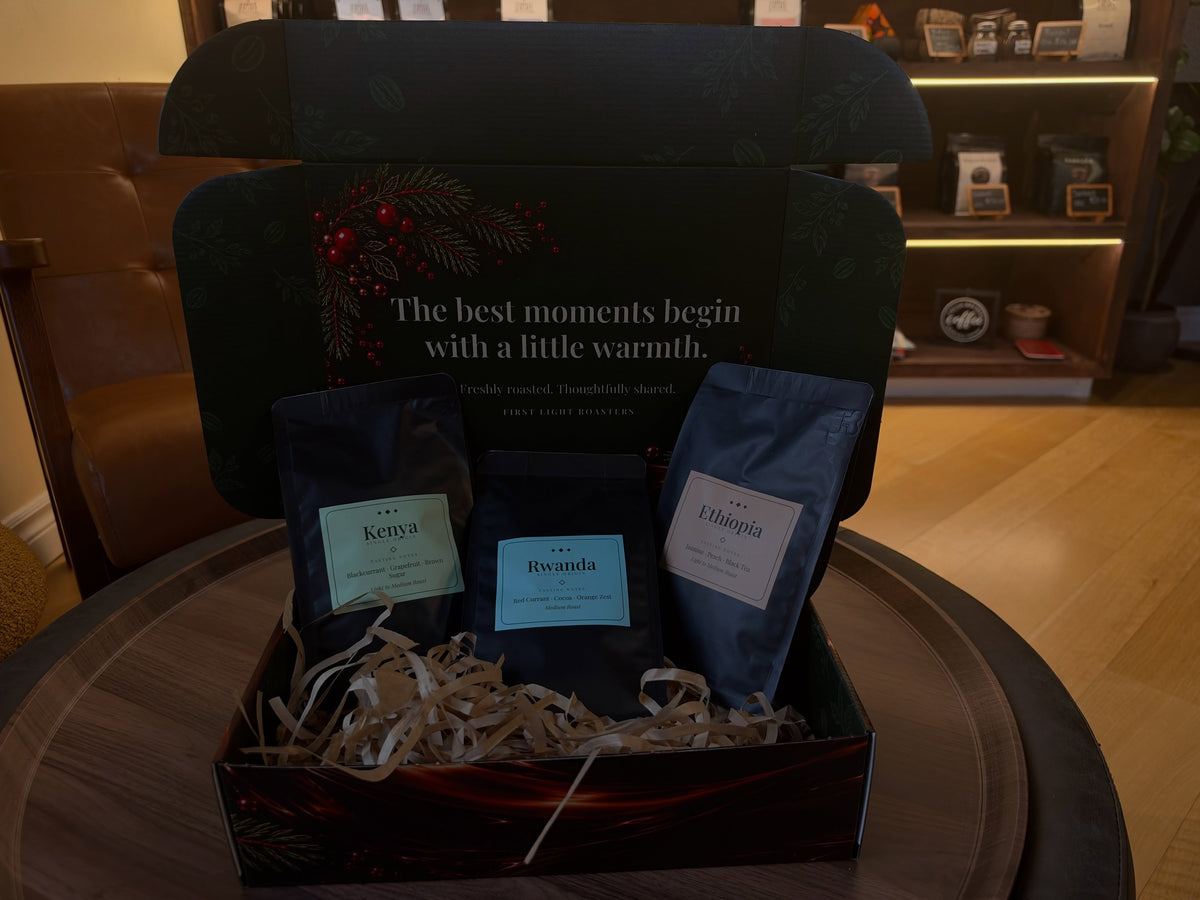
Three single origins in one of our Coffee Flights boxes: Kenya, Rwanda and Ethiopia. Each small bag names one country, and each tastes nothing like the other two.
Single origin vs blend: what is the difference?
A single origin is one coffee. A blend is a recipe. When we build a blend, each coffee has a job. Our Signature Espresso is the clearest example: one coffee brings body and chocolate, another rounds out the middle, and a specialty robusta brings crema and caffeine. No single coffee does all three things, which is the whole reason to blend.

Single origin and blend side by side. They are built for different jobs.
| Single origin | Blend | |
|---|---|---|
| Where it is from | One country, region, station or farm | Two or more coffees combined |
| What it tastes like | Distinct, shaped by the place | Balanced, shaped by the recipe |
| Through the year | Changes with each harvest and lot | Adjusted to stay consistent |
| Best for | Pour-over, black coffee, exploring | Espresso, milk drinks, daily drip |
| On the label | Origin, process, often variety | Blend name, roast, tasting notes |
Is single origin better than a blend?
No. This is the most common misunderstanding about the term. Single origin is a statement about where the coffee came from, not about how good it is. A poorly grown or badly roasted single origin is worse than a well built blend made from good coffee.
What decides quality is the same for both: how good the green coffee is, how well it is roasted, and how fresh it is when you brew it. Every coffee we roast, in blends or on its own, is specialty grade.
The honest way to choose is by what you want from the cup:
- Choose single origin if you drink coffee black, enjoy noticing differences, or want to learn what you like.
- Choose a blend if you want the same dependable cup every morning, pull espresso, or add milk and sugar. Our House Blend exists for exactly that.
Why does single origin cost more?
Usually three reasons, and none of them is hype:
- Smaller lots. A lot that is kept separate is smaller than a mixed one, and small quantities cost more per pound to buy, ship and store.
- Separation and traceability. Keeping one farm's or one station's coffee apart, from picking through milling to export, takes extra labor and record keeping at every step.
- Nothing to average the price. In a blend, a more expensive coffee can sit next to a less expensive one. A single origin carries its whole cost alone.
A simple way to think about it: cost per roasted pound = green coffee cost per pound, divided by (1 minus the share of weight lost in roasting), plus roasting and packing. The rarer and smaller the lot, the higher that first number. For the bigger picture on coffee prices, see why coffee is so expensive in 2026.
Why does it taste different from year to year?
Because it is a crop. Rain, temperature and timing differ every harvest, and each new lot arrives a little different from the last. When a fresh lot lands at the roastery, we roast samples, taste them, and adjust the roast to suit that coffee. Sometimes the tasting notes on the bag change with it.
A blend hides those shifts, because the roaster can change the components or their proportions to keep the cup steady. With single origin, the change is part of what you are buying.
Which single origin should you try first?
Start from flavors you already like, not from a country name.
| If you like | Try | Why |
|---|---|---|
| Chocolate, nuts, low acidity, coffee with milk | Brazil | Natural process, medium-dark roast, the smoothest coffee we roast |
| A balanced cup that is sweet with a little brightness | Colombia | Washed, medium roast: caramel, red apple, milk chocolate |
| Fruit and bright, juicy acidity | Kenya | The boldest, most vivid cup on our shelf |
| Floral, tea-like, delicate | Ethiopia | Washed, light to medium roast, from the birthplace of coffee |
| Something rare for a special occasion | Pacamara Honduras | A single farm limited release |
The fastest way to learn is to taste two side by side. Brew a Brazil and a Kenya the same way on the same morning and the idea of origin stops being abstract.
How should you brew it?
Any brewer works, but methods with a paper filter show origin character most clearly, because the paper holds back oils and fine particles and leaves a clean cup.
- Pour-over: 20 g of coffee to 320 g of water (1:16), medium-fine grind, water just off the boil, finished in about 3 minutes.
- Drip machine: 60 g of coffee per liter of water, medium grind.
- French press: 30 g to 450 g, coarse grind, 4 minutes. Heavier body, a little less clarity.
- Espresso: start at 18 g in, 36 g out, 25 to 30 seconds. Lower acid origins are easier to dial in.
Two things matter more with single origin than with a dark blend: grind fresh, and use good water. Hard or heavily treated tap water flattens the delicate notes you paid for. Our guide to the best water for coffee covers what to use in Livonia and metro Detroit.
How do you read a single origin label?

One of our 12 oz bags on the roastery worktable. Under the country name the label reads Single Origin, then the tasting notes and the roast level.
A good single origin bag or product page answers these questions. If most are missing, the term is doing marketing work, not informing you.
- Where exactly? Country at minimum, ideally region, station or farm.
- How was it processed? Washed coffees taste cleaner and brighter. Natural coffees taste heavier, sweeter and fruitier.
- What roast level? Lighter roasts keep more origin character. Very dark roasts taste mostly of the roast, whatever the origin.
- What does it taste like? Tasting notes are comparisons, not added flavors. Nothing is put in the coffee.
- When was it roasted? A roast date, not just a best-by date. We print the roast date on every bag and ship within 48 hours of roast.
Should a cafe serve single origin?
For most cafes the answer is both, each in its place. A blend on espresso keeps milk drinks consistent from shift to shift, which is what regulars notice. A single origin earns its spot as a pour-over, a rotating batch brew, or a featured espresso, where it gives staff something to talk about and guests a reason to try something new.
Keep the list short. One dependable blend and one or two single origins that rotate with the seasons is easier to train on, wastes less coffee, and sells better than a long menu nobody can explain. If you run a cafe, restaurant or hotel in Michigan and want to talk it through, our wholesale page is the place to start.
Frequently asked questions
What does single origin coffee mean?
Single origin means all the coffee in the bag comes from one place: one country, one region, one washing station or one farm. Nothing from anywhere else is blended in.
Is single origin coffee better than a blend?
Not better, different. Single origin shows the character of one place and suits black coffee and pour-over. A blend is built for balance and consistency and suits espresso, milk drinks and everyday drip. Quality depends on the green coffee and the roasting, not on the category.
Why is single origin coffee more expensive?
Single origin lots are smaller, kept separate from farm to roastery, and bought for a distinct flavor, all of which costs more than buying large mixed lots. A blend can also balance a pricier coffee with a less costly one.
Can you use single origin coffee for espresso?
Yes. Lower acid origins such as Brazil pull sweet, chocolatey shots and are forgiving. Brighter origins such as Kenya or Ethiopia make vivid, fruity espresso that is harder to dial in and can taste sharp in milk.
Is single origin coffee stronger?
No. Single origin describes where the coffee is from, not its caffeine or strength. Strength comes from the brew ratio and the roast.
Does single origin coffee taste the same every year?
No. It is a farm product, so each harvest and each lot tastes a little different. Roasters adjust the roast to suit each new lot, and the tasting notes on the bag may change.
First Light Roasters is co-founded by Sam Noor and Amal Almaflahi. Roasted for clarity. Crafted at first light.

Leave a comment
This site is protected by hCaptcha and the hCaptcha Privacy Policy and Terms of Service apply.