Kenya AA Coffee Guide: Taste, Brewing, Roast and Where Ours Comes From
Our Kenya is a washed AA lot from Kirinyaga County, on the slopes of Mount Kenya, roasted medium-dark. In the cup it is blackcurrant up front, grapefruit acidity through the middle and brown sugar sweetness in the finish. It tastes best as a pour-over or Chemex with water around 200°F, and it is one of the few single origins we also recommend as espresso.
This guide covers what "AA" really means, where our lot comes from, why we roast it the way we do, exactly how to brew it, what to eat with it, and a short history of coffee in Kenya.
What does Kenya AA mean?
AA is a size grade, not a flavor score. After milling, Kenyan coffee is passed over a stack of metal screens with round holes, and the beans are sorted by which screen stops them. AA beans are the large ones, held at screen 17 to 18, which is a little over 7 millimeters across. AB is the next size down, and PB (peaberry) is the small round bean that forms when a coffee cherry grows one seed instead of two (Trabocca, Kenya grades explained).
So why does AA have the reputation? Two honest reasons. Big, dense beans from high farms tend to be the ones that ripened slowly, and slow ripening builds sugar and acidity. And even sizing matters to a roaster: beans of the same size roast at the same pace, so the batch comes out even.
What AA does not promise is a great cup. A carefully picked AB from a good washing station can taste better than a careless AA. The grade tells you the size. The washing station, the region and the roast tell you the rest. We wrote more about this in our guide to Kenya's grading system.

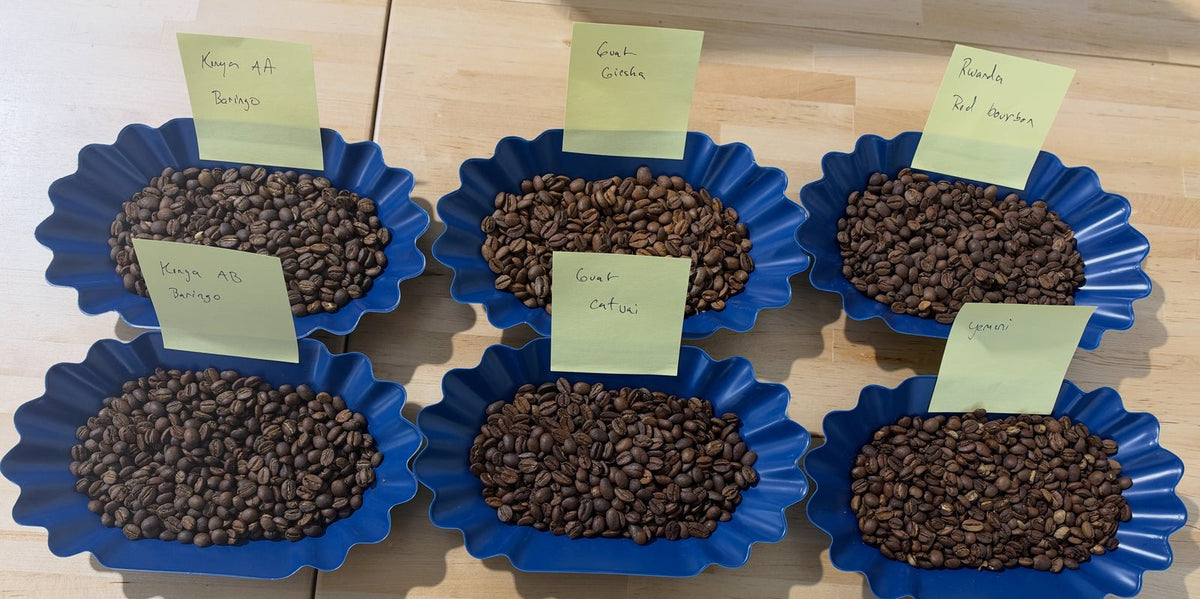
Sample roasts on our worktable in Livonia. Look at the two trays on the left: the handwritten note on the top one reads "Kenya AA" and the one below it "Kenya AB." Same country, two size grades, roasted side by side so we can taste the difference before we buy. These were samples from another Kenyan lot we were evaluating, not the coffee in the bag, but this is how every coffee we sell gets chosen.
Where does this coffee come from?
Our Kenya comes from Kirinyaga County in central Kenya, on the southern slopes of Mount Kenya. Kirinyaga, Nyeri and Murang'a are the three counties behind most of the Kenyan coffees that specialty roasters chase.
The lot we are roasting now is Gachami AA. Gachami is a "factory," which is what Kenyans call a washing station: the place where farmers deliver ripe cherries to be pulped, fermented, washed and dried. It belongs to the Baragwi Farmers Cooperative Society, a cooperative registered in 1953 that runs 12 factories for its smallholder members at roughly 1,500 to 1,800 meters (Sucafina, Baragwi cooperative profile).
That matters for how you picture this coffee. It was not grown on one estate. It was grown by many families, most with a few hundred trees each, who carry their cherries to the same factory. The varieties they mainly grow are SL28 and SL34, the two that made Kenya's name.
Kenyan washed coffee is processed with unusual care. The cherries are pulped, fermented for the better part of a day, washed and sorted in long channels of water, soaked again in clean water, and then dried slowly on raised beds for one to three weeks. That second soak is part of why Kenyan coffee tastes so clean.
It is a traceable lot, and it reaches us through Kifahari Coffee, an importer licensed by the Coffee Board of Kenya that works with farmers and mills on the ground. We have bought two Kirinyaga lots through them, Gachami and Nyanja, and both are AA.
This coffee at a glance
| Origin | Kirinyaga County, Kenya |
|---|---|
| Current lot | Gachami factory, Baragwi Farmers Cooperative Society |
| Grade | AA |
| Process | Washed, dried on raised beds |
| Roast | Medium-dark |
| Tasting notes | Blackcurrant, grapefruit, brown sugar |
| Best as | Pour-over, Chemex, single-origin espresso |
| Sizes | 12 oz, 2 lb and 5 lb, whole bean or ground |
What does Kenya AA taste like?
Blackcurrant first: a dark, tart-sweet berry note, closer to blackberry jam than to anything citrus. Then grapefruit, which is the acidity, bright and a little bittersweet. Then brown sugar as the cup cools and you swallow.
People often ask whether Kenyan coffee is acidic. Yes, in the good sense. Acidity in coffee is the quality that makes fruit taste like fruit. A Kenyan coffee without it would taste flat. If your cup tastes sour or sharp instead of juicy, that is almost always a brewing problem, and the fix is in the table below.
You will sometimes read that Kenya's blackcurrant snap comes from phosphoric acid in the soil. It is a popular story, but the evidence behind it is thin, and coffee scientists have pushed back on it. What we can say with confidence is that the varieties, the altitude and that careful washed process all point in the same direction: a clean, vivid, fruit-forward cup.
How does it compare with our Ethiopia? Ethiopia is floral and tea-like. Kenya is deeper and juicier, with more weight. We put the two side by side in Kenyan vs Ethiopian coffee: which should you buy?
How do we roast it?
We roast our Kenya medium-dark, in small batches on our Diedrich roaster in Livonia, and only after you order it.
Many specialty roasters take Kenyan coffee very light. Light Kenyas can be thrilling, and they can also be sharp enough to make you wince. We go a step further into the roast on purpose. A medium-dark roast rounds the acidity from lemon toward grapefruit, turns the sugars toward brown sugar, and builds enough body that this coffee holds up as espresso and under milk, not only as a pour-over. The blackcurrant stays. The bite goes.
Co-founder Sam Noor describes what we are after this way: "Clarity is not a metaphor for us. It's a technical goal. A clean cup, where every flavor note resolves into the next one. With a Kenyan coffee, where the acidity can either dance or assault, that clarity is the whole game."
AA beans help here. They are big and dense, so they take heat steadily and roast evenly from the outside to the center.
Sam is a roaster as well as the owner of the business, and on the roast itself he puts it this way: "Kenya AA is a dense bean, so we give it steady heat early and we don't rush it. SL28 and SL34 carry a lot of acidity, and the roaster's job is to keep that bright without letting it turn sharp. On the Diedrich I'm listening for first crack, then giving the coffee enough time afterward to build the brown sugar sweetness. Pull it too early and Kenya tastes sour. Take it too far and you lose the blackcurrant."

Co-founder Sam Noor at the roaster. The burlap sacks in the foreground are how green coffee arrives from East Africa: about 60 kilograms each, stamped by the exporter. The open one on the right shows the plastic liner inside that protects the beans on the ocean crossing.
Every bag carries its roast date. A medium-dark roast is ready sooner than a light one: for filter coffee it is good from about four or five days after roast, and for espresso we would give it a week to ten days so the shots settle down.
How do you brew Kenyan coffee?
Use filtered water, a scale, and a 1:16 ratio (1 gram of coffee to 16 grams of water) as your starting point. Grind right before you brew. Because this is a medium-dark roast, use water a little cooler than you would for a light roast: around 200°F, or about a minute off the boil.
| Method | Coffee | Water | Grind | Temp | Time |
|---|---|---|---|---|---|
| Pour-over (V60, Kalita) | 20 g | 320 g | Medium, like table salt | 200°F | 2:45 to 3:15 |
| Chemex | 40 g | 640 g | Medium-coarse | 200°F | 4:00 to 4:30 |
| AeroPress | 15 g | 240 g | Medium-fine | 190°F | 1:30 steep, 30 second press |
| Drip machine | 60 g | 1 liter | Medium | Machine set | Machine set |
| French press | 30 g | 480 g | Coarse | 200°F | 4:00 |
| Espresso | 18 g | 38 to 40 g out | Fine | 200°F | 27 to 32 seconds |
| Iced pour-over | 20 g | 200 g hot, onto 120 g ice | Medium-fine | 200°F | 2:30 to 3:00 |
Pour-over, step by step (our pick)
- Rinse the paper filter with hot water and empty the rinse water.
- Add 20 g of coffee ground like table salt. Start your timer.
- Bloom: pour 50 g of water, enough to wet all the grounds. Wait 30 to 40 seconds.
- Pour in slow circles up to 320 g, finishing around the 1:45 mark.
- Let it drain. The whole brew should finish near 3:00.
- Give it two minutes in the cup. The blackcurrant gets clearer as it cools.
Which method should you pick?
- Pour-over or Chemex for the clearest fruit. Paper filters keep the cup clean, and that is where the blackcurrant and grapefruit stand out.
- French press for a rounder, heavier cup. The acidity steps back and the brown sugar comes forward. A good choice if bright coffees are new to you.
- Espresso for something different. As a straight shot it is jammy and bright. Pull it slightly longer than a classic 1:2, as in the table, to keep the acidity juicy rather than sharp. In a cortado or small latte it tastes like berries and cream.
- Iced is one of the best uses of this coffee. Cold makes the grapefruit note snap.
How do you fix a cup that tastes off?
| If it tastes | It usually means | Do this next time |
|---|---|---|
| Sour, sharp, lemony | Under-extracted | Grind a little finer, or brew a little longer |
| Savory, like tomato or broth | Often under-extracted, sometimes water that is too cool | Grind finer and make sure your water is near 200°F |
| Bitter, smoky, dry | Over-extracted | Grind coarser, or drop the water to 195°F |
| Weak, watery | Not enough coffee | Weigh your dose; move from 1:16 to 1:15 |
| Sour espresso that runs fast | Grind too coarse or coffee too fresh | Grind finer; rest the bag a week from roast |
| Flat, no aroma | Stale grind or tap water issues | Grind fresh; switch to filtered water |
Change one thing at a time. For more on technique, see our pour-over protocol.
No grinder at home? Order it ground and tell us your brew method. We grind to order with a separate setting for pour-over, drip and French press.
What should you eat with Kenyan coffee?
Pair to the notes. Blackcurrant and grapefruit love dark chocolate, berries, citrus and anything with brown sugar or caramel. This coffee has enough weight to stand next to rich food.
- Pain au chocolat. Dark chocolate and blackcurrant is the classic match.
- Cheesecake. The coffee acts like a berry sauce over the top.
- Cinnamon roll. Brown sugar in the pastry, brown sugar in the cup.
- Strawberry cheese danish. Berry on berry, with cream cheese to round the acidity.
- Banana nut bread. Sweet and nutty against a bright cup.
- At home: a square of 70% dark chocolate, orange or lemon pound cake, blueberry muffins, or toast with blackcurrant or blackberry jam.
For an East African table, put out mandazi, the lightly sweet fried dough, often scented with cardamom or coconut, that is eaten with hot drinks all over Kenya. You can taste this coffee and several of the pastries above at Detroit Halite, the cafe in front of our roastery in Livonia.
Coffee in Kenya: a short history
Kenya borders Ethiopia, where arabica coffee comes from, yet coffee was not planted in Kenya until 1893, when French missionaries brought trees to the Taita Hills. Under British colonial rule, coffee became a settler crop, and for decades Kenyan farmers were effectively barred from growing it for themselves. That only began to change in the 1950s.
Two things from the 1930s still shape every bag of Kenyan coffee. The first is the Nairobi auction, started in the middle of that decade, where lots are sold in the open to the highest bidder. Good coffee earns more, which gave farmers and factories a reason to chase quality. The second is the work of Scott Agricultural Laboratories, the research station whose selections are still labeled "SL." SL28 was selected there in 1935 from a single drought-resistant tree, and World Coffee Research rates its cup quality at high altitude as exceptional, while noting it is susceptible to the major coffee diseases (World Coffee Research, SL28). Farmers keep growing it anyway, for the cup.
After independence, smallholders organized into cooperatives, each running its own factories, and by the late 1970s they were growing more coffee than the big estates. That is the system our lot comes out of. In 2023 Kenya reformed how coffee is sold and how farmers are paid, with the aim of getting money to growers faster. For more, see our articles on the Nairobi auction and on SL28 and SL34.
Here is the part that surprises people: Kenya mostly drinks tea. Nearly all of its coffee is exported. The country's own coffee tradition lives on the Swahili coast, in Mombasa and Lamu, where vendors pour kahawa chungu, "bitter coffee," from tall brass kettles kept hot over charcoal. It is brewed strong with spices, served unsweetened in small cups, and usually taken with something sweet on the side.
The main harvest in central Kenya runs from about October to December, and the new crop typically reaches the United States the following summer.
Frequently asked questions
What does AA mean on Kenyan coffee?
AA is a bean size grade. It marks the large beans held at screen 17 to 18, a little over 7 mm across. It describes size and evenness, not flavor, although large dense beans from high altitude often cup very well.
Is Kenyan coffee very acidic?
Kenyan coffee is known for bright, fruity acidity, the kind you taste in grapefruit or blackcurrant. Our medium-dark roast rounds it off, so the cup is juicy rather than sharp. If it tastes sour, grind a little finer.
Is Kenya AA good for espresso?
Yes, ours is. The medium-dark roast gives it enough body and sweetness for espresso. Start with 18 g in, 38 to 40 g out, in 27 to 32 seconds, and rest the bag at least a week from the roast date.
What is the best way to brew Kenyan coffee?
A paper-filtered pour-over or Chemex shows the most fruit: 20 g of coffee to 320 g of water at about 200°F, finishing in around three minutes. French press gives a rounder, sweeter cup.
What is the difference between Kenyan and Ethiopian coffee?
Washed Ethiopian coffees lean floral and tea-like, with notes such as jasmine and peach. Kenyan coffees are deeper and juicier, with blackcurrant and citrus and a heavier body.
Does Kenyan coffee have more caffeine?
No. Kenyan coffee is arabica, and its caffeine is in the normal arabica range. Your caffeine per cup depends mostly on how much coffee you use.
First Light Roasters is co-founded by Sam Noor and Amal Almaflahi. Roasted for clarity. Crafted at first light.

Leave a comment
This site is protected by hCaptcha and the hCaptcha Privacy Policy and Terms of Service apply.