Michigan Roasted Coffee: How to Buy Fresh Beans From a Michigan Roaster
Michigan roasted coffee is coffee that was grown in the tropics and roasted here in Michigan by a local roaster. The reason to buy it is freshness: roasted coffee tastes its best in the first few weeks after roasting, and a local roaster can get it to you inside that window. To buy well, look for a printed roast date from the last two to three weeks, a roaster who roasts to order, and whole beans you grind at home.
We roast in Livonia, so we are not neutral. But the checklist below works for judging any roaster in the state, including us.

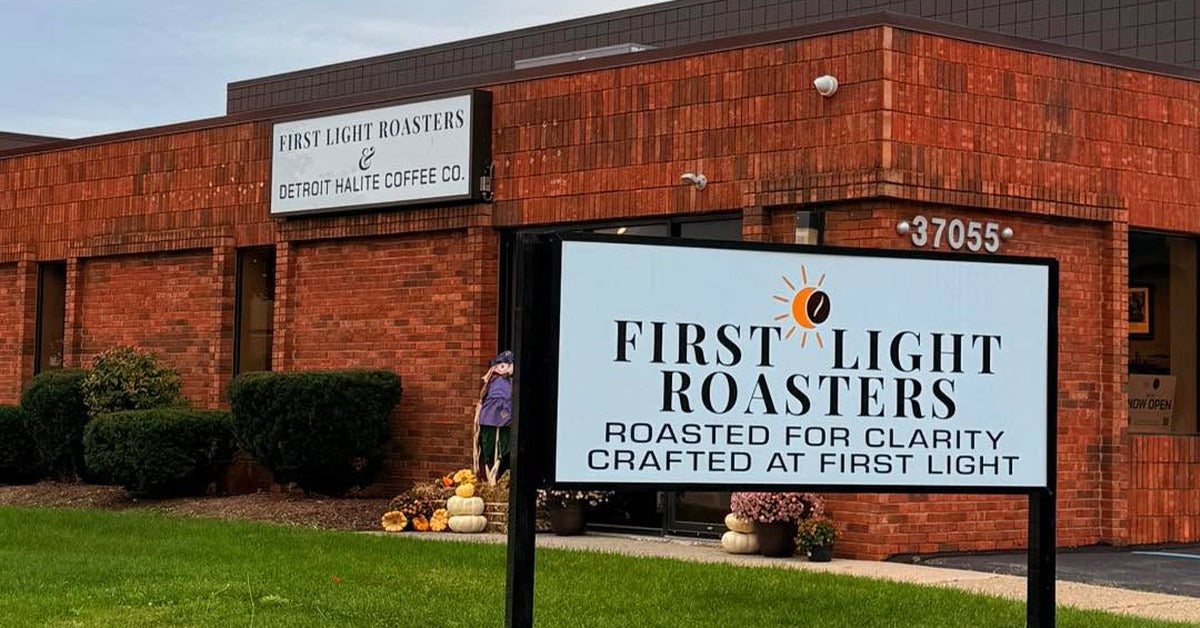
Our roastery at 37055 Industrial Road in Livonia. Look at the smaller sign on the brick above the hedge: it lists both First Light Roasters and Detroit Halite Coffee Co. The roaster and the cafe share one building, so the coffee poured out front was roasted a few steps behind the counter.
What does "Michigan roasted" actually mean?
No coffee is grown in Michigan. Coffee is a tropical plant, and commercial coffee comes from places like Ethiopia, Kenya, Colombia, Brazil and Honduras. It arrives here as green coffee: raw, pale green seeds that are stable and can be stored for months.
Roasting is the step that turns those seeds into something you can brew. It is also the step that starts the clock. Green coffee keeps. Roasted coffee does not. From the day it leaves the roaster, it slowly loses the aromas that make it taste like anything.
That is why where your coffee is roasted matters more than most people think. "Michigan roasted" means the clock started close to your kitchen.
Why does the roast date matter so much?
A "best by" date tells you when coffee stops being sellable. A roast date tells you when it was actually made. Only the second one helps you buy fresh coffee. If a bag has no roast date on it, you have no way of knowing how old it is.
Here is the rule of thumb we use for whole beans kept sealed at room temperature:
| Days since roast | What to expect | What to do |
|---|---|---|
| 1 to 4 | Very fresh. The beans are still releasing gas, and cups can taste sharp or uneven. | Fine to brew, better to wait a few days |
| 5 to 21 | The sweet spot. Full aroma, full sweetness. | Drink it now |
| 22 to 45 | Still good. The top notes start to soften. | Keep it sealed and finish the bag |
| Past 45 | Safe to drink, but flatter and duller. | Use it for cold brew or milk drinks |
Two notes on that table. First, "too fresh" is real: coffee roasted yesterday is not at its best yet, and light roasts in particular often open up after the first week. Second, ground coffee moves through this timeline much faster than whole beans, which is the best argument for owning a grinder.
How do you judge a Michigan coffee roaster?
Use this before you buy from anyone, online or in person.
- Is there a roast date on the bag? Not a "best by" date. The actual day it was roasted.
- Do they roast to order? Ask how long coffee sits on the shelf before it ships. Roasted after you order beats roasted last month.
- Do they tell you where the coffee is from? At minimum the country and region. Better: the farm or washing station, the process and the elevation.
- Is the roast level stated plainly? Light, medium or dark, with tasting notes you can actually check against the cup.
- Will they grind it for your brewer? If you do not own a grinder, a roaster who asks how you brew, and grinds for that method, will give you a much better cup than one generic "ground" setting.
- Can you reach a person? A local roaster should be able to answer a question about the coffee, or fix a problem, without a ticket number.
- Can you taste before you commit? A cafe, a tasting bar, or small bags you can try first.
For the record, here is how we answer our own checklist. Every bag carries its roast date. We roast to order and ship within 48 hours of roast. Each coffee lists its origin, process and roast level. We grind to order with separate settings for pour-over, drip and French press. Our company is a Specialty Coffee Association member, and you can taste everything at Detroit Halite, the cafe in the front of our building.

Co-founder Sam Noor at the roaster. The wide steel drum in front of him is the cooling tray, where beans are dropped and stirred the moment a roast ends so they stop cooking. The screen on the left tracks each batch as it roasts.
Where is coffee roasted in Michigan?
All over the state. Michigan has an active roasting scene, and you are probably closer to a roaster than you think. The main clusters:
- Metro Detroit: Detroit itself plus the suburbs, including Livonia, Plymouth, Ferndale and Birmingham.
- Ann Arbor and Ypsilanti.
- Grand Rapids and West Michigan, out to the lakeshore.
- Lansing and Kalamazoo.
- Traverse City and Northern Michigan.
The easiest way to find one near you: the next time you have a great cup at an independent cafe, ask whose coffee it is. Cafes that care about coffee are proud to tell you, and it is often someone within an hour's drive.
If you are in western Wayne County, that someone can be us. We serve Livonia and Plymouth from our roastery, and you can walk in and buy whole bean bags in person.
How fast can fresh coffee get to your door?
Fast enough to land inside the sweet spot in the table above, which is the whole point. Here is how it works with us:
- Roast: your coffee is roasted after you order, Monday through Saturday.
- Ship: it leaves within 48 hours of roast.
- Arrive: standard delivery takes another 3 to 7 business days.
- Or pick up: local pickup in Livonia is usually ready within 24 hours.
That means a bag ordered online typically reaches you rested and ready, right as it enters its best weeks. Compare that with a grocery shelf, where you often cannot tell when a bag was roasted at all.
Which coffee should you start with?
Start with how you drink it, not with the fanciest name.
| If you like | Try | Roast | Tastes like |
|---|---|---|---|
| A dependable daily cup, with or without milk | House Blend | Medium | Milk chocolate, hazelnut, caramel |
| Espresso, lattes, cappuccinos | Signature Espresso | Medium-dark | Milk chocolate, toasted almond, cherry |
| Smooth and low in acidity | Brazil | Medium-dark | Milk chocolate, toasted almond, caramel |
| Balanced and a little fruity, hot or iced | Colombia | Medium | Caramel, red apple, milk chocolate |
| Bold and bright | Kenya | Medium-dark | Blackcurrant, grapefruit, brown sugar |
| Floral, tea-like pour-overs | Ethiopia | Light to medium | Jasmine, peach, black tea |
| Coffee after dinner | Decaf | Medium | Cocoa, vanilla, caramel |
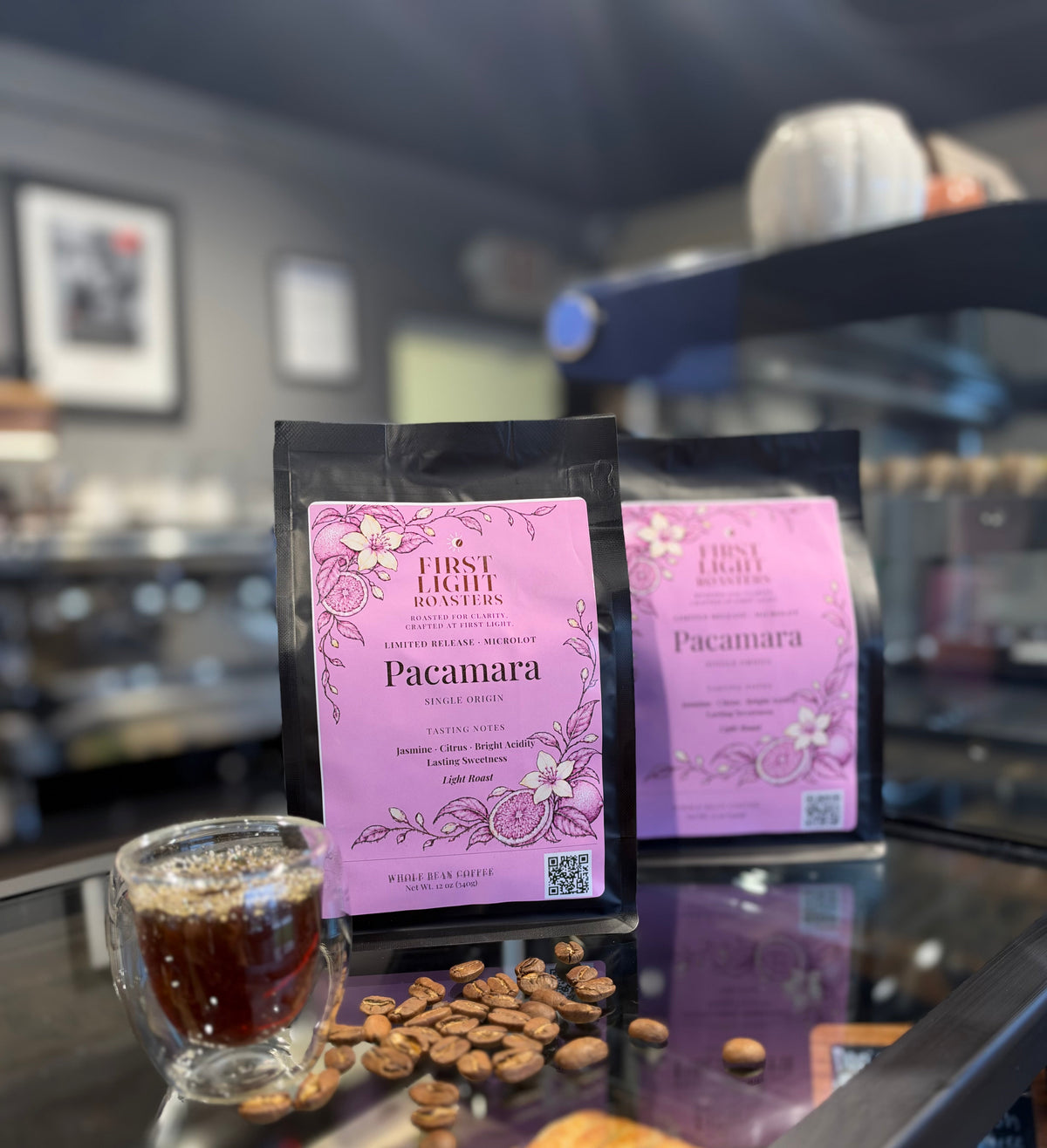
Want to go deeper on one coffee? Read our full guides to the Ethiopia Guji and the limited Pacamara Honduras, or browse all of our coffee.

On the bar at Detroit Halite, the cafe in front of the roastery. The two pump bottles are our Brown Butter and Brown Butter Maple syrups, made in house. Behind them you can see the espresso machine and the framed prints along the cafe wall.
How do you keep coffee fresh at home?
Roasted coffee has four enemies: air, moisture, heat and light. The National Coffee Association's advice is simple: keep beans in an opaque, airtight container at room temperature, and buy smaller amounts more often (National Coffee Association, how to store coffee).
In practice:
- Keep it in the bag it came in. A good coffee bag has a one-way valve and a zip seal. Press the air out and close it after every use.
- Use a cupboard, not the counter. Away from the stove, the oven and any window.
- Skip the fridge. It is humid, and coffee absorbs moisture and food smells.
- Buy what you will drink in three to four weeks. A 12 oz bag makes roughly 20 to 24 mugs of coffee.
- Grind right before you brew.
Two Michigan questions we hear at the counter. In winter, a sealed bag that sat in a cold mailbox or on the porch for a few hours is fine; let it come up to room temperature before you open it so moisture does not condense on the beans. In a humid July, the airtight seal matters most, so close the bag properly every time. For the longer version, see our article on coffee freshness.
Is Michigan roasted coffee worth the price?
Honestly, a bag from a local specialty roaster usually costs more than a bag from the grocery aisle. You are paying for three things: better green coffee, small batches roasted to order, and freshness you can verify from the date on the bag.
Per cup, it is still one of the cheapest good things you can buy. The formula is simple: divide the price of the bag by the number of cups you get from it. A 12 oz bag (340 g) at 15 to 17 grams per mug is about 20 to 24 cups. Run that math against what you pay for a single cup at a drive-through.
Ways to bring the cost down without giving up freshness:
- Buy a bigger bag if your household finishes it within a month. We sell 12 oz, 2 lb and 5 lb.
- Subscribe. Regular deliveries cost less per bag and you never run out.
- Use the Livonia Promise. If you live, work, go to school or own a business in Livonia, you get 10% off with code LIVONIA10, online or at the cafe. It is a standing offer, not a sale.
Buying for a cafe, restaurant or hotel in Michigan?
The same checklist applies, with higher stakes. Ask any wholesale roaster for a roast date on every bag, straight answers on pricing, and a direct line to the person roasting your coffee. That is how we work with our wholesale partners, with no contracts. Details are on our wholesale page.

Co-founders Sam Noor and Amal Almaflahi on the roastery floor, coffee in hand. The steel ductwork running up to the ceiling behind them is part of the roasting line.
Frequently asked questions
Is any coffee grown in Michigan?
No. Coffee needs a tropical climate. "Michigan coffee" means coffee roasted in Michigan from green coffee grown in countries like Ethiopia, Kenya, Colombia, Brazil and Honduras.
How long after roasting is coffee fresh?
Whole beans taste their best from about 5 to 21 days after roast and stay good for roughly six weeks if kept sealed. Ground coffee fades much faster, so grind just before brewing when you can.
Who is the best coffee roaster in Michigan?
There is no single answer, because it depends on what you like to drink. Use the seven-point checklist above: a printed roast date, roasted to order, clear origin and roast information, grinding for your brewer, a real person to talk to, and a way to taste first. Any roaster who passes it is worth trying.
Can I buy coffee beans in person in Livonia?
Yes. You can buy whole bean bags at our roastery and at Detroit Halite, the cafe in the front of the building, at 37055 Industrial Road, Livonia, MI 48150. You can also order online for local pickup.
Should I buy whole bean or ground?
Whole bean, if you have a grinder. It stays fresh far longer. If you do not, order it ground and tell the roaster how you brew, so it is ground for your method.
Do you ship outside Michigan?
Yes. We roast to order in Livonia and ship across the United States within 48 hours of roast.
First Light Roasters is co-founded by Sam Noor and Amal Almaflahi. Roasted for clarity. Crafted at first light.

Leave a comment
This site is protected by hCaptcha and the hCaptcha Privacy Policy and Terms of Service apply.