

The Chemistry of Freshness: Preserving Coffee Volatiles
Introduction: Freshness is Not a Date
In the world of specialty coffee, "freshness" is perhaps the most overused and least understood term. For the average consumer, it is a simple countdown from the roast date. However, in the First Light Roasters lab, we define freshness as a specific chemical state: the presence and stability of over 800 volatile organic compounds (VOCs) that create the aroma and flavor of the bean. Once these compounds are lost to the environment, they can never be recovered.
Our motto, "Roasted for Clarity. Crafted at First Light," is a promise to deliver the bean at its peak molecular potential. But the moment the coffee leaves our roastery, a silent war begins against oxygen, moisture, and light. To honor the geological legacy of the Rift Valley and the technical precision of our roasts, you must understand the chemistry of degradation. In this guide, we explore the kinetics of staling and how to turn your kitchen into a fortress for flavor preservation.
Protect the Pursuit of Clarity
Our bags feature the latest 2026 mono-material high-barrier tech. View our fresh-roasted collection
I. The Anatomy of Staling: Oxidation and Volatilization
Coffee staling is not a single event; it is a multi-front chemical assault. The primary enemies are Oxidation and the Loss of Volatiles through gas diffusion.
1.1 Oxidation: The Flavor Thief
When oxygen comes into contact with the roasted coffee bean, it reacts with the lipids (fats) and oils present in the seed. This creates hydroperoxides, which eventually break down into aldehydes and ketones that taste rancid, ashy, or like "old paper". For natural processed coffees, which are rich in fruit-based oils, this oxidation happens even more rapidly if the beans are not stored in an oxygen-free environment.
1.2 Volatilization: The Disappearing Aroma
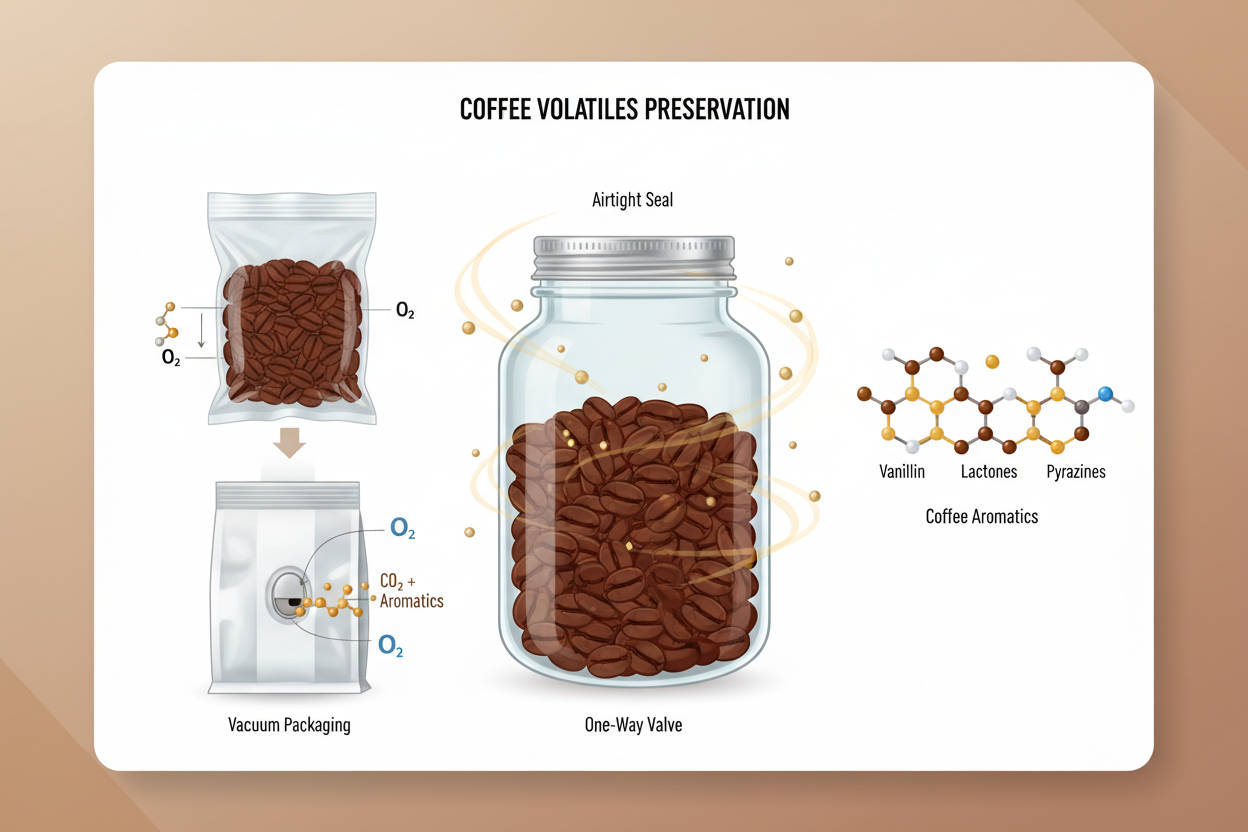
The "smell of fresh coffee" in your kitchen is actually the sound of flavor escaping. Aromatic compounds like sulfur-containing thiols (which provide roasted notes) and esters (which provide fruit notes) are highly volatile. Because roasted coffee is porous, these gases are constantly diffusing out of the bean and into the air. This is why pre-ground coffee loses its soul in minutes: the surface area is increased by a factor of thousands, allowing the volatiles to vanish almost instantly.
II. The Science of Degassing: The Resting Period
While we want to keep volatiles in, we must let CO2 out. During the roasting process, carbon dioxide is trapped within the cellular structure of the bean. This gas is essential for protection, but a disaster for brewing.
2.1 The CO2 Barrier
If you brew coffee the hour it is roasted, the escaping CO2 acts as a physical shield, preventing water from penetrating the coffee grounds. This leads to a bubbly "bloom" that looks impressive but results in an uneven, muddled extraction. This is why professional coffee sommeliers always recommend a resting period.
2.2 Peak Flavor Windows
For our clarity-focused light roasts, we recommend the following resting windows to achieve the ideal chemical balance:
- Filter/Pour-Over: 5 to 10 days post-roast.
- Espresso: 10 to 21 days post-roast.
Espresso requires a longer rest because the intense pressure of the machine will amplify any residual CO2, resulting in a harsh, "fizzy" acidity that masks the sparkling phosphoric notes of a Kenya AA.
III. Storage Physics: Vacuum, Temperature, and Light
To preserve the pursuit of clarity in your home lab, you must master the three variables of storage physics.
3.1 The Vacuum Myth vs. Reality
Many "vacuum" canisters only remove air, but they do not create a true vacuum. Any remaining air still contains 21% oxygen. In 2026, the gold standard is Active Displacement: containers that use a plunger to physically push all air out, leaving only the coffee and its own protective CO2 cloud.
3.2 The Freezer: The Ultimate Preservation Tool
In the past, freezing coffee was discouraged due to moisture concerns. Today, we know better. Chemical reactions, including oxidation and degassing, are temperature-dependent. For every 10°C drop in temperature, the rate of staling is roughly cut in half.
If you have a special micro-lot from the Ethiopian genetic birthplace, seal it in an airtight, moisture-proof bag and freeze it. This effectively "stops the clock" on its flavor profile. Just ensure you brew it directly from frozen or let it come to room temperature fully before opening the seal to avoid condensation.
3.3 UV Protection: Light is Energy
UV light provides the activation energy needed for oxidative reactions to occur. This is why you should never store coffee in clear glass jars on your counter. Our 2026 high-barrier mono-material bags are designed to be 100% opaque, protecting the beans from the "photo-oxidation" that creates bitter off-flavors.
IV. The Grinding Gap: Particle Surface Area
We cannot emphasize this enough: grind only what you are about to brew. When a bean is ground, its surface area increases by over 1,000 times. This exposes the internal lipids to oxygen and allows the remaining VOCs to escape through diffusion in a matter of minutes. Brewing for clarity requires the volatile aromatics to be released into the *water*, not the air of your kitchen.
Conclusion: Respecting the Million-Year Journey
When you hold a bag of First Light Roasters coffee, you are holding the result of a million-year geological process and a thousand-year cultural legacy. To let those beans go stale in a cupboard is to lose the final chapter of the story.
By understanding the chemistry of volatiles and the physics of storage, you ensure that every cup you brew is a true reflection of its origin. This is exceptional specialty coffee, crafted at first light, for a refined and full-bodied experience consistently delivered on a global scale. Protect the clarity. Master the brew.
Experience Peak Freshness
Roasted with 2026 technical precision and shipped in high-barrier tech. Shop our latest arrivals
FAQ: The Science of Coffee Freshness
How long does coffee stay fresh?
In an unopened, high-barrier bag, whole bean coffee stays at peak flavor for 4 to 8 weeks. Once opened, you have roughly 10 to 14 days before oxidation and volatilization significantly muddle the cup.
Should I store my coffee in the fridge?
No. The fridge is a moist, odorous environment. Coffee is hygroscopic, meaning it absorbs moisture and smells from the air, which will ruin the delicate sommelier-level notes of the bean. The freezer is a better option if the bag is perfectly sealed.
Why does my coffee bag have a one-way valve?
The valve allows CO2 to escape (degassing) without allowing oxygen to enter. Without this valve, the bag would eventually burst from the internal gas pressure of fresh-roasted beans.
Is "oily" coffee fresher?
Not necessarily. Oils on the surface of the bean are a sign of a darker roast or age. For our clarity-focused light roasts, the oils should remain inside the bean structure. If you see oils on a light roast, it likely means the coffee is past its peak and the lipids have begun to oxidize.
What is "zombie coffee"?
This is a term for coffee that is months old. While it may still contain caffeine, its 800+ volatile compounds have vanished, leaving behind a flat, woody, and bitter taste that lacks any origin clarity.
Does freezing coffee change the grind?
Yes. Frozen beans are more brittle and tend to shatter more uniformly, often producing fewer "fines". Many high-end baristas prefer grinding frozen beans for this reason, as it can actually improve flavor clarity.
What are VOCs?
VOCs are Volatile Organic Compounds. They are the chemical building blocks of flavor and aroma that turn into gas at room temperature. Their preservation is the ultimate goal of the "Roasted for Clarity" philosophy.


Leave a comment
This site is protected by hCaptcha and the hCaptcha Privacy Policy and Terms of Service apply.