Pacamara Honduras Coffee Guide: Taste, Brewing, Roast and the Farm Behind It
Our Pacamara Honduras is a washed, light roast microlot from Francisco Romero's small family farm in El Paraíso, Honduras. In the cup it is jasmine and citrus up front, with a bright, clean acidity and a sweetness that stays after the last sip. It tastes best as a pour-over or Chemex, brewed with water just off the boil, and the entire lot was just five sacks.
This guide covers what Pacamara is, the farm it came from, how we roast it, exactly how to brew it at home, what to eat with it, and a little of the coffee culture of Honduras.

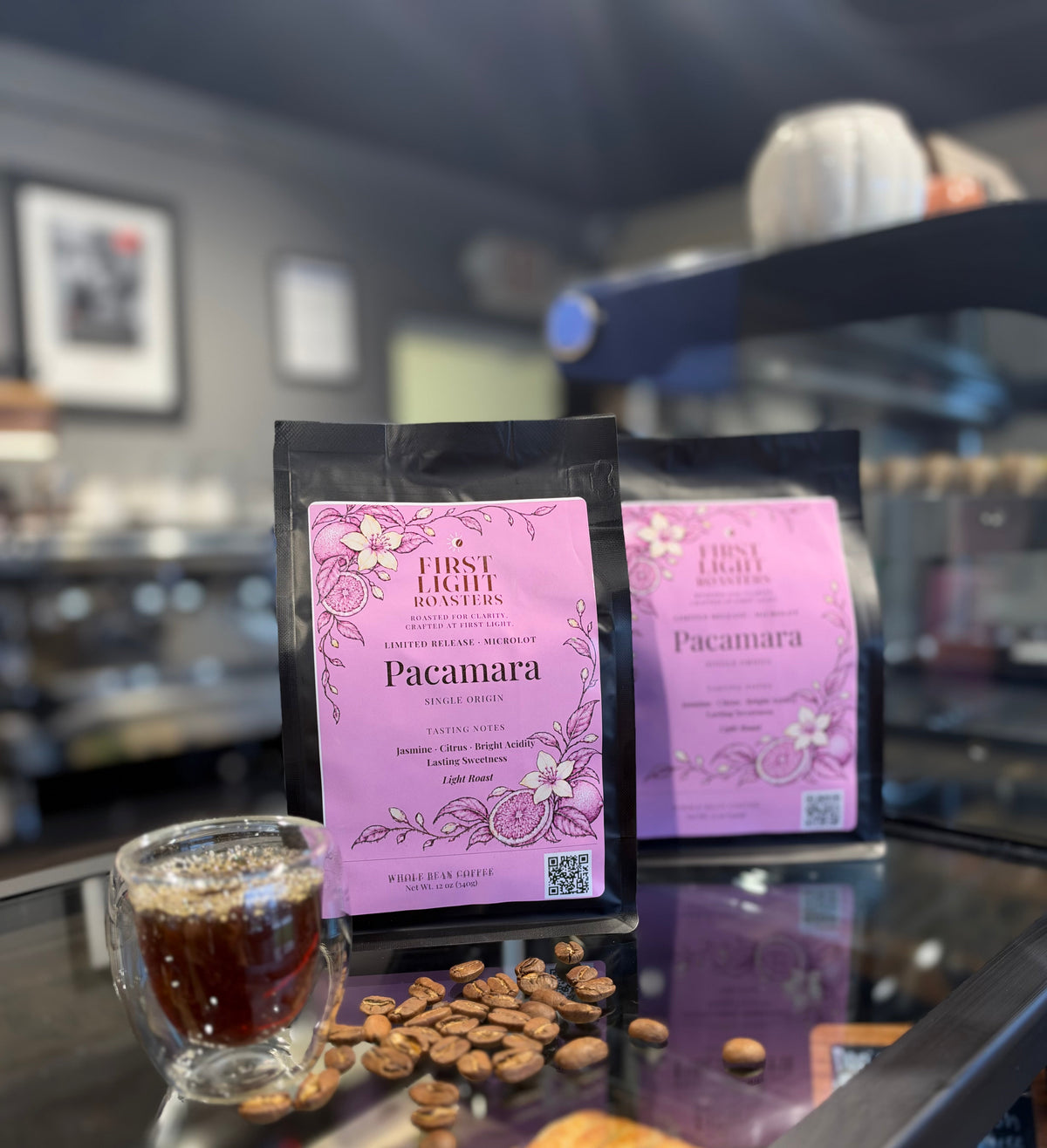
Pacamara on the counter at Detroit Halite, the cafe in front of our roastery. Look at the beans next to the glass: a light cinnamon brown with a dry, matte surface and no oil. That is what a light roast looks like. The brewed cup beside them is a clear amber red, not black, and you can see light through it.
What is Pacamara coffee?
Pacamara is a coffee variety, not a place. It is a cross between two older varieties: Pacas, a compact plant found in El Salvador, and Maragogipe, a tall plant famous for its giant beans. The name is simply the first four letters of each parent put together.
The Salvadoran Institute for Coffee Research made the cross in 1958 and spent roughly 30 years on it before releasing it to farmers in the late 1980s. World Coffee Research, the nonprofit that catalogs coffee varieties, puts Pacamara in its top category for bean size and rates its cup quality at high altitude as exceptional (World Coffee Research variety catalog).
So why isn't it everywhere? Because it is hard to grow. The same catalog lists Pacamara as highly susceptible to coffee leaf rust, the disease farmers fear most, and notes the variety is not fully stable from one generation of plants to the next. A farmer who plants Pacamara is taking a real risk for the sake of the cup. That is the main reason you see it in small lots and at higher prices.
Where does this coffee come from?
This lot comes from Finca Romero in Las Champas, Alauca, in the El Paraíso department of southeastern Honduras. The farm is small, about 2.8 hectares, and sits between 1,250 and 1,300 meters.
It has been in Francisco Romero Rodríguez's family since about 1960. It belonged to his grandfather, then passed to his mother, Lucía. In 2000, at 18 years old, Francisco took it over and began building his own path as a coffee producer.

Francisco Romero on his farm. Notice how the coffee trees around him are chest high and packed with dark, glossy leaves, and how banana plants and tall timber trees rise above them. That canopy is the shade his coffee grows under. Photo courtesy of the Honduran Coffee Alliance.
Francisco grows most of his coffee under shade, with banana, plantain and timber trees mixed in. After picking, this lot was washed and then dried slowly in a solar dryer for about 17 days.
A third place finish in a coffee competition pushed him to look for buyers who would pay for quality, and a relative introduced him to the Honduran Coffee Alliance, the importer we bought this coffee through. This lot is his first sale into the specialty coffee market. The whole lot was five 69 kg sacks, about 761 pounds of green coffee, and all five came to us in Livonia.
It is a traceable lot brought in through a trusted importer.
This coffee at a glance
| Producer | Francisco Romero Rodríguez, Finca Romero |
|---|---|
| Origin | Las Champas, Alauca, El Paraíso, Honduras |
| Variety | Pacamara |
| Process | Washed, solar dried about 17 days |
| Elevation | 1,250 to 1,300 meters |
| Roast | Light |
| Tasting notes | Jasmine, citrus, bright acidity, lasting sweetness |
| Best as | Pour-over and Chemex |
| Availability | Limited release microlot, limit 2 bags per person |
What does Pacamara Honduras taste like?
Jasmine on the nose, citrus in the first sip, a bright and clean acidity through the middle, and a sweetness that hangs around after you swallow. If you like our Ethiopia Guji, you will recognize the floral side. The Pacamara is the livelier of the two, with more citrus snap.
Two things to know before your first cup:
- "Bright acidity" does not mean sour. Think of the difference between a ripe orange and a lemon. Good acidity is juicy and sweet. If your cup tastes sharp or sour, that is a brewing problem with an easy fix, covered below.
- Let it cool a little. This coffee changes as the temperature drops. Hot, it is mostly floral. Warm, the citrus and sweetness come forward. Many people like it best a few minutes after pouring.
How do we roast it?
We roast this coffee light, in small batches, on our Diedrich roaster in Livonia, and only after you order it.
Light is a deliberate choice. Everything that makes Pacamara worth the trouble of growing, the jasmine, the citrus, the long sweet finish, lives at the light end of the roast range. Take it darker and those flavors get covered by roast flavor, and you are left with an expensive coffee that tastes like any other.
The oversized beans also make it a coffee you have to pay attention to. A big bean takes longer for heat to reach its center than a small one, so the roast needs steady, even heat rather than a hard push. You can see the result in the photo above: an even, light brown color with no dark tips and no oil on the surface.
Every bag carries its roast date. Light roasts like this one usually taste their best starting about a week after roast, once the coffee has had time to rest. If your bag arrives very fresh, give it a few days before you judge it.

The label tells you what to expect before you open the bag. Under the name it reads "Limited Release, Microlot," and the citrus blossoms and cut citrus drawn around the border match the tasting notes printed in the middle: jasmine, citrus, bright acidity, lasting sweetness. Light roast.
How do you brew Pacamara?
Use filtered water, a scale, and a 1:16 ratio (1 gram of coffee to 16 grams of water) as your starting point. Grind right before you brew. Because this is a light roast, use hotter water than you would for a dark roast: just off the boil.
One tip that is specific to Pacamara: weigh it, do not scoop it. The beans are so large that a scoop holds fewer of them, with more air in between, than a scoop of a regular coffee. If you measure by scoop you will under-dose and get a weak, sour cup. A small kitchen scale fixes this.
| Method | Coffee | Water | Grind | Temp | Time |
|---|---|---|---|---|---|
| Pour-over (V60, Kalita) | 20 g | 320 g | Medium, like table salt | 205°F | 3:00 to 3:30 |
| Chemex | 40 g | 640 g | Medium-coarse | 205°F | 4:00 to 4:30 |
| AeroPress | 15 g | 240 g | Medium-fine | 195°F | 1:30 steep, 30 second press |
| Drip machine | 60 g | 1 liter | Medium | Machine set | Machine set |
| French press | 30 g | 480 g | Coarse | 205°F | 4:00 |
| Iced pour-over | 20 g | 200 g hot, onto 120 g ice | Medium-fine | 205°F | 2:30 to 3:00 |
Pour-over, step by step (our pick)
- Rinse the paper filter with hot water and empty the rinse water.
- Add 20 g of coffee ground like table salt. Start your timer.
- Bloom: pour 50 g of water, enough to wet all the grounds. Wait 45 seconds. Light roasts need the longer bloom.
- Pour in slow circles up to 320 g, finishing around the 2:00 mark.
- Let it drain. The whole brew should finish between 3:00 and 3:30.
- Wait a couple of minutes, smell it, then sip.
Which method should you pick?
- Pour-over or Chemex if you want the full jasmine and citrus. Paper filters give the clean, clear cup this coffee was roasted for. The Chemex, with its thicker paper, is the most tea-like.
- AeroPress if you are making one cup and want a little more body.
- French press works, and gives a heavier cup, but it softens the florals. We would not make it your first brew of this coffee.
- Iced is excellent. The citrus gets brighter as it chills.
- Espresso is not what we roasted this for. A light roast Pacamara pulls sharp on most home machines. Keep this one for filter brewing.
How do you fix a cup that tastes off?
| If it tastes | It means | Do this next time |
|---|---|---|
| Sour, thin, salty | Under-extracted | Grind a little finer, or use hotter water |
| Bitter, dry, harsh | Over-extracted | Grind a little coarser |
| Weak, watery | Not enough coffee | Weigh your dose; move from 1:16 to 1:15 |
| Flat, no aroma | Stale grind or tap water issues | Grind fresh; switch to filtered water |
Change one thing at a time. For more on technique, see our pour-over protocol and our guide to water, grind and temperature.
No grinder at home? Order it ground and tell us your brew method. We grind to order with a separate setting for pour-over, drip and French press.
What should you eat with it?
Pair to the notes. Jasmine and citrus go with butter, vanilla, honey and light fruit. Skip dark chocolate and heavy spice here; they will bury the coffee.
- Madeleines. Butter and a little lemon sit right next to the citrus in the cup.
- Pound cake. Plain vanilla sweetness lets the floral side lead.
- Plain butter croissant. Clean, flaky, and it stays out of the way.
- Strawberry cheese danish. Bright fruit with bright coffee, and the cream cheese rounds off the acidity.
- Cheesecake. Rich and tangy against a light, clean cup.
- At home: lemon shortbread, almond biscotti, orange slices, or toast with honey.
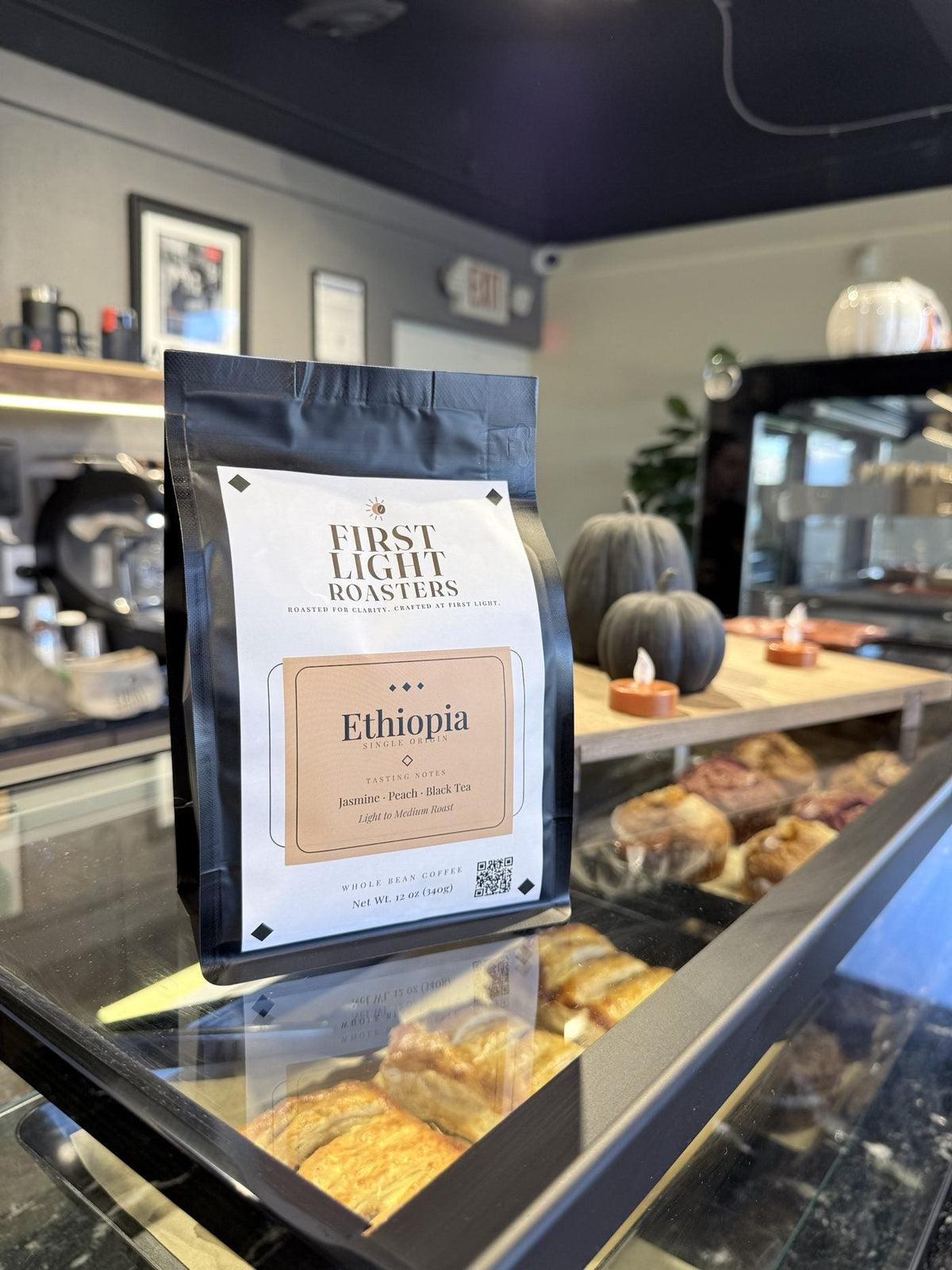
To drink it the Honduran way, put out rosquillas, the small, crunchy ring-shaped corn and cheese biscuits that are made for dunking, or a slice of semita, a soft sweet bread. The first five are in the pastry case at Detroit Halite, the cafe in front of our roastery in Livonia, if you would rather taste before you buy.
Coffee in Honduras: a short history
Coffee reached Honduras in the 1700s, but for most of the next two centuries the country was known for bananas, not coffee. Serious, widespread coffee farming only took off in the late 1900s. In 1970 the government created IHCAFE, the Honduran Coffee Institute, to support farmers with training, quality programs and help fighting leaf rust.
The change since then has been dramatic. Honduras is now among the largest arabica producers in the world and regularly trades third place with Ethiopia, according to the importer Sucafina (Sucafina, Honduras origin profile). The harvest runs from about November to April, and nearly all farms sit above 1,000 meters.
IHCAFE divides the country into six coffee regions: Copán, Opalaca, Montecillos, Comayagua, Agalta and El Paraíso, where this coffee grew. Most Honduran coffee is still grown the way Francisco grows his: on small family plots, by hand, with the same family working the same land for generations.
At home, coffee in Honduras is an everyday ritual more than a ceremony. It is the afternoon cup, served sweet, with something to dunk and someone to talk to. For decades the best Honduran coffee was blended away without a name on it. Lots like this one, sold under the farmer's own name, are how that is changing.
Frequently asked questions
Is Pacamara a type of bean or a place?
It is a variety of the arabica coffee plant, a cross of Pacas and Maragogipe first made in El Salvador in 1958. It is grown in several countries. Ours was grown in El Paraíso, Honduras.
Why is Pacamara coffee more expensive?
It is risky to grow. Pacamara is highly susceptible to coffee leaf rust and the plants are not fully uniform, so farmers plant less of it. Lots are small. This one was five sacks in total.
Does Pacamara have more caffeine because the beans are bigger?
No. Bean size does not raise caffeine. Pacamara is arabica, and its caffeine is in the normal arabica range. What changes your caffeine per cup is how much coffee you use, which is one more reason to weigh your dose.
Is Pacamara Honduras good for espresso?
We roast it light for filter brewing, and that is how it tastes best: pour-over, Chemex, AeroPress or drip. As espresso, a light roast like this tends to taste sharp.
How long does the bag stay fresh?
For the best flavor, start drinking it about a week after the roast date printed on the bag and finish it within about four weeks of opening. Keep it in its bag, sealed, in a cool, dry cupboard away from sunlight. Do not store it in the fridge.
How should I grind Pacamara?
The same as any light roast for your brew method: medium for pour-over and drip, medium-coarse for Chemex, coarse for French press. The large beans can feed slowly through some small hand grinders, so be patient, and always measure by weight, not by scoop.
First Light Roasters is co-founded by Sam Noor and Amal Almaflahi. Roasted for clarity. Crafted at first light.

Leave a comment
This site is protected by hCaptcha and the hCaptcha Privacy Policy and Terms of Service apply.