

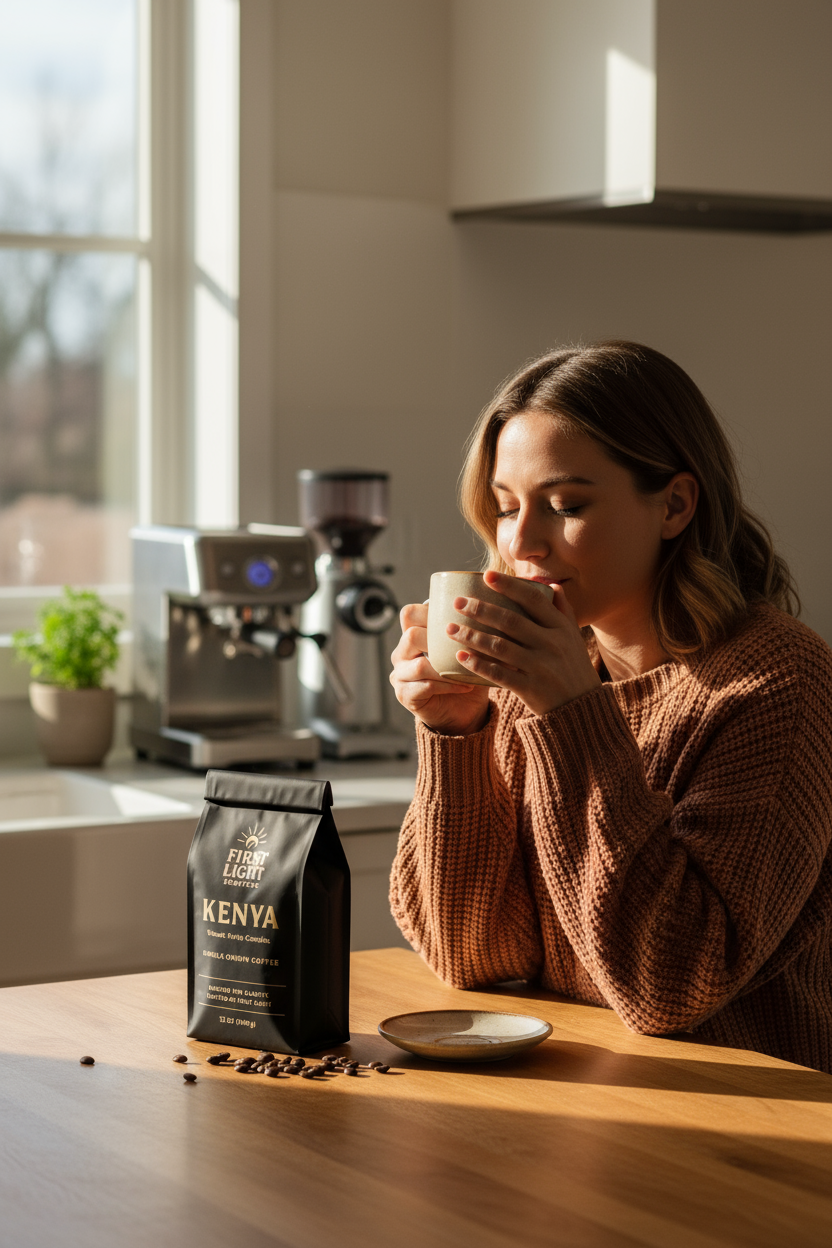
The First Light Pour-Over Protocol: 7 Variables That Separate a Good Cup from a Great One
Pour-over coffee has a reputation for being fussy, and that reputation is not entirely unearned. Done carelessly, a pour-over produces results no better than a standard drip machine. Done with attention to the variables that actually matter, it produces the most expressive, clearest, and most rewarding cup available from any home brewing method. The gap between a mediocre pour-over and a great one comes down to seven variables that most home brewers either ignore or address imprecisely.
At First Light, pour-over is the primary brewing method we recommend for our Kenya AA and all our single-origin offerings. The reasons are technical: pour-over allows the brewer to control all relevant variables precisely, and the slow, steady extraction it enables shows more clearly than any other method what the coffee is actually capable of. It is also the method where the quality difference between specialty coffee and commodity coffee is most apparent — which, for us, is a compelling business reason to teach people how to do it well.
This post walks through our pour-over protocol — the seven variables we consider non-negotiable for producing a genuinely excellent cup and explains why each variable matters, how it affects the final result, and what to do when something tastes wrong.
Variable 1: Coffee Freshness
The first variable is one most home brewers underestimate: how recently the coffee was roasted. Freshness is not a marketing concept — it is a measurable physical reality with direct cup quality consequences.
Freshly roasted coffee contains elevated levels of CO2 that off-gas over the days following roasting. During this off-gassing period, brewing too soon produces an uneven extraction: the CO2 creates a barrier between water and coffee grounds, resulting in inconsistent contact and a cup that tastes flat or underdeveloped despite technically correct brew parameters.
The optimal pour-over brewing window for First Light Kenya AA is 4 to 14 days post-roast. Before day 4, the CO2 is still too active for optimal extraction. After day 14, the volatile aromatics have begun to oxidize, and the cup starts losing complexity. Within this window, the coffee is at peak expressiveness — meaning the same grind, ratio, and pour technique that produces a mediocre result with stale coffee produces a genuinely great result with fresh coffee.
Check the roast date on your bag. If there is no roast date — only a "best by" date — that is useful information about the roaster's priorities. We always print the roast date on every First Light bag, because we believe you deserve to know exactly what you are brewing.
Variable 2: Grind Size and Consistency
Grind size is the single most impactful variable in pour-over brewing, and grind consistency — how uniform the particle size distribution is across the entire ground dose — is what determines whether grind size adjustments actually work.
For pour-over of a medium-light Kenya AA, the target grind falls between medium-coarse and medium — coarser than automatic drip, finer than French press. The exact setting will vary by grinder; the target brew time (described below) is a better guide than any specific grinder number.
Consistency matters because water flows through coffee grounds by the path of least resistance. If the grind contains a mix of large particles (which extract too little in the available time) and fine particles (which extract too much, producing bitterness), the cup will taste simultaneously under-extracted and over-extracted — sour AND bitter, flat AND harsh. This combination is a clear diagnostic indicator of grind inconsistency, not grind size error.
This is why a quality burr grinder — which shears coffee between two precision-machined burrs, producing a uniform particle size distribution — produces better pour-over results than a blade grinder, regardless of how careful you are with the blade grinder. A blade grinder does not grind; it chops, and the result is a chaotic distribution of particle sizes. The investment in a quality burr grinder is the single most impactful equipment upgrade available to a home brewer.
Variable 3: Water Quality and Temperature
Water constitutes approximately 98.5 percent of the finished cup of coffee. Its quality and temperature are therefore critical in ways that most home brewers do not fully appreciate.
On water quality: coffee extraction is primarily accomplished by the mineral ions in water , specifically calcium and magnesium — which bond to flavor compounds and carry them into solution. Distilled or filtered water (too low in minerals) extracts poorly and produces a flat, thin cup. Very hard water (too high in minerals) can over-extract bitter compounds and produce a harsh, cloudy cup. The SCA's recommended water chemistry for brewing falls between 50 and 175 ppm total dissolved solids, with a target hardness in the range of 50 to 100 ppm calcium carbonate. Filtered tap water in most US cities falls within an acceptable range; very hard tap water or distilled water does not.
On temperature: the Specialty Coffee Association's standard brewing temperature recommendation is 90.5 to 96°C (195 to 205°F). For our Kenya AA, we use 93°C. Lower temperatures result in under-extraction — the water does not have enough energy to dissolve the full range of flavor compounds, and the cup tastes sour, thin, and incomplete. Higher temperatures can over-extract bitter compounds, particularly in medium-light roasts where certain bitter precursors are more present. 93°C is our tested sweet spot for this specific coffee.
A gooseneck kettle with a built-in thermometer — or a variable-temperature electric kettle — is the best investment after a good grinder. The ability to consistently hit 93°C without guessing produces results that are consistently better than anything achievable by boiling and waiting a variable amount of time.
Variable 4: Coffee-to-Water Ratio
Ratio determines the strength and concentration of your brew. The SCA's golden ratio recommendation is 55 grams of coffee per liter of water, which translates to approximately 1:18 coffee-to-water by weight. For our Kenya AA, we use a slightly stronger ratio of 1:15 — 20 grams of coffee to 300 grams of water — because we find it optimizes the balance between the coffee's natural brightness and its body.
Measuring both coffee and water by weight (not by volume) is important for consistency. Coffee varies in density and packs differently depending on the grind size; tablespoon measurements are not reliable. Water varies similarly. A digital kitchen scale is cheap, precise, and indispensable for pour-over brewing if you want repeatable results.
If you prefer a lighter, more delicate cup, you can move toward 1:16 or 1:17. If you want more intensity and body, try 1:14. But adjust the ratio as a deliberate choice after you have brewed the coffee correctly at 1:15, not as a workaround for other brewing problems. Adjusting the ratio to fix a sour cup (typically a grind or temperature issue) or a bitter cup (typically a grind or over-extraction issue) is a common mistake that produces a cup that tastes less bad but not actually better.
Variable 5: Bloom and Pour Technique
The bloom pour — the initial small pour of approximately twice the weight of the coffee dose, held for 30 to 45 seconds before the main pour begins — serves a specific purpose. It pre-wets the grounds and allows the accumulated CO2 in the coffee to off-gas rapidly before extraction begins in earnest. When you pour the bloom water and see the coffee bed swell and bubble, you are watching CO2 escape. This off-gassing, if not managed, interferes with even water-to-coffee contact during the main pour.
After the bloom, the main pour should proceed in steady, slow circles or a controlled center pour, keeping the water level consistent above the coffee bed. The goal is to maintain even saturation across the entire coffee bed without disturbing the grounds too aggressively or creating channels in the bed where water moves faster.
Pouring too fast creates turbulence and can compact the coffee bed unevenly, disrupting flow. Pouring too slowly allows the water level to drop and the extraction rate to become uneven between the top and bottom of the bed. For a 20g dose with a 300g water total, we aim to complete the pour by 2:15 to 2:30, with total brew time (including drip-through) between 3:00 and 3:30.
Variables 6 and 7: Brew Time and Temperature Stability
Total brew time — from first bloom water contact to the last drip — is the primary diagnostic for whether your grind and ratio are working together correctly. For our 1:15 ratio with 20g of Kenya AA, target total brew time is 3:00 to 3:30.
If your brew runs faster than 3:00, the grind is too coarse — water is moving through too quickly for complete extraction. The cup will taste sour, thin, and incomplete. Grind finer.
If your brew runs slower than 3:30 or stalls significantly, the grind is too fine — the coffee bed has become so dense that water moves through slowly, leading to over-extraction. The cup will taste bitter and harsh. Grind coarser.
Brew time is the feedback mechanism that makes grind adjustment reliable. Every time you change your grind size, measure the new brew time and compare it to the target. This creates a feedback loop that prevents you from making changes without knowing whether they moved you toward or away from the target.
Temperature stability — maintaining 93°C throughout the pour rather than starting there and letting the kettle cool — matters more than most home brewers realize. A gooseneck kettle sitting on the counter loses heat at approximately 1°C per minute. For a pour that takes 2 to 3 minutes, this means your water temperature may drop by 2 to 3 degrees during the brew. This is usually acceptable, but keeping the kettle on a temperature-stable base (a low-heat burner or an insulated trivet) helps maintain more consistent extraction.
Seven variables, all manageable, all consequential. The first time you nail all seven together with a bag of fresh Kenya AA, you will understand immediately why pour-over has become the signature brew method of the specialty coffee world. We are here to help you get there.


Leave a comment
This site is protected by hCaptcha and the hCaptcha Privacy Policy and Terms of Service apply.