


The Maillard Reaction, First Crack, and Development Time: A Deep Dive
Specialty coffee roasting has developed its own technical vocabulary over the past two decades — terms like rate of rise, development time ratio, turning point, and Maillard browning have moved from roastery jargon to online forums to, increasingly, the conversations of well-informed home brewers and coffee enthusiasts. These terms describe real phenomena with real flavor consequences, and understanding them gives you a framework for thinking about why coffees taste the way they do and what a roaster is actually trying to accomplish.
At First Light Roasters, we believe that informed customers are better customers — not in the sales sense, but in the experiential sense. When you understand why we make the roast decisions we do, you can make better brew decisions at home, choose coffees that align with what you actually want in the cup, and engage with specialty coffee as the craft it genuinely is rather than as a premium product category defined by marketing language.
This post is a deep dive into three of the most important concepts in specialty roasting: the Maillard reaction, first crack, and development time. These three phenomena govern most of what happens in the roast, and together they determine the flavor profile of every specialty coffee you have ever tasted.
The Maillard Reaction: Coffee's Core Chemistry
The Maillard reaction is the chemical process responsible for the brown color, complex aromas, and most of the flavor compounds in roasted coffee. It was first described by French chemist Louis-Camille Maillard in 1912 and occurs in any food system where amino acids and reducing sugars are exposed to heat above approximately 140°C. In coffee, these conditions are met during the browning phase of roasting — roughly between 150 and 200°C in the bean interior, though the sequence of reactions continues and evolves throughout the entire development phase.
The Maillard reaction is not a single reaction but a cascade of hundreds of simultaneous and sequential reactions, each producing different compounds. The specific pathways that dominate depend on which amino acids are present in the bean (which varies by variety and origin), which reducing sugars are available (which varies by ripeness and processing), and the temperature and time conditions of the roast. This is why coffees from different origins can taste so different even when roasted to identical color levels: the Maillard reaction is working with different chemical inputs.
Furans, aldehydes, and ketones are among the most important Maillard products in coffee. Furans contribute caramel, nutty, and sweet-roasted notes. Specific aldehydes — particularly furfural — contribute a range of fruity and floral aromas. Pyrazines, another class of Maillard products, are responsible for the roasted, earthy, and nutty characteristics that increase as roast progresses. At high development levels, pyrazines become dominant and suppress the more delicate furan and aldehyde aromas — which is part of why dark roasts taste primarily of "roast" rather than of the origin's specific character.
Caramelization: Related But Distinct
Caramelization is often confused with the Maillard reaction, and the two processes do occur in overlapping temperature ranges during roasting. However, they are chemically distinct. The Maillard reaction requires both amino acids and sugars, and produces primarily aromatic compounds. Caramelization involves only sugars — sucrose, glucose, and fructose breaking down and reforming into new compounds under heat.
In coffee, caramelization of sucrose begins around 170°C and progresses through the roast. Early caramelization produces the sweet, toffee-like compounds associated with medium roast sweetness. Extended caramelization at higher temperatures converts those sweet compounds into bitter caramel, and eventually into the acrid, bitter notes associated with very dark roasts. This is why the "sweetness window" in coffee roasting is a real and bounded phenomenon — too little development and you don't get the caramelization; too much and you burn past it into bitterness.
Managing the rate and extent of caramelization alongside the Maillard reaction is one of the core challenges of specialty roasting. The roaster is trying to maximize both processes in their optimal ranges simultaneously and those ranges overlap but do not perfectly coincide. Different roast profiles make different tradeoffs between Maillard-derived aromatic complexity and caramelization-derived sweetness, which is one reason that two roasters working with the same green coffee can produce cups that taste quite different.
First Crack: The Physical Turning Point
First crack is the most dramatic physical event in the roasting process and one of the most important timing markers for the roaster. At approximately 196 to 205°C, CO2 and steam that have been accumulating inside the bean's cellular structure reach a pressure that exceeds the structural integrity of the cell walls. The cells rupture rapidly and audibly, producing a series of sharp pops — the "crack" — that is audible to anyone in the roastery.
First crack is not instantaneous. It typically takes one to three minutes for all beans in a batch to crack, beginning with the densest beans and progressing through the rest. The roaster listens not just for the first pops but for the character and pace of the crack — a rolling, sustained series of pops indicates even development across the batch; sporadic, uneven cracking may indicate inconsistencies in green density or moisture content.
The physical changes during first crack are dramatic: the bean expands by 50 to 80 percent in volume, its density decreases significantly, and the surface transitions from matte to slightly shiny as internal cell structure reorganizes. The color shifts from light tan to medium brown. The aroma in the roastery changes from baked grain to something recognizable and inviting — the beginning of what we actually associate with coffee aroma.
From the flavor standpoint, beans at first crack are drinkable but not optimal. The Maillard reaction has been progressing, but development is incomplete. The goal is to continue past first crack into the development phase while carefully managing how far the development proceeds.
Development Time Ratio: The Roaster's Most Critical Number
Development time ratio (DTR) describes the proportion of total roast time spent after first crack begins. If a roast takes 10 minutes total and first crack begins at minute 8, the development time is 2 minutes and the DTR is 20 percent. This number — expressed as a percentage rather than an absolute time — normalizes for differences in total roast time and makes profiles comparable across different batch sizes and roasters.
DTR is perhaps the single number most closely watched by modern specialty roasters, and for good reason: it determines how much heat-driven development the beans receive after the structure-opening event of first crack. Too low a DTR (under 15 to 18 percent for most coffees) and the beans are underdeveloped — they may have light color on the outside from Maillard browning while the inside remains raw and undeveloped. This produces the "baked" or "roasty" character some light roasts have, where the aroma is interesting but the cup tastes flat, straw-like, or astringent.
Too high a DTR for a given coffee or roast level — particularly combined with high temperatures in the development phase — pushes the roast toward darker characteristics: reduced acidity, increased bitterness, and the loss of the volatile aromatic compounds that define specialty coffee complexity. For washed Kenyan coffee specifically, DTR beyond 25 percent begins to meaningfully reduce the citric and malic acid concentrations that define the origin's brightness.
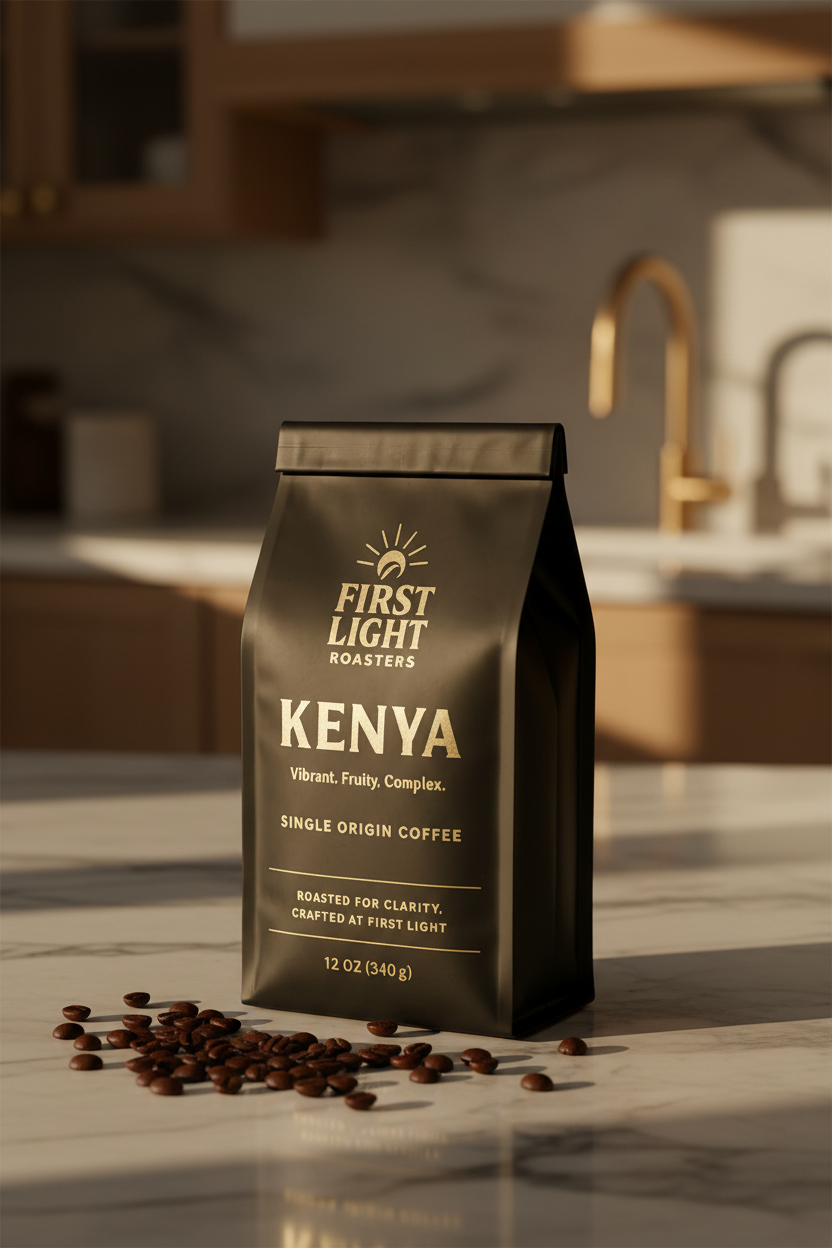
For our Kenya AA at First Light, we target a DTR of 20 to 22 percent — chosen through systematic testing to maximize the balance between developed sweetness (which requires adequate Maillard browning through the development phase) and preserved brightness (which requires protecting the organic acids from excessive heat). Every production batch is timed to within 30 seconds of this target.
What This Means for the Cup You Drink
The Maillard reaction, first crack, and development time are not abstract chemistry — they are the mechanisms by which the roaster translates green coffee potential into cup quality. Every flavor note you taste in a specialty coffee is the product of these processes, either produced by them or preserved by careful management of their extent.
When you taste the blackcurrant and clean citric brightness in our Kenya AA, you are tasting Maillard-derived aromatic compounds developed through a carefully controlled browning phase, combined with organic acids preserved by precise termination of the roast at the right development point. When you taste the brown sugar and dark chocolate in the mid-palate, you are tasting caramelization products from the appropriate development window. The long, clean finish is the result of minimal over-roasting, which would have produced the bitter compounds that truncate the palate experience.
Understanding these processes doesn't make the coffee taste better — the coffee tastes what it tastes regardless of your knowledge of the chemistry. But it gives you a framework for appreciating what a skilled roaster is actually doing, and for making sense of why coffees taste the way they do. That understanding, we believe, enriches the entire experience.
→ See Our Approach to Roasting →
The chemistry of roasting is profound and fascinating, and it has practical consequences for every cup you brew. At First Light, we take it seriously — not because we want to be academic about coffee, but because understanding the science is how we reliably deliver the cup quality you deserve.


Leave a comment
This site is protected by hCaptcha and the hCaptcha Privacy Policy and Terms of Service apply.