Light vs. Medium vs. Dark Roast: Which Brings Out Kenya's Best?
The roast level question is the most common one specialty coffee drinkers ask, and it is also one of the most misunderstood. Light roast, medium roast, dark roast — these terms appear on every bag of coffee ever sold, but the industry has no standardized definition for any of them. A "medium" roast at one roastery may be what another calls "medium-dark," and a "light roast" at a specialty shop may be considerably lighter than what a grocery store chain sells under the same label.
More importantly for our purposes at First Light: roast level is not a universal preference question. It is a coffee-specific question. The same bean will produce dramatically different cups at different roast levels, and the "best" roast level for a given coffee is determined by the coffee's origin character, processing method, variety, and intended brewing application — not by the drinker's prior experience with grocery store roasts.
For Kenyan coffee specifically, the roast level decision has more flavor consequences than almost any other origin. Kenya's high acidity, complex organic acid structure, and pronounced fruit character respond sharply to heat at every stage of development. Understanding how roast level affects Kenyan coffee will help you choose the right bag for your preferences and equipment, and appreciate what goes into the decision when a roaster like First Light selects a development level for their Kenya AA.
What Roast Level Actually Changes in the Bean
Roast level is a shorthand for describing how far through the roasting process a bean has been developed — essentially, how much heat has been applied over time and how many of the bean's chemical compounds have been transformed versus preserved. Different compounds react differently to heat, and at different rates, which is why roast level has such dramatic and specific effects on flavor.
The organic acids that give Kenyan coffee its signature brightness — citric acid, malic acid, phosphoric acid — are volatile. They are present in the green bean, develop further during the Maillard phase, and then begin to degrade under continued heat application past certain temperature thresholds. A lighter roast preserves these acids; a darker roast converts them into less acidic compounds or destroys them entirely.
Conversely, the heavy, bitter compounds associated with darker roasting — particularly kahweol and other diterpene derivatives, and degradation products of chlorogenic acids — are produced only at higher temperatures. They do not exist in light roast coffee; they develop as roast progresses. This is why a dark roast tastes fundamentally different from a light roast of the same bean: they are, in a meaningful chemical sense, different products, not merely the same product delivered at different intensities.
Sugar caramelization also plays a role that is often overlooked. Sucrose begins caramelizing around 170°C and continues through the roast. Early caramelization contributes sweetness and brown-sugar notes. Extended caramelization at higher temperatures converts sweetness into bitter caramel and then into ash-like bitterness. The "sweetness window" for most coffees is in the medium-light to medium range — wide enough for flexibility but bounded on both ends.
Light Roast Kenya: Bright, Intense, Demanding
A light roast Kenya AA — what a specialty roaster would call City or light City, dropped shortly after first crack completes with a DTR below 20 percent — is an extraordinary and challenging cup. The brightness is almost electric. Citric acid is at its most prominent. The fruit notes are vivid — blackcurrant, blood orange, passion fruit and the body is lighter and more tea-like than at higher development levels.
The challenge with light roast Kenya is that it demands precision from every part of the brew chain. The high acidity and low body are unforgiving of grind inconsistency, improper water temperature, or imprecise ratios. Brewed incorrectly, a light roast Kenya reads as sour and thin — not the exciting brightness its advocates describe, but an uncomfortable tartness that makes you reach for sugar. Brewed correctly, with a precise grind, water at exactly 93 to 95°C, and a controlled pour-over, it is one of the most interesting cups specialty coffee can produce.
Light roast is also more origin-expressive: it shows the terroir, the variety, and the processing most clearly because it has added the fewest roast-derived compounds. If you want to taste the difference between a Nyeri and a Kirinyaga, light roast is where that difference shows most distinctly. This is why competitive cupping — SCA cupping protocol for scoring lots — uses a light-medium roast standard. It is the most informative roast for evaluating what the coffee actually is.
Medium-Light Roast Kenya: The First Light Standard
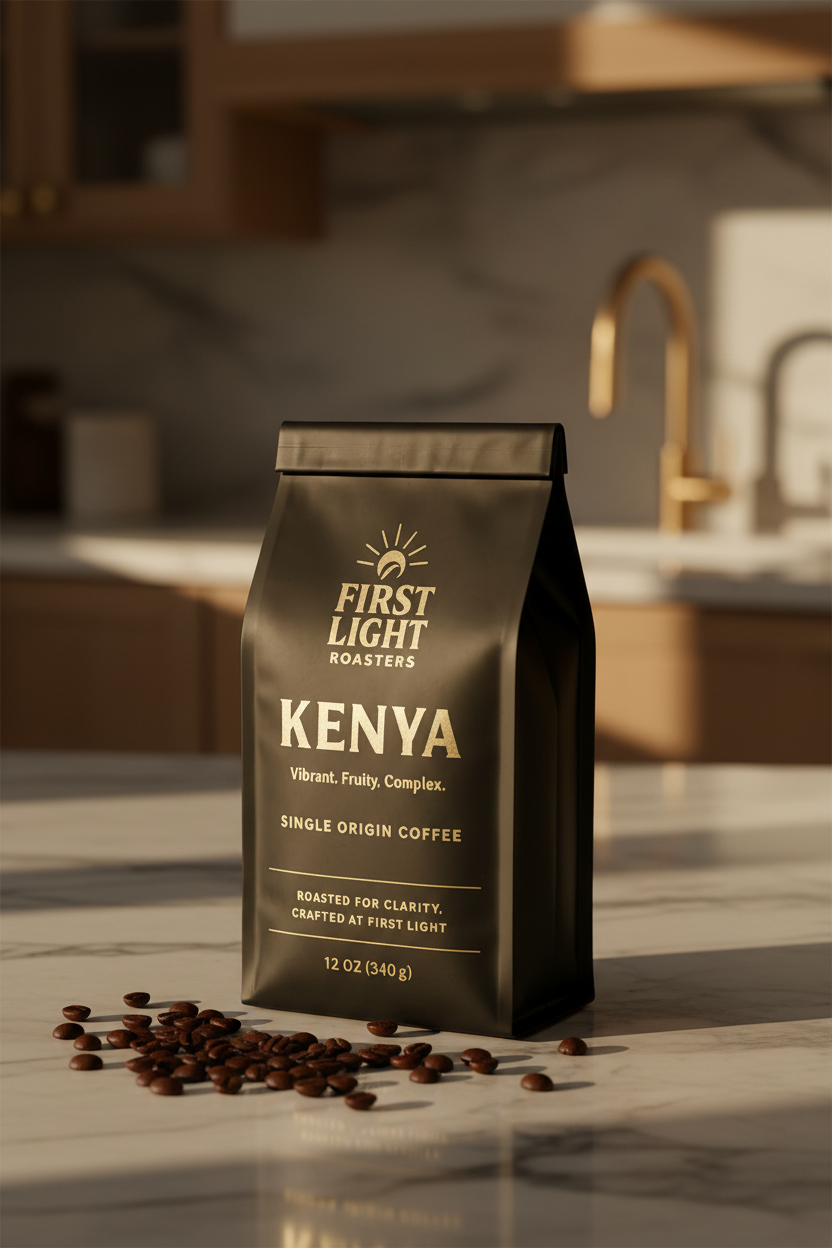
Our Kenya AA at First Light is roasted to what we call a medium-light profile , specifically City+ to Full City, an Agtron reading of approximately 58 to 62. This is the sweet spot for Kenyan coffee in our view, and we have arrived at it through years of comparative testing rather than aesthetic preference.
At this development level, the organic acids are fully expressed but balanced by developed sweetness — the caramelization and Maillard browning have generated enough brown sugar and chocolate compounds to support the brightness rather than leave it exposed and harsh. Body is medium, with enough presence to satisfy without obscuring the origin's clarity. The finish is clean and long, with the characteristic Kenyan acidity lingering pleasantly rather than dominating.
This roast level is also more forgiving in the home brewing environment. It rewards careful pour-over technique but does not punish minor variations the way a very light roast does. The development window is slightly wider, which means the difference between a good brew and a great brew is smaller — making it a better choice for home brewers who are still dialing in their technique while also wanting to experience what Kenya can genuinely do.
We have also found that our medium-light Kenya AA performs remarkably well as an iced pour-over. The acidity that reads as bright and structured hot transforms into something almost effervescent and refreshing over ice — one of the most convincing arguments we know for the superiority of pour-over iced coffee over cold brew for high-quality single-origin coffees.
Medium-Dark and Dark Roast Kenya: What Gets Lost
We do not roast Kenya dark at First Light, and the reason is not aesthetic snobbery. It is that Kenya's defining flavor compounds — the acids, the fruit, the clarity — are destroyed by the heat required to reach a dark roast level. Taking a Kenya AA to a Full City+ or Vienna roast is, from our perspective, the equivalent of buying fresh produce and cooking it until the nutrients are gone: technically still food, but having sacrificed the qualities that justified the premium in the first place.
At medium-dark and dark roast levels, Kenyan coffee tastes like a generic roast. The fruit and brightness have been cooked out. The body has increased and the acidity has flattened. You are left with bitter chocolate, roasted grain, and smoke — flavors that have nothing to do with the origin and could have come from any coffee grown anywhere. The premium you paid for traceable, double-washed, high-altitude Kenyan coffee expresses itself as zero additional value in the cup, because the compounds that created that value have been destroyed.
We recognize that dark roast preferences are real and valid. Some people genuinely prefer lower-acid, heavier-bodied coffee, and there is nothing wrong with that. But for those preferences, we would recommend different origins — Brazilian naturals, Sumatran wet-hulled coffees, full-body blends — that thrive at higher development levels. Kenya is not the origin to choose if you want a dark roast, and we believe being honest about that serves our customers better than pretending otherwise.
Choosing the Right Roast for Your Brewing Method
Beyond origin character, brewing method is the other critical variable in roast level selection. Different brew methods extract differently — some are more forgiving of high acidity, others better suited to heavier body and lower brightness.
Pour-over methods (V60, Chemex, Kalita Wave) are best suited to light and medium-light roasts. The slow, controlled extraction emphasizes clarity and separation of flavor notes. Kenya at medium-light through pour-over is exactly where First Light lives.
Automatic drip brewers vary widely, but most standard home drip machines extract at slightly lower temperatures and less precisely than pour-over. A medium-light Kenya still works beautifully in a well-calibrated drip machine, though the acidity may read as slightly more prominent. A medium roast may suit those who find the light version too bright for their morning routine through a standard machine.
Espresso and Kenya is a more complex conversation that we address in a separate post. The short version: Kenya AA can produce extraordinary espresso, but it requires a different approach than standard espresso roasts, and it is not a beginner's choice. For most home espresso setups, our medium-light filter roast will produce an unusual but interesting espresso — worth experimenting with if you are curious.
The right roast for Kenya is the one that preserves what Kenya actually offers: brightness, fruit, clarity, and complexity. At First Light, that means medium-light, consistently. Every bag we roast reflects that conviction and we stand behind every cup.


Leave a comment
This site is protected by hCaptcha and the hCaptcha Privacy Policy and Terms of Service apply.