

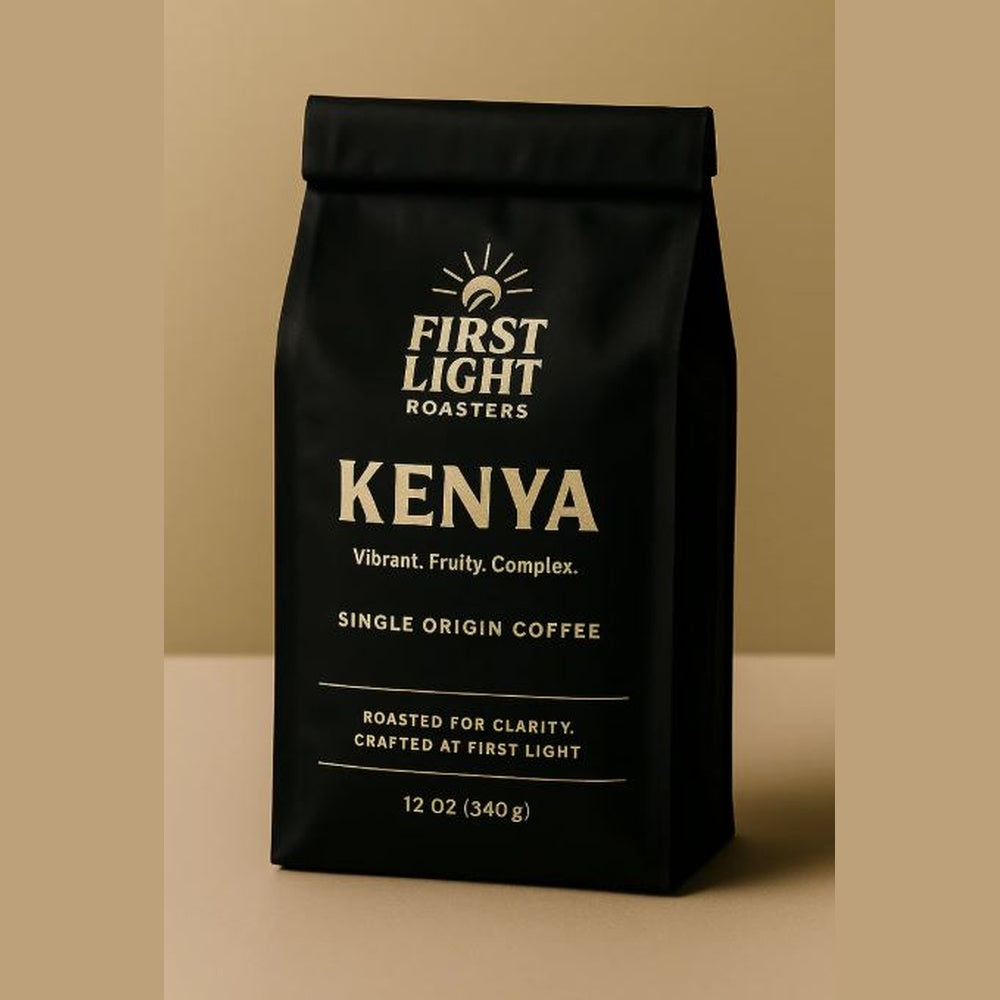
How We Developed Our Kenyan Roast Profile at First Light
Every coffee on the First Light menu has a roast profile behind it — a documented, repeatable sequence of temperatures, rates of rise, and timing decisions that we developed through systematic testing and refined through hundreds of batches. The profile is not guesswork, and it is not intuition alone. It is the result of a development process that we apply to every new coffee we bring into the lineup, and that we return to whenever we need to revisit a roast that is no longer performing at its best.
Roast profile development is one of the least visible parts of what a specialty roaster does, and one of the most important. The profile is where everything we know about a coffee's origin, processing, variety, moisture content, and density gets translated into a specific sequence of heat application decisions. Get the profile right and the cup expresses everything the coffee is capable of. Get it wrong — even slightly and the same green coffee that could have been extraordinary produces something flat, harsh, or simply less than it should have been.
For our Kenya AA specifically, the profile development process was extensive. We spent close to three months with our initial green sample before we felt we had a profile worthy of a public release. What follows is a look at how that process works — the variables we test, the mistakes we make deliberately, the data we collect, and the methodology we use to arrive at a profile that is both excellent and reproducible.
Starting With the Green Coffee
Roast profile development always begins before a single bean goes into the drum. When a new lot arrives at First Light — whether it is a Kenya AA from a new washing station or an existing supply partner from a new season — we begin by analyzing the green coffee itself.
Physical inspection tells us about density, moisture content, and screen size consistency. Dense, high-altitude beans like Kenya AA require different heat application strategies than lower-density origins: they take longer to absorb heat at the beginning of the roast and release more energy during first crack. Screen size consistency tells us whether we are working with a uniform batch that will roast evenly or a mixed batch with multiple size distributions that will require compromises in the profile.
Moisture content measurement is critical. Green coffee with higher moisture content requires a longer, more aggressive drying phase before Maillard reactions can begin in earnest. Coffee that is too dry roasts faster and is more prone to scorching in the early phases. Our target range for incoming green coffee is 10.5 to 11.5 percent moisture, and we track this for every lot. Lots outside this range trigger adjustments to our standard charge temperature before any developmental roasting begins.
We also review cupping notes from origin — either our own from sample cupping before purchase or from trusted supply partners. Understanding what flavor notes exist in the green coffee gives us targets to chase during profile development. If the origin sample showed strong blackcurrant and passion fruit, our roast profile needs to preserve the acids that express those flavors. If the sample showed structural sweetness but muted fruit, we may push development slightly further to unlock caramelization.
The First Roast: Intentional Mistakes
Our profile development process begins with what we call intentional mistake roasts. Rather than trying to get close to optimal on the first attempt, we deliberately roast the same coffee at opposite extremes: one batch very light (underdeveloped, dropped just after first crack begins), one batch very dark (pushed well past our target into territory we know we will not use commercially).
These extremes tell us the full flavor range available in the coffee. The underdeveloped roast shows us the raw, acidic baseline — every organic acid and grain note present before Maillard browning adds complexity and sweetness. The overdeveloped roast shows us what gets destroyed by too much heat: the loss of brightness, the emergence of roast-derived bitterness, the flattening of fruit into chocolate and ash.
By cupping these extremes side by side with a target medium-light reference roast, we triangulate where in the development spectrum the coffee's most interesting attributes live. For our Kenya AA, the extreme light roast showed that the blackcurrant and citric acidity were present and vivid but needed the sweetness contribution of a slightly longer development to be balanced. The dark roast showed that past a certain point — we identified this as roughly Agtron 54 on the whole bean — the fruit collapsed entirely. Our target was clearly somewhere in the range between 56 and 64 Agtron. From there, we began systematic iteration.
Variables We Test Systematically
Once we have established the flavor boundaries of a new coffee, we test specific roast variables systematically — changing one variable per roast and cupping the results against our previous best. This is slower and more resource-intensive than adjusting multiple variables at once, but it is the only way to isolate the contribution of each decision.
The variables we test for a new Kenya lot include: charge temperature (how hot the drum is when beans load), drying phase rate of rise (how aggressively we push through the drying stage), Maillard phase rate of rise (the more subtle heat application through browning), the point at which we transition to development phase management (how we respond to first crack), and the drop temperature.
For our current Kenya AA, the profile that emerged from this process involves a charge temperature specific to the batch size and seasonal humidity of our roastery, a deliberately flattened rate of rise through the Maillard phase (which we achieved by reducing the gas application at around five minutes), and a development time ratio of 20 to 22 percent. The drop is at a drum temperature that corresponds to a whole-bean Agtron of approximately 60 — our target center point within the 58 to 62 range.
Every test roast is cupped at 24 hours, 72 hours, and 7 days post-roast. The 24-hour cup tells us about initial CO2 presence and raw roast character. The 72-hour cup is our primary evaluation window — it gives us the clearest picture of the profile's flavor contribution. The 7-day cup tells us about longevity: how well the profile holds up as the coffee ages.
Calibration and Repeatability
Developing a great profile is only half of what profile development requires. The other half is making the profile repeatable — ensuring that the Kenya AA you buy from us in March tastes substantially the same as the bag you buy in November, roasted from potentially different green lot within the same annual supply relationship.
Repeatability requires calibration. We run calibration roasts at the beginning of each production week, comparing the output against our archived reference cups from the original profile development. If the calibration roast shows drift — even small changes in color, timing, or cup character — we investigate the variable that has changed and adjust accordingly. Common culprits include seasonal humidity changes in the roastery, natural moisture variation between green lots, and minor wear on the roasting equipment that changes heat transfer efficiency.
We also cup every production batch against a blind reference before releasing any coffee for sale. A batch that fails the reference cup standard is not sold as our standard offering. We may reroast it if the issue is correctable, or we may blend it into a different product if the character has drifted in a useful direction. This quality gate adds cost and occasionally reduces our yield, but it is non-negotiable. The profile exists to serve the cup. The cup is what we are ultimately responsible for.
What Profile Development Means for You
The detail we invest in profile development is not visible in the cup unless it's done wrong. When the profile is right, you simply taste a great cup of coffee — the blackcurrant, the brightness, the long finish. The weeks of testing, the systematic variable changes, the comparative cuppings, the calibration roasts — none of that is perceptible as effort. It is perceptible as quality.
This is the nature of craft at the technical level: the work is most present when it is absent from the result. A great roast profile is indistinguishable from the coffee itself. It is transparent — a medium through which the origin expresses itself rather than an imposition on top of it.
For you as a buyer and brewer, what profile development means practically is this: when you open a bag of First Light Kenya AA, you are receiving not just a roasted coffee but a specific technical decision about how that origin should taste. That decision was made deliberately, tested rigorously, and documented precisely. We believe you deserve that level of care, and we put it into every bag.
→ Order Kenya AA →
Roast profile development is invisible work that produces visible results. At First Light, it is how we honor the origins we source and the customers we serve. The Kenya AA in your cup is the product of that work and it will always be.

Leave a comment
This site is protected by hCaptcha and the hCaptcha Privacy Policy and Terms of Service apply.