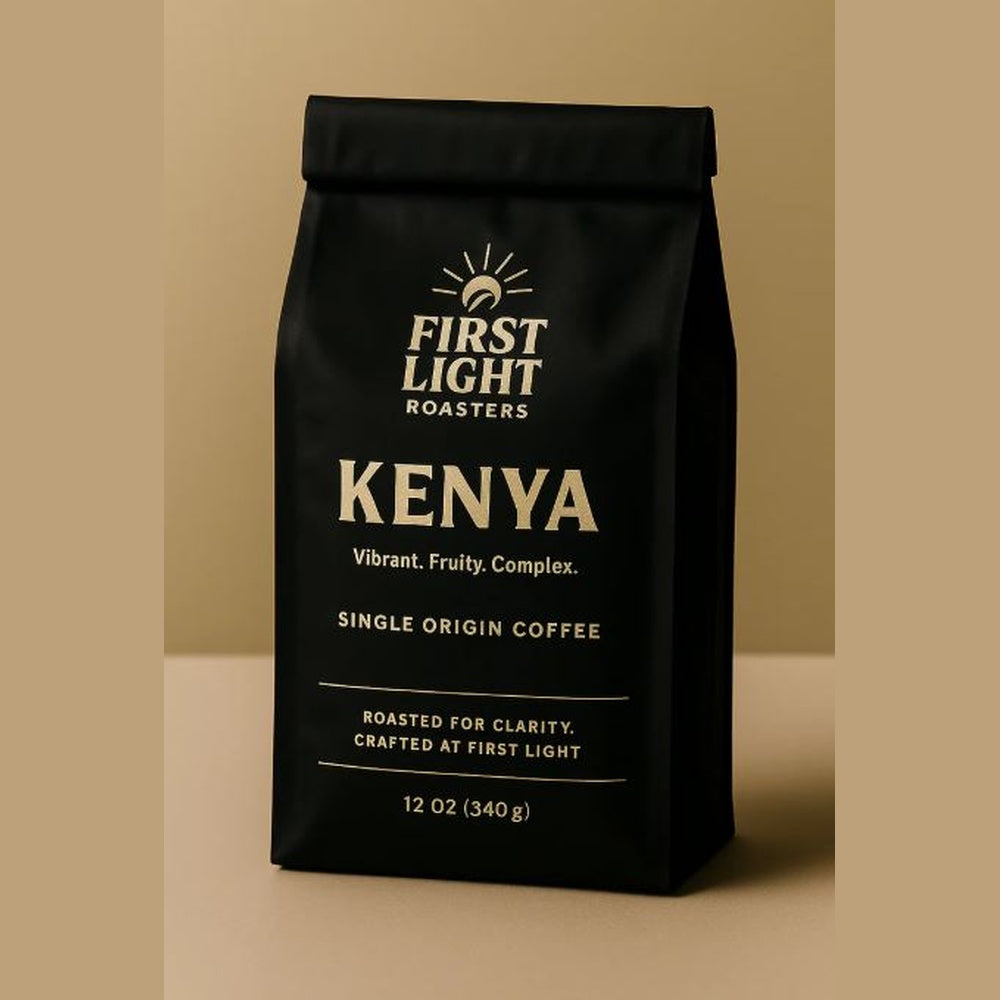
Most conversations about improving coffee at home focus on the coffee itself — buying better beans, sourcing from specialty roasters, learning about origins and processing. This is understandable and not wrong. The coffee in the bag is the primary ingredient. But it is also the case that even the finest specialty coffee in the world, including the best Kenya AA First Light produces, cannot overcome fundamental limitations in the brew environment. And the three most impactful limitations home brewers face have nothing to do with the coffee at all.
Water quality, grind consistency, and brewing temperature are the three variables that most reliably separate consistently excellent home coffee from consistently mediocre home coffee. They are also the three variables most frequently overlooked, dismissed as marginal, or addressed with the wrong tools. This post addresses each one directly: what it is, why it matters, how to diagnose whether it is your limiting variable, and what to do about it.
If you have been buying good coffee and still finding that your home brew doesn't match what you taste at a quality coffee bar, the issue is almost certainly one of these three variables — not the coffee. And all three are solvable.
Water Quality: The Most Overlooked Variable
Water constitutes approximately 98 to 98.5 percent of your finished cup of coffee. Everything else — the coffee's origin, variety, processing, roast profile, grind size, and brew technique — expresses itself through and via the water. It follows mathematically and practically that water quality has a larger impact on cup quality than almost any other variable.
The specific property of water that matters most for coffee extraction is its mineral content — particularly calcium and magnesium ions. These positively charged mineral ions interact electrostatically with the negatively charged polyphenols, acids, and aromatic compounds in coffee grounds, bonding to them and pulling them into solution. Without adequate mineral content, this bonding process is inefficient: the water "can't grab" flavor compounds effectively, and the result is a flat, thin, under-extracted cup even when brew time, temperature, and grind are all correct.
The Specialty Coffee Association (SCA) recommends a total dissolved solids (TDS) range of 75 to 250 ppm for brewing water, with a target of approximately 150 ppm. Extremely soft water (below 50 ppm, typical of distilled water or some heavily filtered water) extracts poorly and produces muted, lifeless cups. Very hard water (above 250 ppm, common in many municipal water supplies) can over-extract certain compounds and leave mineral deposits in your equipment that degrade performance over time.
For most US cities, lightly filtered tap water falls within an acceptable range for coffee brewing — the filtration removes chlorine (which interferes with delicate aromas) while retaining the minerals that drive extraction. Heavily filtered or reverse osmosis water needs mineral supplementation. If you consistently find that your coffee tastes flat and thin despite correct parameters, water is the most likely cause.
Testing and Improving Your Water
Testing your water quality for coffee brewing purposes is simpler than most people expect. Inexpensive TDS meters are widely available online for under twenty dollars and provide an instant readout of your water's dissolved solids content. A reading between 75 and 200 ppm is suitable for coffee brewing. Below 50 ppm (typically distilled or heavily filtered water), adding a small amount of mineral supplementation will dramatically improve extraction. Above 300 ppm, you may benefit from diluting with filtered water or installing a partial filtration system.
For those who want to go further, specialty brewing water products , specifically formulated mineral blends from companies like Third Wave Water — are available in small packets that turn distilled water into precisely calibrated brewing water with optimal mineral profiles for coffee. These are not necessary for most home brewers but can be revealing as an experiment: brewing the same coffee with tap water, filtered water, and mineral-supplemented distilled water back to back demonstrates concretely how much water chemistry affects the cup.
The simplest practical recommendation for most home brewers: use cold, filtered tap water (through a standard pitcher filter or under-sink filter), allow it to reach room temperature briefly to off-gas any residual chlorine, and heat it to your target temperature. This will produce water that is suitable for high-quality coffee brewing in virtually all US municipal water systems without any additional investment or complexity.
Grind Consistency: Why Your Grinder Matters More Than Your Brewer
The grinder is the most impactful piece of equipment in your coffee brewing setup — more impactful than the brewer, the kettle, or any other component. This is a claim that surprises many home brewers who have invested in premium brewers while continuing to use blade grinders or low-quality burr grinders, and it is a claim we make with confidence based on extensive comparative testing.
Here is why: coffee extraction relies on water moving through coffee grounds of a specific and uniform particle size. The extraction time, flavor balance, and consistency of your cup are all determined by how uniformly sized those particles are. A blade grinder — which chops coffee randomly using a spinning blade — produces a highly variable distribution of particle sizes, from fine powder to coarse chunks, in every batch. The fine particles over-extract quickly, producing bitterness. The coarse chunks under-extract, producing sourness and flatness. The resulting cup tastes like a simultaneous combination of both problems — which is exactly what it is.
A quality burr grinder — which shears coffee between two precision-machined burrs at a specific distance — produces a narrow, consistent particle size distribution. The narrow distribution means all particles extract at approximately the same rate, and the grind size setting can be used as a reliable lever for controlling extraction. When you adjust a burr grinder, the entire distribution shifts predictably. When you adjust a blade grinder by running it longer, you create more powder without meaningfully changing the coarse particles.
The minimum investment for a burr grinder that produces genuinely consistent results for pour-over brewing is approximately sixty to eighty dollars for a hand grinder (the Comandante and the 1Zpresso series are well-regarded) or one hundred fifty to two hundred dollars for an entry-level electric burr grinder. The improvement in cup quality at this investment level is dramatic and immediately perceptible.
Brewing Temperature: Precision Matters
Water temperature at the moment of coffee contact determines extraction rate: higher temperatures extract faster and more completely; lower temperatures extract slower and less completely. The SCA's recommended brewing temperature range for most coffees is 90.5 to 96°C (195 to 205°F), with most specialty roasters recommending within this range based on roast level and origin character.
For First Light Kenya AA at medium-light roast, we recommend 93°C. At this temperature, the extraction rate is fast enough to dissolve the full range of flavor compounds — including the body compounds and sweetness that require adequate heat to extract — while being cool enough to avoid over-extracting the bitter compounds present at higher temperatures.
The challenge for most home brewers is achieving and maintaining a precise temperature without purpose-built equipment. Boiling water from a standard kettle sits at 100°C and needs to cool before use. The traditional guidance of "bring to boil and wait 30 seconds" produces water at approximately 94 to 96°C — within range, but varying based on ambient temperature and how long you actually waited. This introduces unnecessary variability.
A variable-temperature electric kettle with a 1°C precision setting (available for sixty to one hundred dollars) eliminates this variability entirely. Set it to 93°C, and it heats to exactly that temperature and holds it. The consistency this produces in your daily cup is real and noticeable — particularly for a brightness-sensitive coffee like Kenya AA, where a 3°C temperature difference can meaningfully shift the acidity from balanced and bright to sharp and aggressive.
Diagnosing Your Brew Problems
With these three variables in mind, here is a diagnostic framework for the most common pour-over problems home brewers encounter.
If your coffee tastes flat, thin, and lifeless despite correct brew time and ratio: suspect water quality first. Test your TDS. If it is below 75 ppm, supplement with minerals or switch to lightly filtered tap water. If water is adequate, check coffee freshness — beans more than three weeks post-roast lose volatile aromatics regardless of other variables.
If your coffee tastes sour and weak: suspect under-extraction from grind size (too coarse), water temperature (too low), or both. Check your brew time; if it is shorter than target, coarsen your troubleshooting focus to temperature first, then grind. Confirm you are brewing within the correct freshness window.
If your coffee tastes simultaneously sour AND bitter — thin and harsh at the same time: this is the grind inconsistency signature. The bitter taste comes from fine particles over-extracting; the sour taste comes from coarse particles under-extracting. No ratio or temperature adjustment will fix this. The solution is a better grinder.
If everything seems correct but the cup is still disappointing: check whether your kettle is actually reaching target temperature (not all electric kettles are accurate), whether your scale is calibrated, and whether your coffee has reached the 4-day minimum post-roast window. Small inaccuracies in multiple variables can compound into a significant result difference even when each individual variable seems acceptable.
Water, grind, and temperature are unglamorous brew variables — they don't have the story of a Kenyan origin or the craft narrative of a roast profile. But they are where cup quality is won or lost every morning. Get them right, and every bag of First Light Kenya AA performs as it was designed to.