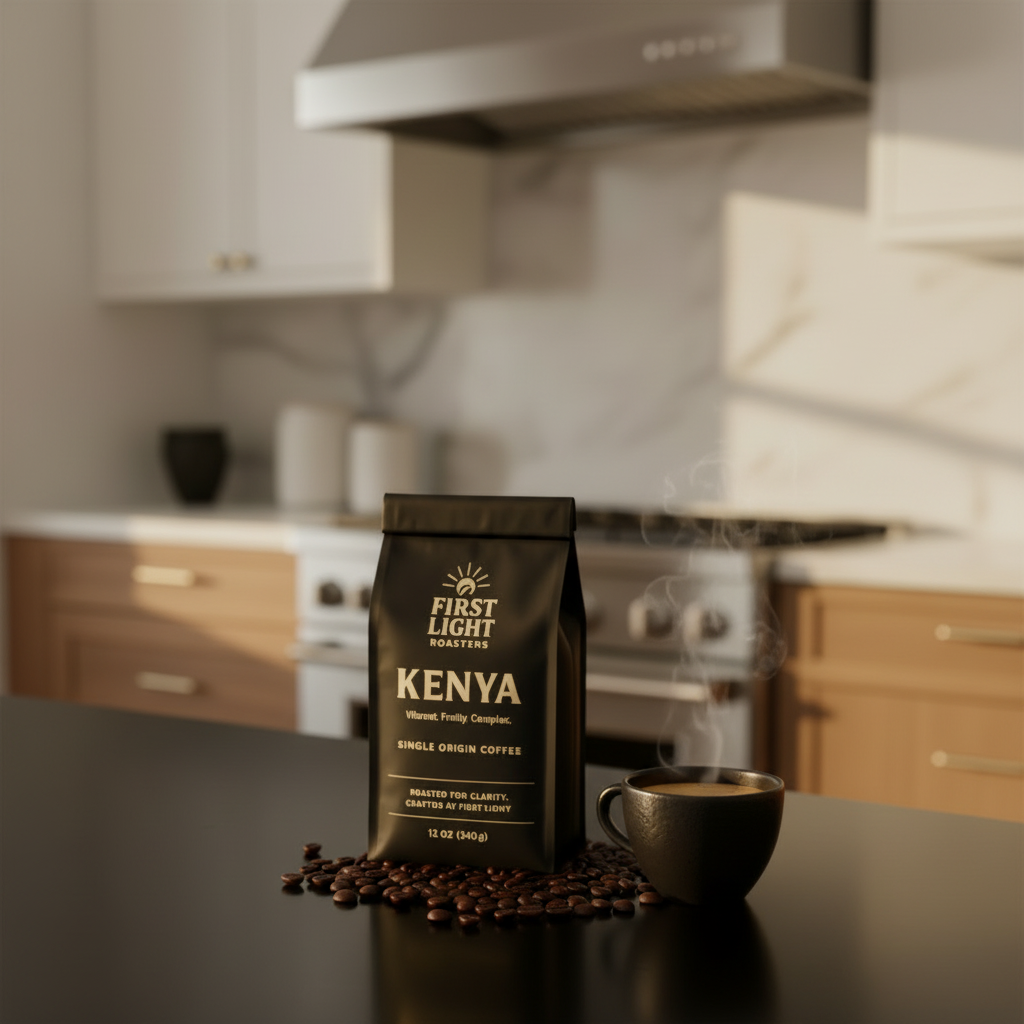
Kenya is not one coffee. Kenya is a collection of distinct microclimates, soil compositions, and processing traditions that happen to share a national border and a national grading system. The difference between a washed Nyeri AA and a washed Kirinyaga AA from the same harvest season is real, measurable, and perceptible to any palate that has experienced both. Understanding Kenya at the county level — understanding why Nyeri produces the coffee it does, why Kirinyaga differs, and what Murang'a contributes — is the difference between knowing Kenyan coffee broadly and knowing it in depth.
At First Light Roasters, county-level sourcing is core to how we build our Kenya program. We don't buy undifferentiated "Kenya" by grade alone. We source from specific named washing stations within specific growing counties, because we believe the county-level geography is a meaningful and communicable part of the cup's story. This post is our guide to the three counties that matter most for specialty Kenyan coffee and what distinguishes them from one another.
This is also practical information for buyers and coffee enthusiasts. If you are choosing between two bags of Kenyan coffee from different roasters, knowing which county each comes from tells you something specific about what to expect in the cup — even before you open the bag.
Why County-Level Terroir Matters in Kenya
Kenya's coffee-growing counties are all elevated, equatorial, and volcanic in soil composition — the broad similarities that make Kenyan coffee identifiable as Kenyan. But within those broad similarities, meaningful differences in altitude, slope aspect, soil depth and composition, rainfall distribution, and processing tradition create cup profiles that are distinct enough to be reliably identified by experienced tasters.
This kind of regional specificity within a single origin is not unique to Kenya — it exists in Burgundy vs. Bordeaux, in Yirgacheffe vs. Sidamo, in Oaxaca vs. Veracruz — but it is particularly well-developed in Kenya because of the country's systematic cooperative structure and the auction infrastructure that creates economic incentives to identify and document regional lots separately rather than blending them together for undifferentiated sale.
The Nairobi Coffee Exchange (NCE), Kenya's central auction platform, sorts and sells coffee by washing station lot, which means county-level and even washing station-level traceability is built into the supply chain structure. A roaster who wants to source Nyeri specifically can do so, and the documentation supports that claim precisely. This is not the case in many other origins where regional labels are marketing descriptions rather than documented supply chain facts.
Nyeri: The Benchmark for Kenyan Excellence
Nyeri County sits on the southwestern slopes of the Aberdare Range, at elevations predominantly between 1,600 and 1,900 meters above sea level. It is widely regarded as Kenya's most prestigious growing county — the origin whose name carries the most consistent weight in specialty coffee markets globally and that reputation is grounded in objective cup quality rather than mere brand recognition.
The soils in Nyeri are among the deepest and most mineral-rich in all of Kenya's growing zones. Formed from millions of years of volcanic erosion from the Aberdare peaks, these soils drain efficiently while retaining adequate moisture for coffee tree health. The altitude creates temperature conditions ideal for slow cherry development — cool nights and moderate days that stretch the ripening period and allow more time for sugar and acid accumulation in the cherry.
Nyeri coffees are characterized by: exceptional clarity, meaning the cup shows its flavors in distinct, well-defined layers rather than as a blended mass; prominent tomato leaf and red berry aromatics on the nose; blackcurrant and dark cherry in the cup entry; a bright, structured citric acidity that persists into a clean finish; medium to medium-full body; and a syrupy quality at the mid-palate that indicates complete cherry ripeness at harvest.
Washing stations in Nyeri that consistently produce cup quality above 88 SCA points include Thiriku, Gaturiri, Mahiga, and several others operated by long-established cooperatives. When First Light sources from Nyeri, we are working with specific named stations from this category — not generic Nyeri lots from broker pools.
Kirinyaga: The Tropical Fruit Alternative
Kirinyaga County occupies the eastern slopes of Mount Kenya, directly opposite Nyeri on the mountain's other side. Elevations are comparable to Nyeri — predominantly 1,600 to 2,000 meters — but the aspect and the specific soil composition of the eastern slopes create a growing environment that produces a distinctly different cup character.
Where Nyeri tends toward the red fruit and citric brightness end of the Kenyan flavor spectrum, Kirinyaga tends toward tropical fruit and stone fruit: passion fruit, mango, and apricot are common descriptors from tasters working with high-quality Kirinyaga lots. The acidity in Kirinyaga is slightly softer than Nyeri — still vivid and present, but with a rounder, less sharp character. Body is similar to or slightly lighter than Nyeri. Floral aromatics — jasmine, rose — appear more frequently in Kirinyaga cups than in Nyeri.
The tropical character of Kirinyaga is partly explained by the mountain's eastern aspect: the slope receives the Indian Ocean moisture-laden winds that travel inland from the Kenyan coast, creating slightly different humidity and rainfall patterns than the western slopes. The forest cover on this side of the mountain is also slightly different, influencing the soil ecology and the biological environment in ways that are not fully documented but are empirically perceptible in the cup.
For buyers who find that classic Nyeri Kenya can read as too aggressive or sharp in its acidity, Kirinyaga is frequently the answer — same structural quality and origin character, more rounded and fruit-forward, slightly more approachable for palates calibrated on lower-acid coffees.
Murang'a: The Body Builder
Murang'a County sits south of both Nyeri and Kirinyaga, at elevations slightly lower on average — predominantly 1,400 to 1,700 meters, with some higher pockets along the ridgelines. The lower average altitude has predictable effects on the cup: slower evaporation of moisture creates a more humid growing environment, slower temperature swings mean cherries ripen somewhat faster, and the result is a cup with more body and slightly less of the electric brightness that defines the higher-altitude counties.
Murang'a coffees are characterized by: fuller body than Nyeri or Kirinyaga, often with a syrupy, viscous mouthfeel; stone fruit flavors — particularly plum, dark cherry, and occasionally dried fig — in the cup entry; a softer, more rounded acidity that reads as complex rather than bright; and a longer, more substantial finish with caramelized sweetness.
These characteristics make Murang'a an excellent choice for espresso applications among Kenya's county offerings. The fuller body provides the structural weight that espresso extractions call for, and the softer acidity is less likely to become sharply acidic under the elevated pressure and concentration of espresso brewing. Several specialty espresso bars that work with single-origin Kenyan espresso specify Murang'a for exactly this reason.
For filter brewing, Murang'a offers a different Kenya experience than Nyeri or Kirinyaga — less bright, more substantive, closer to a medium-altitude Colombian or a washed Ethiopian from the Gedeo zone than to the electric brightness that most people associate with "Kenyan coffee." This is not a lesser experience; it is a different one, and many drinkers prefer it.
How First Light Chooses Between Regions
Our Kenya sourcing is not fixed to a single county. We evaluate available lots from multiple regions each season and select based on cup quality, traceability, price relative to quality, and how the available lots balance our broader offering lineup.
When we are building our core Kenya AA program — the coffee we carry year-round as our signature single-origin offering — we tend to prioritize Nyeri for the reasons described above: consistency, cup clarity, and the vivid brightness that best represents what Kenya can offer. Our customers who come to First Light specifically for Kenya come for that brightness.
However, when exceptional Kirinyaga or Murang'a lots become available at quality levels that justify their placement alongside our core offering, we bring them in as limited releases with full regional disclosure. We believe in showing our customers the range of what Kenya is capable of, not just one expression of it. Those releases sell quickly, and the feedback from customers who have tried different regional expressions back to back is consistently one of discovery — they didn't know Kenya could be this varied.
→ Explore Our Kenya Offerings →
Nyeri, Kirinyaga, and Murang'a are not interchangeable labels on a bag of Kenyan coffee. They are specific places with specific flavors, and knowing the difference makes you a more informed buyer and a deeper appreciator of what specialty coffee geography actually means. At First Light, every Kenya we sell tells you exactly where it came from — because that place is part of what you are tasting.