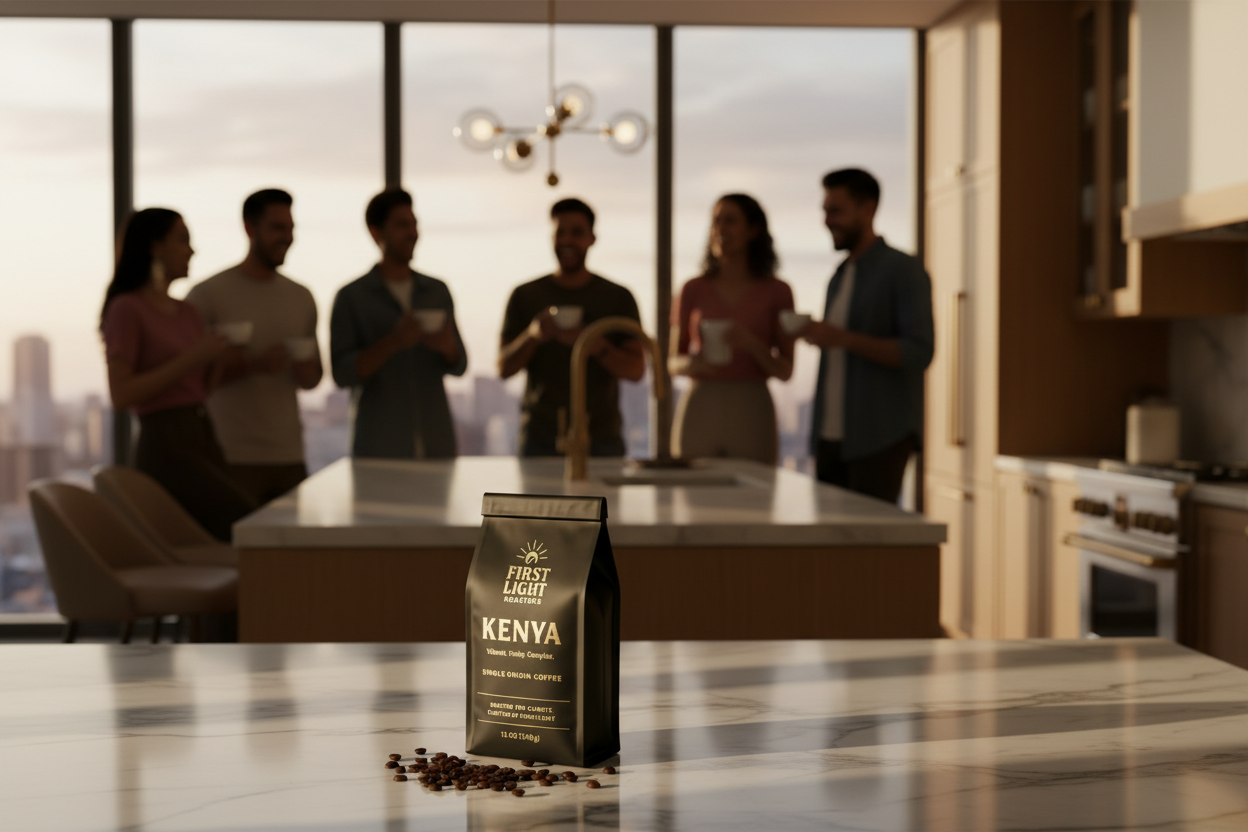
Every extraordinary food product has a cultivar at its core. The Comice pear. The Honeycrisp apple. The Heirloom Brandywine tomato. These are not generic varieties; they are specific genetic expressions that produce flavors other varieties cannot replicate. In coffee, Kenya's SL28 and SL34 occupy this role. They are the varieties behind the blackcurrant brightness, the complex acidity, and the deep fruit intensity that make Kenyan specialty coffee unlike any other origin on earth.
Understanding SL28 and SL34 is not academic background noise — it is central to understanding why Kenyan coffee tastes the way it does, why it commands premium prices, and why roasters like First Light source Kenyan green coffee with the deliberateness of a wine buyer seeking a specific producer and appellation. The variety matters. At origin, variety is terroir.
At First Light, we source exclusively from washing stations and cooperatives where we have confirmed the presence of SL28 and SL34 in the farm stock. When we tell you that your First Light Kenya AA is grown from these legacy varieties, we are not relying on regional generalization — we are stating a verified fact about the genetic identity of the coffee you are drinking.
The Scott Laboratories and the Origin of the SL Designations
The story of SL28 and SL34 begins in the 1930s in colonial Kenya, at a government agricultural research station called Scott Laboratories, located in what is now Kabete, on the outskirts of Nairobi. The station was tasked with identifying and developing coffee varieties suitable for Kenyan growing conditions , specifically high-altitude varieties with drought tolerance, high yield potential, and excellent cup quality.
The "SL" designation simply stands for Scott Laboratories. Researchers at the station tested hundreds of varieties and selections between the 1930s and 1950s, numbering them sequentially as they evaluated them. Most of these numbered selections were abandoned as the research progressed. Two survived: SL28 and SL34.
SL28 was selected in 1935 from a Tanganyika Drought Resistant variety, itself descended from the Bourbon botanical family — one of the two primary lineages of Coffea arabica, the other being Typica. SL34 was selected from the French Mission variety, believed to be of the Typica lineage, possibly originating from Bourbon Island (now Réunion) coffee brought to East Africa by French missionaries in the 19th century.
The breeding objectives of the Scott Laboratories work were primarily practical: drought resistance, large yield, and disease tolerance in the context of 1930s Kenyan agricultural conditions. The extraordinary cup quality that SL28 and SL34 would prove to deliver was not the primary design criterion — it was a genetic accident of the most fortunate kind, an expression of the specific Bourbon and Typica lineages interacting with Kenya's unique growing environment in ways that no subsequent breeding program has been able to replicate or improve upon.
What Makes SL28 Genetically Special
SL28 is widely considered the more cup-quality-focused of the two varieties, and it is the one most closely associated with Kenya's signature flavor profile in specialty coffee circles. Its Bourbon lineage contributes the genetic coding for the intense fruit and complex organic acids that Kenyan coffee is known for , specifically the blackcurrant, tomato leaf, and citric acid character that appears most vividly in well-grown, carefully processed SL28 lots.
The genetics of SL28 produce a bean with particularly high concentrations of citric and malic acids — the primary organic acids that create brightness in coffee — relative to most other Coffea arabica varieties. This is a measurable chemical difference that corresponds directly to what specialty tasters experience in the cup. SL28 is not just perceived as brighter than other varieties; it is chemically brighter, in ways that persist through processing and roasting.
SL28 also tends to produce beans of larger physical size — which aligns with Kenya's AA grading system, where SL28-derived lots disproportionately achieve AA screen sizing. The combination of large bean size, Bourbon lineage genetics, and high-altitude growing conditions produces the complete package: physical consistency in the roaster and complex flavor in the cup.
The agronomic weaknesses of SL28 are real and significant. It has limited natural resistance to coffee leaf rust (Hemileia vastatrix) and coffee berry disease (CBD), two of the most economically damaging fungal diseases affecting East African coffee production. In seasons where these diseases are severe, SL28 yields can drop dramatically and quality can be compromised. This vulnerability is a primary reason that some Kenyan farmers have transitioned toward more resistant hybrid varieties in recent decades — a transition that has cup quality implications.
SL34: The Partner Variety
SL34 is the complementary variety to SL28 and is often grown in mixed plots with it. Its Typica lineage produces a flavor profile that is similar in structure to SL28 — bright, fruit-forward, complex — but slightly different in specific expression. SL34 tends toward slightly more floral notes, less of the intense blackcurrant of SL28, and a body that some tasters describe as slightly fuller or rounder.
From an agronomic standpoint, SL34 is somewhat more tolerant of high rainfall than SL28, making it better suited to certain regions and microseasons within the Kenyan growing zone. It handles the wet conditions of the long rains harvest period with slightly less disease pressure than SL28 in some environments. This complementarity is part of why the two varieties have historically been grown together on the same farms and processed together at the same washing stations.
In the cup, lots that contain mixed SL28 and SL34 — which is the majority of Kenyan cooperative lots, since most farms grow both — tend to show a slight additional complexity compared to lots from exclusively SL28 trees. The different flavor contributions blend together in a way that produces a more layered cup: the intensity of SL28's blackcurrant carried on SL34's fuller body, with SL34's floral notes adding complexity to SL28's fruit-forward entry.
This is one reason that "Kenya AA" from a mixed cooperative washing station is not a compromise between varieties but potentially a complementary blend of them — more complex than either variety alone, just as many of the world's great wines are blends of complementary grape varieties from the same terroir.
The Threat of Disease and the Rise of Ruiru 11
The cup quality of SL28 and SL34 comes at an agricultural cost that the Kenyan coffee industry has grappled with for decades. Coffee leaf rust and coffee berry disease remain constant threats across the East African growing zones, and both SL28 and SL34 are susceptible. Outbreaks have caused devastating crop losses in Kenya in the past, most notably during the severe leaf rust epidemic of the 1980s and subsequent CBD outbreaks.
In response, the Coffee Research Station at Ruiru developed a hybrid variety called Ruiru 11, released in 1985, specifically designed to be highly resistant to both diseases. Ruiru 11 carries genetic material from multiple disease-resistant varieties, including dwarf types bred for robustness rather than cup quality. It delivers on its agronomic promises: high yield, disease resistance, drought tolerance.
But Ruiru 11's cup quality does not match that of SL28 and SL34. Specialty tasters consistently score Ruiru 11 lots lower, with less complexity, less brightness, and a flavor profile that is more generic and less distinctly Kenyan. The variety's widespread adoption among Kenyan farmers facing economic pressure and crop losses has been a source of concern among specialty buyers who worry about the gradual replacement of the legacy varieties.
Batian, a newer high-yielding, disease-resistant variety developed more recently by the Coffee Research Institute of Kenya, offers somewhat better cup quality than Ruiru 11 but still does not match the complexity ceiling of SL28 and SL34. The specialty coffee industry's best response to this challenge has been to create economic incentives for farmers to maintain SL28 and SL34 plots: paying premium prices specifically for lots from these varieties, and communicating that premium to end consumers.
Why First Light Sources SL28 and SL34 Exclusively
Our commitment to SL28 and SL34 at First Light is both a quality decision and a preservation decision. It is a quality decision because these varieties produce the flavor profile that makes our Kenya AA distinctive — the blackcurrant intensity, the structured brightness, the long finish that distinguishes our offering from commodity Kenyan coffee. We cannot produce the cup we want to produce from any other variety currently available at scale in Kenya.
It is also a preservation decision. Every premium paid for SL28 and SL34 lots creates economic incentive for farmers to maintain these trees rather than replanting with higher-yielding disease-resistant varieties. The premium market for variety-specific Kenyan coffee is, in effect, the economic mechanism that sustains the variety's survival in the face of legitimate agronomic pressure toward replacement.
We verify variety composition through our supply partners at the cooperative and washing station level. We ask specific questions about variety distribution in the farm stock contributing to each lot we purchase. We do not require 100 percent SL28 — that is not realistic in most cooperative lots — but we do require confirmation that SL28 and SL34 constitute the majority of the farm stock contributing to our purchased lots. This is a sourcing requirement that not all roasters make, and we believe it is one of the ways in which our buying decisions actively support the long-term quality potential of Kenyan coffee.
When you drink First Light Kenya AA, you are drinking the product of trees that have been grown in Kenya for over eighty years, carrying genetic material that produces a cup unlike anything else in the world. That is not marketing language. It is botanical history in your mug.
SL28 and SL34 are irreplaceable. They are the reason Kenyan coffee is Kenyan coffee. At First Light, sourcing them is a commitment to quality, to the farmers who grow them, and to the cup that only they can produce.