Article: What Is the Best Water for Coffee? Tap vs Filtered vs Distilled
What Is the Best Water for Coffee? Tap vs Filtered vs Distilled
The best water for coffee is clean, has no chlorine smell, and carries a moderate amount of minerals: roughly 50 to 175 ppm of hardness and about 40 to 70 ppm of alkalinity. For most homes that means tap water run through a carbon filter. Distilled and reverse osmosis water are too empty on their own, and very hard or softened water mutes flavor.
A cup of brewed coffee is about 98 percent water, so the water is the largest ingredient you choose. Below: what the minerals do, how each kind of water performs, the numbers to aim for, and how tap water in Livonia and Detroit measures up, using the cities' own water quality reports.
Does water really change how coffee tastes?
Yes. Water is the solvent that pulls flavor out of the grounds, and what is already dissolved in it decides how well it does that job. Three things matter:
- Hardness is the calcium and magnesium in the water. These minerals help water grab flavor compounds from coffee. Too little and the cup tastes thin and hollow. Too much and it tastes heavy and chalky.
- Alkalinity is the bicarbonate in the water. It acts as a buffer that neutralizes acid. A little keeps coffee from tasting sharp. A lot flattens the bright, fruity notes until the cup tastes dull.
- Chlorine is added by city water systems to keep water safe. It is doing its job, but you can smell and taste it in a cup.
Hardness and alkalinity are not the same thing, and alkalinity is not the same as pH. Two waters with the same pH can brew very different coffee. If you only learn one number about your water, learn the alkalinity.

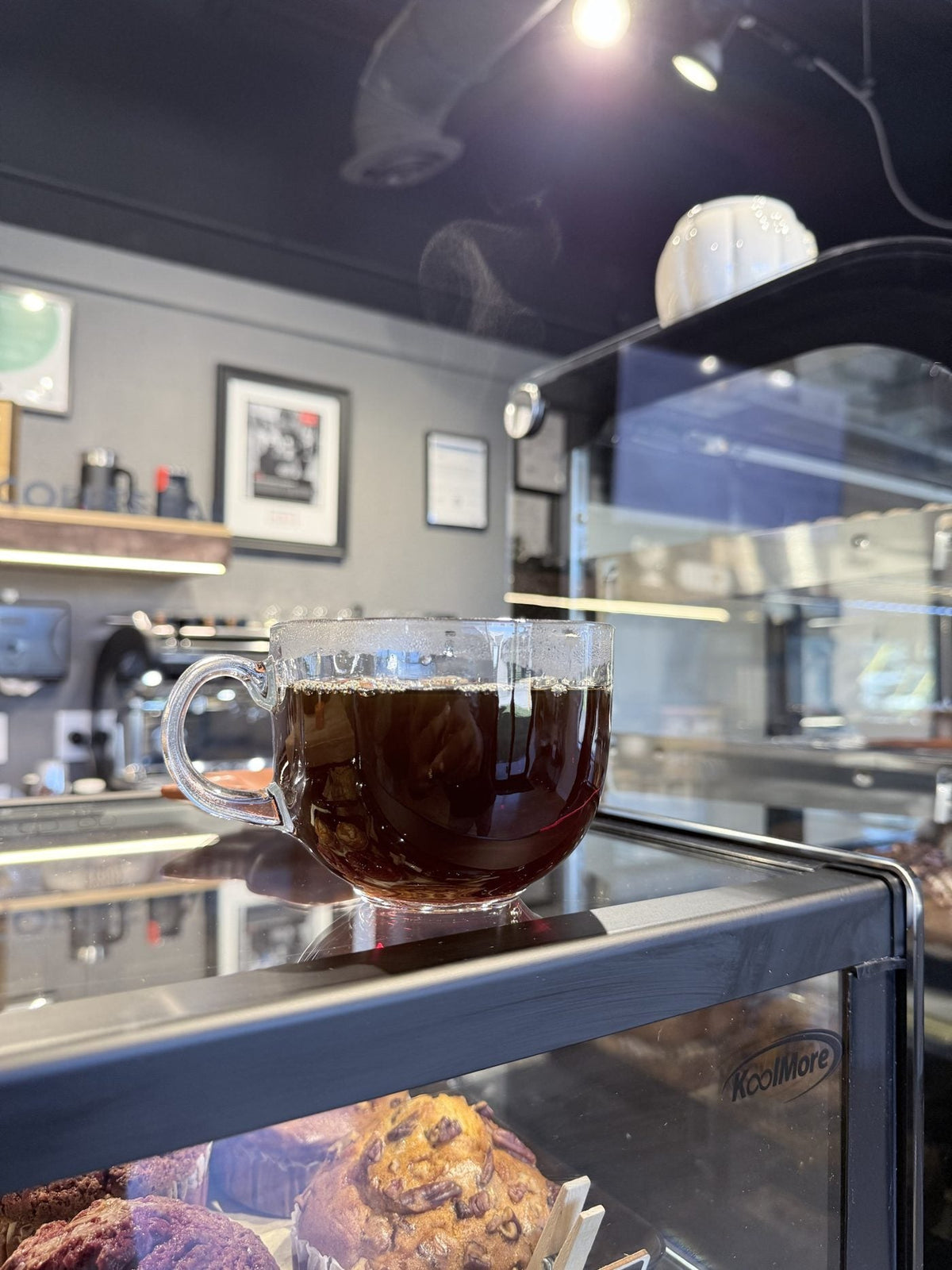
A glass mug of black coffee on the pastry case at our cafe, with the muffins just visible below. Everything in that mug except about 2 percent is water.
What numbers should coffee water hit?
The Specialty Coffee Association's water for brewing standard is the reference most roasters and cafes use (SCA coffee standards). The targets:
| Measure | Target | Why it matters |
|---|---|---|
| Odor | Clean, fresh, odor free | If you can smell it, you will taste it |
| Chlorine | None | Adds a pool or medicine note |
| Calcium hardness | 50 to 175 ppm (as calcium carbonate) | Drives extraction and body |
| Alkalinity | At or near 40 to 70 ppm (as calcium carbonate) | Balances acidity without flattening it |
| pH | 7, acceptable from 6 to 8 | Near neutral |
A note on units: ppm (parts per million) and mg/L (milligrams per liter) are the same thing for water. Water softener companies use grains per gallon. To convert, divide ppm by 17.1.
Tap, filtered, bottled, distilled or softened: which is best?
| Water | What it does to coffee | Verdict |
|---|---|---|
| Straight tap | Depends entirely on your city. Chlorine is the usual problem. | Fine if it tastes and smells clean |
| Carbon filtered tap (pitcher, fridge, under sink) | Removes chlorine and odors, leaves most minerals in place | Best choice for most homes |
| Bottled spring water | Varies widely by brand. Some are near ideal, some are very hard. | Good if the label's mineral numbers fit the targets |
| Distilled or reverse osmosis | Almost no minerals. Coffee tastes sharp, thin and hollow. | Only as a base you add minerals back to |
| Softened water (salt softener) | Swaps calcium and magnesium for sodium and leaves the alkalinity. Coffee tastes flat. | Avoid. Use the unsoftened kitchen tap if you have one. |
| Hard well water | High hardness and alkalinity. Dull, chalky cups and fast scale. | Test it. Often needs blending with distilled. |
A common mistake is switching to distilled water to "get the purest cup." Pure water makes worse coffee. The minerals are part of the recipe.
Is Detroit and Livonia tap water good for coffee?
Yes, better than most people expect. Livonia, where we roast, buys its water from the Great Lakes Water Authority. It is drawn from the Detroit River and treated at the Springwells plant. The city's 2024 water quality report lists these averages for that tap water (City of Livonia, 2024 Water Quality Report):
- Total hardness: 101 mg/L, with a range of 88 to 110. That is about 5.9 grains per gallon by our conversion, which is moderately hard.
- Total alkalinity: 73 mg/L, with a range of 66 to 82.
- pH: 7.15.
- Total dissolved solids: 120 mg/L.
- Chlorine residual in the pipes: a running average of 0.74 ppm.
Detroit's own 2025 report shows nearly the same water: average total hardness of 107 ppm, alkalinity of 71 ppm, pH of 7.20 and a chlorine residual averaging 0.95 ppm (Detroit Water and Sewerage Department, 2025 Water Quality Report).

Livonia and Detroit tap water against the SCA targets. Hardness sits in the middle of the green band. Alkalinity sits at its top edge. The city reports list total hardness, while the SCA figure is for calcium hardness, so treat the left panel as a close guide.
What that means for your cup:
- The minerals are in a good place. Hardness is squarely in range, and alkalinity is at the high end of the target without being far over it.
- Chlorine is the one thing to fix. The SCA target is none, and the tap carries some. A basic carbon filter, the kind in a pitcher or a refrigerator, takes care of it.
- Your own tap can differ. These are system averages. Old pipes, a home softener or a private well change the picture.
So for most of metro Detroit on city water, the answer is simple: carbon filter your tap water and brew. You do not need bottled water. If you are on a well in the outer suburbs or up north, test first. Michigan well water is often much harder than Great Lakes water.
How do you test your own water?
- Smell and taste it at room temperature. Any pool, metal, sulfur or musty note will end up in the coffee.
- Read your city's water quality report. Every public water system publishes one each year. Look for hardness and alkalinity in the mineral table.
- Use aquarium test drops. A GH and KH drop kit from a pet store measures hardness (GH) and alkalinity (KH) in a few minutes. Each drop equals roughly 17.9 ppm.
- Skip the TDS pen as your only tool. It gives one number for everything dissolved and cannot tell hardness from alkalinity.
Can you make your own coffee water?
Yes, and it is the cheapest way to get ideal water if yours is poor. Start with a gallon of distilled water and add two grocery store minerals. You need a scale that reads to 0.01 g.
| Add to 1 gallon distilled water | Amount | What it gives you |
|---|---|---|
| Epsom salt (magnesium sulfate), unscented | 0.75 g | About 80 ppm hardness |
| Baking soda (sodium bicarbonate) | 0.25 g | About 40 ppm alkalinity |
Shake until dissolved. The formula, if you want to adjust it: every 0.1 g of Epsom salt per gallon adds about 11 ppm of hardness, and every 0.1 g of baking soda per gallon adds about 16 ppm of alkalinity. Coffee tasting sharp? Add a pinch more baking soda. Tasting dull? Use less.
Easier still: if your tap water is too hard, cut it half and half with distilled water. That halves both hardness and alkalinity. Pre-measured mineral packets made for coffee do the same job as the recipe above for more money and less fuss.
What does water do to your coffee maker?
Hardness and alkalinity together form limescale when water is heated. Scale coats heating elements, slows drip machines, and clogs the small passages in espresso machines. Water with almost no minerals has the opposite problem: it can be corrosive to metal boilers, and some machines with water level sensors will not even detect it.
With water like Livonia's and Detroit's, expect slow, steady scale:
- Kettle: descale with citric acid or white vinegar when you see a white film.
- Drip machine: descale every one to three months, following the maker's instructions.
- Espresso machine: use filtered or softening cartridge water from day one, and follow the manufacturer's descaling guidance. Scale damage is expensive to repair and easy to avoid.

The espresso machine on our cafe bar, portafilter locked in and cups warming on top. Machines like this heat water all day, which is why water quality matters even more for espresso than for drip.
What does bad water taste like in the cup?
| If the cup tastes | Likely water cause | Fix |
|---|---|---|
| Like a swimming pool or medicine | Chlorine | Carbon filter. Replace the cartridge on schedule. |
| Flat, dull, chalky, no brightness | Alkalinity or hardness too high | Blend tap water with distilled, half and half |
| Sharp, sour, thin, hollow | Too few minerals (distilled, reverse osmosis) | Add minerals with the recipe above, or use filtered tap |
| Flat and faintly salty | Softened water | Use an unsoftened tap or bottled water |
| Metallic or musty | Old pipes, stale tank water, a dirty kettle | Run the tap for a few seconds, use fresh water, clean the equipment |
Rule out water before you blame the beans or the grinder. If a coffee tastes dull at home and bright at a cafe, water is the first suspect. Once the water is right, grind and temperature are the next two things to tune. We cover those in water, grind and temperature and in our pour-over protocol.
Frequently asked questions
Is tap water OK for coffee?
Usually, yes, if it tastes and smells clean. Run it through a carbon filter to remove chlorine and it is the best choice for most homes.
Should I use distilled water for coffee?
Not on its own. Distilled water has no minerals, so coffee tastes sharp and thin, and it can be hard on metal boilers. Use it only as a base and add minerals back.
Is Detroit tap water good for making coffee?
Yes. City reports put Detroit and Livonia tap water at about 100 to 107 ppm of hardness and about 71 to 73 ppm of alkalinity, inside or at the edge of the range coffee likes. Filter out the chlorine and brew.
Does a Brita filter make better coffee?
A carbon pitcher filter removes chlorine and odors, which is the main problem with most city water, so yes for most people. It will not fix very hard water.
Is hard water bad for coffee?
Moderately hard water is good for coffee. Very hard water, especially with high alkalinity, makes coffee taste dull and chalky and builds scale in your machine.
Can I use softened water for coffee?
It is better not to. A salt softener replaces calcium and magnesium with sodium and leaves the alkalinity, which makes coffee taste flat.
First Light Roasters is co-founded by Sam Noor and Amal Almaflahi. Roasted for clarity. Crafted at first light.