Article: Coffee to Water Ratio: How Much Coffee Per Cup? (Chart for Every Brewer)
Coffee to Water Ratio: How Much Coffee Per Cup? (Chart for Every Brewer)
The best starting coffee to water ratio is 1:16: 1 gram of coffee for every 16 grams of water. For one 10 oz mug that is 22 grams of coffee (about 4 level tablespoons) and 350 grams of water. For a full 12 cup coffee maker it is about 110 grams of coffee, or 11 standard scoops. Use 1:15 if you like it stronger and 1:17 if you like it lighter.
That is the short answer. The rest of this guide gives you the ratio for every brewer, a chart for your coffee maker, how to measure without a scale, and how to fix a cup that tastes weak, strong, sour or bitter.
What is a coffee to water ratio?
It is how much ground coffee you use for a given amount of water, written by weight. A ratio of 1:16 means 1 part coffee to 16 parts water. Twenty grams of coffee and 320 grams of water is 1:16. So is 60 grams and a liter, give or take.
We use weight because it is the only measure that stays honest. A tablespoon of dark roast weighs less than a tablespoon of light roast, and a "cup" means something different on every coffee maker. A gram is always a gram. Conveniently, 1 milliliter of water weighs 1 gram, so you can weigh your water on the same scale.
The ratio sets one thing: strength. More coffee per unit of water makes a stronger cup. Less makes a weaker one. It does not fix sour or bitter coffee. That is the job of the grind, and we get to it below.
What is the right ratio for each brew method?
Here are the starting points we recommend. They are starting points, not rules. Brew it once, taste it, and move one step in either direction.

Six brewers, six starting ratios. Save the chart or tape it inside a cabinet door.
| Method | Ratio | Coffee | Water | Grind | Makes about |
|---|---|---|---|---|---|
| Drip machine | 1:16 | 60 g | 1,000 g (1 liter) | Medium, like coarse sand | 30 oz brewed |
| Pour-over | 1:16 | 22 g | 350 g | Medium-fine, like table salt | One 10 oz mug |
| French press | 1:15 | 30 g | 450 g | Coarse, like sea salt | 13 oz brewed |
| AeroPress | 1:16 | 15 g | 240 g | Medium-fine | 7 oz brewed |
| Cold brew concentrate | 1:5 | 200 g | 1,000 g | Extra coarse | Dilute 1 to 1 to serve |
| Espresso | 1:2 | 18 g in | 36 g out | Fine | A double shot |
Why does the "makes about" column come out smaller than the water you poured? Because the grounds keep some. Coffee grounds hold back roughly twice their weight in water. Pour 350 grams over 22 grams of coffee and about 305 grams reaches the mug.
French press gets a slightly stronger ratio because the coarse grind extracts more slowly. Cold brew is a concentrate, built to be cut with water, milk or ice.
What is the golden ratio for coffee?
You will see two versions of this, and they agree more than they seem to.
- The National Coffee Association calls it the Golden Ratio: 1 to 2 tablespoons of ground coffee for every 6 ounces of water (National Coffee Association, drip coffee).
- The Specialty Coffee Association's Golden Cup standard is 55 grams of coffee per liter of water, plus or minus 10%. That works out to about 1:18, with a range from roughly 1:16.5 to 1:20.
Our 1:16 sits at the strong end of that range on purpose. Most home drip machines and most pour-overs extract a little less than a lab brewer does, and a touch more coffee covers the difference. If 1:16 tastes heavy to you, move to 1:17. You are still inside the standard.
How much coffee for 4, 8, 10 or 12 cups?
First, a warning about the word "cup." The cup lines on most American coffee makers mark 5 ounces, not the 8 ounces of a measuring cup and not the 12 ounces of your favorite mug. A "12 cup" machine makes about 60 ounces, which is five big mugs.
This table uses 5 ounce cups, a 1:16 ratio, and a standard coffee scoop of 2 level tablespoons, which holds about 10 grams of ground coffee.
| Carafe line | Water | Coffee by weight | Scoops (2 tbsp) | Tablespoons |
|---|---|---|---|---|
| 4 cups | 20 oz (590 g) | 37 g | About 3.5 | About 7 |
| 8 cups | 40 oz (1,180 g) | 74 g | About 7.5 | About 15 |
| 10 cups | 50 oz (1,480 g) | 92 g | About 9 | About 18 |
| 12 cups | 60 oz (1,775 g) | 111 g | About 11 | About 22 |
The easy rule to remember: a little less than one scoop per cup line. If your machine's manual says its cups are 6 ounces, add about 20% to the coffee.
One more tip for drip machines. Small batches brew badly in big machines, because the water runs through a thin bed of coffee too fast. If you only want two mugs, fill to at least the 4 cup line or use a pour-over.
How do you measure coffee without a scale?
You can get close with a spoon. These are honest approximations:
- 1 level tablespoon of ground coffee is about 5 grams.
- 1 standard coffee scoop is 2 tablespoons, about 10 grams.
- One 10 oz mug needs about 4 tablespoons (2 scoops) of coffee and 1.5 measuring cups of water.
- Whole beans measure about the same per tablespoon as ground, but less evenly. Measure after grinding if you can.
Here is why we still nudge everyone toward a scale. A darker roast is physically lighter and larger than a light roast of the same coffee, because the beans lose water and puff up in the roaster. So a scoop of our Signature Espresso weighs less than a scoop of our Ethiopia. A spoon cannot see that. An inexpensive kitchen scale that reads to 1 gram can, and it is the cheapest upgrade in coffee.

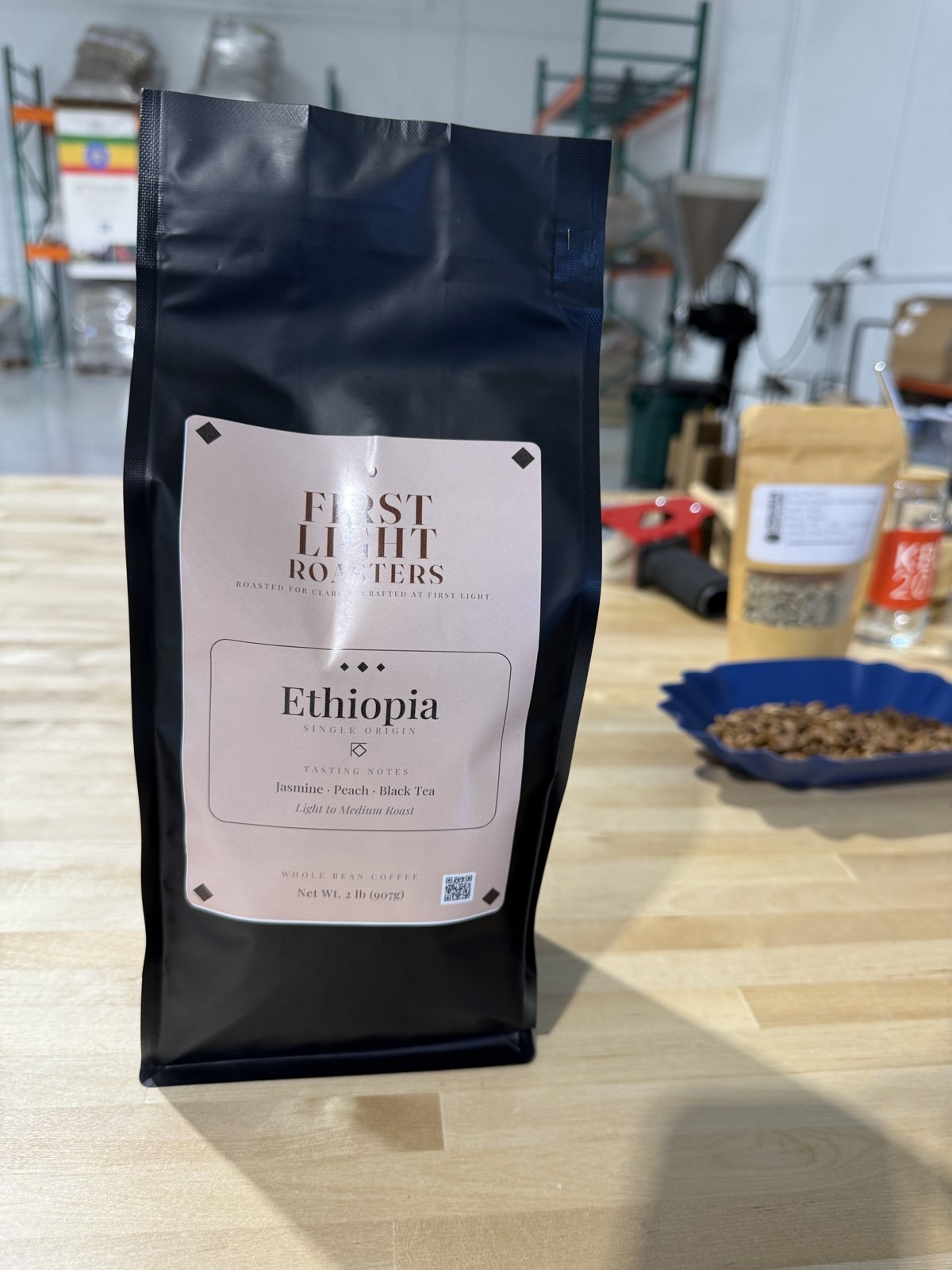
A 2 lb bag on our worktable, with a blue sample tray of roasted beans behind it. At 22 grams a mug, this bag holds about 41 mugs of coffee.
Why does my coffee taste weak or too strong?
Weak or strong is a ratio problem. Sour or bitter is a grind problem. People mix these up all the time, add more coffee to fix a sour cup, and end up with a strong sour cup.
| If the cup tastes | What is wrong | Fix |
|---|---|---|
| Weak, watery, thin | Too little coffee for the water | Move from 1:16 to 1:15 |
| Too strong, heavy | Too much coffee for the water | Move to 1:17, or add a splash of hot water to the cup |
| Sour, sharp | Under-extracted: grind too coarse or water too cool | Grind finer. Keep the ratio the same |
| Bitter, drying | Over-extracted: grind too fine or brew too long | Grind coarser. Keep the ratio the same |
| Flat, dull, no matter what | Stale coffee or hard water | Check the roast date and try filtered water |
That last row is the one people miss. Hard water flattens a good coffee at any ratio. We covered the numbers for Livonia and Detroit tap water in our guide to the best water for coffee.
Once the ratio is set, the rest of a great pour-over is technique. Our pour-over protocol walks through the other variables one at a time.
What about espresso and cold brew?
Espresso: 1:2
Espresso ratios compare dry coffee to the liquid in the cup, not to the water you put in. A 1:2 ratio means 18 grams of ground coffee in the basket and 36 grams of espresso out, in about 25 to 30 seconds. The National Coffee Association gives the same 1:2 starting point.
- 1:1.5 (ristretto): thicker, sweeter, more intense. Good for dark roasts and small milk drinks.
- 1:2 (standard): the place to start with any espresso blend.
- 1:2.5 to 1:3 (lungo): lighter body, more clarity. Good for light roast single origins.
Put a small scale under the cup. Timing a shot without weighing it is guessing. Our Signature Espresso guide has a full dial-in routine.

The espresso machine at Detroit Halite, our cafe in front of the roastery, with a portafilter locked into the group. Espresso is the one brew where a gram either way changes the cup.
Cold brew: 1:5 concentrate or 1:8 ready to drink
For concentrate, steep 200 grams of extra coarse coffee in 1,000 grams of cold water for 12 to 18 hours in the fridge, then strain. Cut it 1 to 1 with water or milk over ice. For a batch you can drink straight, use 1:8, which is 125 grams of coffee per liter. We sell a coarse ground Cold Brew coffee for exactly this.
How many cups are in a bag of coffee?
Divide the weight of the bag by your dose. At 22 grams per 10 oz mug:
- 12 oz bag (340 g): about 15 mugs.
- 2 lb bag (907 g): about 41 mugs.
- 5 lb bag (2,268 g): about 103 mugs.
So one person drinking two mugs a day goes through a 12 oz bag in about a week. That is also the right pace for freshness. Buy what you will drink in two to four weeks, and brew it by weight.
Frequently asked questions
What is the best coffee to water ratio?
Start at 1:16, which is 1 gram of coffee for every 16 grams of water. Use 1:15 for a stronger cup and 1:17 for a lighter one. French press does well at 1:15 and espresso uses 1:2.
How many tablespoons of coffee per cup?
For a 5 ounce cup on a coffee maker, use a little under 2 level tablespoons. For a 10 oz mug, use about 4 level tablespoons. A level tablespoon of ground coffee is about 5 grams.
How much coffee do I use for 12 cups?
A 12 cup coffee maker holds about 60 ounces of water. At 1:16 that takes about 110 grams of ground coffee, which is roughly 11 standard scoops or 22 level tablespoons.
How many scoops of coffee for 8 cups?
About 7.5 standard scoops, or 74 grams, for 40 ounces of water. A standard coffee scoop is 2 tablespoons and holds about 10 grams.
Does more coffee make coffee less sour?
No. More coffee makes the cup stronger, not sweeter. Sour coffee is under-extracted. Grind finer or use hotter water and keep the ratio the same.
Is 1:15 or 1:17 better?
Neither is better. 1:15 is stronger and heavier, and suits dark roasts, French press and coffee with milk. 1:17 is lighter and clearer, and suits light roasts and black coffee. Try both with the same bag and keep the one you like.
First Light Roasters is co-founded by Sam Noor and Amal Almaflahi. Roasted for clarity. Crafted at first light.