Signature Espresso Guide: What's in the Blend, How to Dial It In, and Milk Drink Recipes
Signature Espresso is our medium-dark espresso blend of specialty arabica and specialty robusta, built for thick crema and shots that keep their balance under milk. It tastes like milk chocolate and toasted almond with a lift of cherry at the end. Start at 18 grams in, 36 grams out, in 25 to 30 seconds with water near 200°F, then adjust the grind by taste.
This guide covers what is in the blend and why, how we roast it, how to dial it in at home or on a cafe bar, how to fix a shot that tastes wrong, milk drink recipes, what to eat with it, and a short history of espresso itself.
What is in Signature Espresso?
Three coffees, each doing one job:
- The base. It brings the chocolate, the nutty sweetness and the heavy body that make a shot feel like espresso.
- The lift. Roasted lighter than the base, it keeps some fruit and brightness, which is where the cherry note in the finish comes from.
- A specialty robusta. This is the crema and the kick. It thickens the shot and adds caffeine.
Every coffee we buy is specialty grade, the robusta included, and each one comes to us as a traceable lot through importers we trust.
A blend exists for a practical reason. A single coffee changes from harvest to harvest. A blend lets a roaster keep the cup steady all year, which matters a great deal if you are a home barista who has finally found your grind setting, or a cafe that needs Tuesday's latte to taste like Saturday's.
Why is there robusta in an espresso blend?
Because it does things arabica cannot. Robusta has a bad reputation in the United States, mostly earned by cheap commodity robusta in instant coffee. Specialty robusta is a different product: picked ripe, processed clean, and graded for quality like any good arabica.
In an espresso blend, a measured amount of good robusta gives you three things:
- Crema. Robusta produces a thicker, longer-lasting crema, the golden foam on top of the shot.
- Body. The shot feels heavier and stands up when you pour six or ten ounces of milk into it.
- Caffeine. Robusta beans carry roughly twice the caffeine of arabica beans, so a blend with some robusta in it has noticeably more caffeine than an all-arabica espresso.
It is also a coffee with deep roots in our part of the map. Robusta is its own species, Coffea canephora, and it originated in central and western sub-Saharan Africa (World Coffee Research, Robusta).
The trick is the amount. Too much robusta and a shot turns woody and rubbery. Used with a light hand, it gives you the crema and the weight while the arabica still sets the flavor.
This coffee at a glance
| Type | Espresso blend, specialty arabica and specialty robusta |
|---|---|
| Roast | Medium-dark |
| Tasting notes | Milk chocolate, toasted almond, cherry |
| Best as | Espresso, lattes, cappuccinos |
| Sizes | 12 oz, 2 lb and 5 lb |
| Grind options | Whole bean, espresso (fine grind) or moka pot |
What does Signature Espresso taste like?
Milk chocolate first, then toasted almond through the middle of the sip, then a small lift of cherry as you swallow. As a straight shot it is sweet, low in acidity and heavy on the tongue, with a crema that holds long enough to stir.
In milk, the cherry steps back and the chocolate and almond take over. A latte made with it tastes a little like a chocolate almond bar. That is what "balance under milk" means: the coffee does not vanish when the milk goes in, and it does not turn bitter either.
One of our customers described it in a review as "closer to medium than a dark roast," and that is a fair read. It is not a smoky, oily Italian-style dark roast. It sits in the middle on purpose.
How do we roast it?
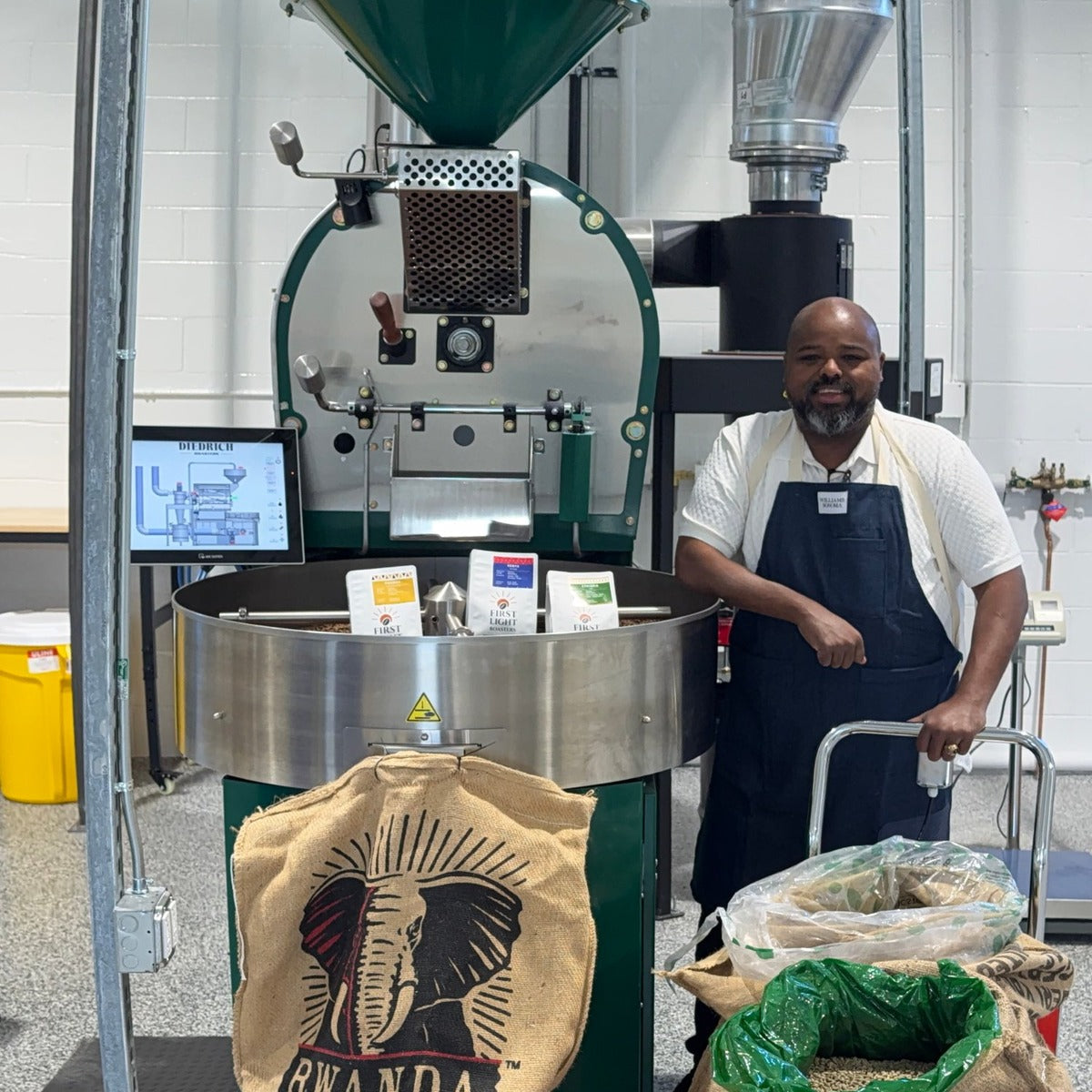
We roast it in small batches on our Diedrich roaster in Livonia, Michigan, and only after you order it. The detail that matters most is that the components are not all roasted to the same level. The base is taken darker for chocolate and body, and the lift is kept lighter so it holds on to its fruit. Roast them all dark and you get a flat, bitter shot. Roast them all medium and the blend goes thin in milk.
Co-founder Sam Noor, who roasts as well as runs the business, explains the thinking: "Each coffee in this blend has one job. The robusta is there for crema and caffeine. If I roasted all three the same way, I'd lose the reason for having three."
Every bag carries its roast date. Espresso is the one brew method where coffee can be too fresh: in the first few days after roasting, the beans are still releasing a lot of carbon dioxide, and shots gush and taste sharp. Give this blend 7 to 10 days from the roast date before you judge it. One reviewer noticed exactly this, writing that the coffee "started to add more flavor as it sat" for a week. Since we ship within 48 hours of roast, your bag will usually arrive a few days before its best window opens.
How do you dial in Signature Espresso?
Use a scale and a timer, and start with this recipe:

Our starting recipe on one card. The four boxes are the numbers to hit first; the lines underneath are what to change when the taste is off.
| Style | Coffee in | Liquid out | Time | Use it for |
|---|---|---|---|---|
| Classic double (start here) | 18 g | 36 g | 25 to 30 s | Straight shots, cortados, cappuccinos |
| Ristretto | 18 g | 27 g | 22 to 28 s | Large lattes and flavored drinks, where you want the coffee to punch through |
| Longer shot | 18 g | 42 to 45 g | 28 to 32 s | Americanos and a lighter, sweeter straight shot |
Step by step
- Weigh 18 g of coffee into the portafilter. If your basket is smaller, keep the 1:2 ratio: 16 g in, 32 g out.
- Level the grounds and tamp flat and firm. Even matters more than hard.
- Put your cup on a scale under the spout and start the timer when you start the pump.
- Stop the shot at 36 g of liquid.
- Check the time. Under 25 seconds, grind finer. Over 30 seconds, grind coarser.
- Taste it. The clock gets you close. Your tongue makes the final call.
Change one thing at a time, and make it the grind first. Keep the dose and the yield fixed until the grind is right.
A note on water temperature: darker roasts extract easily, so this blend does not need very hot water. If your machine lets you set it, 200°F (93°C) is a good middle. If your shots taste harsh even at the right time, drop to 197°F.

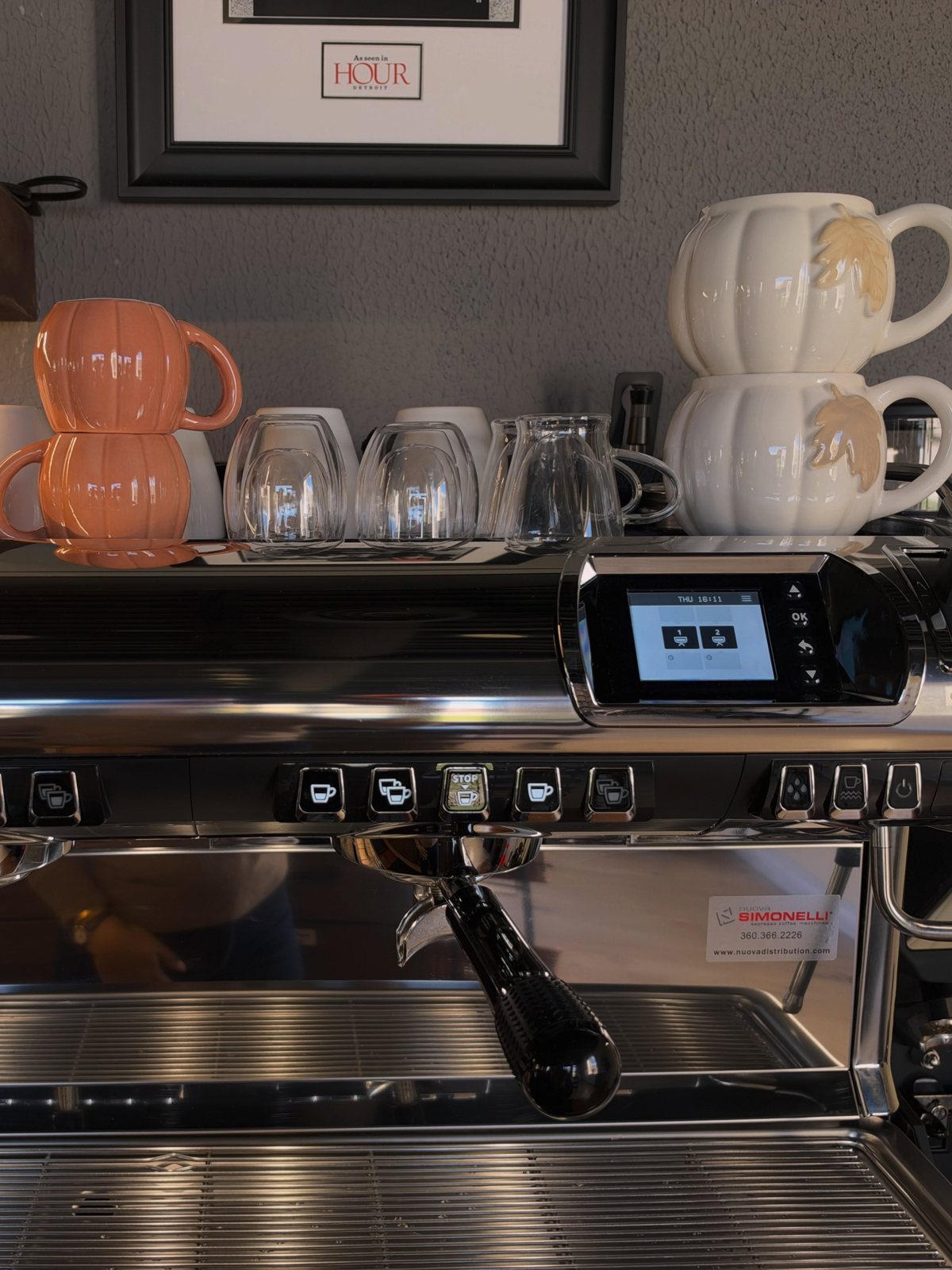
The espresso machine on the bar at Detroit Halite, the cafe in front of our roastery. The black handle in the middle is a portafilter locked into the group head, and the cups stacked on top are there for a reason: the top of the machine is warm, and a warm cup keeps a shot from cooling too fast.
How do you fix a sour or bitter shot?
| If the shot is | It usually means | Do this next |
|---|---|---|
| Sour, thin, done in under 20 seconds | Under-extracted: the grind is too coarse | Grind finer in small steps |
| Bitter, dry, dripping past 35 seconds | Over-extracted: the grind is too fine | Grind coarser |
| Sour and bitter at once | Channeling: water found a crack in the puck | Break up clumps, level the grounds, tamp flat |
| Right time, still harsh | Water too hot, or a dirty machine | Lower the temperature a few degrees; clean the basket and group head |
| Gushing, big pale bubbles in the crema | Coffee is too fresh | Rest the bag 7 to 10 days from the roast date |
| Thin crema, flat taste | Stale coffee or pre-ground coffee opened too long | Grind fresh; buy the size you will finish in three to four weeks |
| Good shot, weak latte | Too much milk for the shot | Pull a ristretto, or use a smaller cup |
One more thing that trips people up: grind settings do not carry over between coffees. If you are switching to this blend from a lighter roast, expect to grind coarser than you did before.
Milk drink and iced recipes
All of these start with the classic double: 18 g in, 36 g out.
| Drink | Espresso | Add | Notes |
|---|---|---|---|
| Cortado | Double | About 2 oz steamed milk | Roughly equal parts. The best way to taste the blend with milk. |
| Cappuccino | Double | About 4 oz milk with a thick layer of foam | A 6 oz cup. Chocolate and almond come forward. |
| Latte | Double | 8 to 10 oz steamed milk, thin foam | For 16 oz, pull the shot as a ristretto or add a third shot. |
| Americano | Double | 4 to 6 oz hot water | Water in the cup first, shot on top, to keep the crema. |
| Iced shaken espresso | Double | Ice, sweetener to taste, a splash of milk | Shake the hot shot hard with ice for 10 seconds, pour, top with milk. |
| Affogato | Single or double | One scoop of vanilla ice cream | Pour the shot over the ice cream at the table. |
For steaming, stop when the pitcher is just too hot to hold comfortably, around 140°F to 150°F. Hotter than that and milk loses its sweetness. We go deeper on this in our guide to milk and foam.
Oat milk works well with this blend. The cereal sweetness of oat sits naturally next to toasted almond and chocolate.
Can you brew it without an espresso machine?
Yes. You will not get true espresso, which needs pressure, but you can get a strong, sweet cup that works in milk.
- Moka pot. Fill the base with hot water to just below the valve. Fill the basket level with coffee ground a little coarser than espresso, and do not tamp it. Brew on medium-low heat with the lid open and take it off the heat when the stream turns pale and starts to sputter. We offer a moka pot grind for exactly this.
- AeroPress. 18 g of fine-ground coffee, 90 g of water at about 195°F, stir, steep one minute, press slowly. Use the concentrate like a shot.
- French press or drip. It makes a full, chocolatey cup of coffee at a normal 1:16 ratio. If drip is your main brew method, though, our House Blend is built for it.
What should you eat with it?
Pair to the notes: chocolate, almond and cherry. Espresso also loves butter and sugar.
- Butter croissant. The classic. Plain, flaky and rich against a short, strong coffee.
- Almond croissant or biscotti. Almond in the pastry, toasted almond in the cup.
- Pain au chocolat. Doubles the chocolate.
- Cheesecake. The cherry note in the finish acts like a fruit topping.
- Tiramisu. Better still, make it with this espresso.
- At home: a square of dark chocolate, shortbread, or vanilla ice cream.
Espresso: a short history
Espresso is Italian, and it is younger than most people think. The first machines, built in Italy around the turn of the 20th century, used steam to push water through coffee quickly so that a cafe could serve each customer a cup made on the spot. The name carries that idea: coffee made expressly for you, and fast.
Those early machines made something closer to strong filter coffee. The espresso we know arrived after the Second World War, when Achille Gaggia in Milan built a machine that used a spring-loaded lever to force water through the coffee at far higher pressure. That pressure produced something nobody had seen before: a layer of golden foam on top of the cup. Customers were suspicious of it at first, so it was sold as a feature and given a name, crema.
Italian roasters have blended robusta into espresso for generations for the same reasons we do: crema, body and strength. And the Italian way of drinking it is worth borrowing. Order at the bar, drink it in three sips, standing up, and get on with your day.
Our version brings that tradition to Michigan, roasted in small batches in Livonia.
Frequently asked questions
What is the best recipe for Signature Espresso?
Start with 18 g of coffee in, 36 g of espresso out, in 25 to 30 seconds, with water near 200°F. If the shot is sour and fast, grind finer. If it is bitter and slow, grind coarser.
Does Signature Espresso contain robusta?
Yes. The blend includes a specialty grade robusta. The robusta adds thicker crema, more body and more caffeine.
Does it have more caffeine than regular espresso?
More than an all-arabica espresso, yes, because robusta beans carry roughly twice the caffeine of arabica. The exact amount in your cup depends on your dose.
Is Signature Espresso a dark roast?
It is medium-dark. The base coffee is roasted darker and the lift is roasted lighter, so the cup is chocolatey and full without tasting smoky or burnt.
How long should espresso beans rest after roasting?
For this blend, 7 to 10 days from the roast date. Fresher than that, the beans release so much carbon dioxide that shots run fast and taste sharp. It stays at its best for about four to five weeks after that if kept sealed.
Can I order it ground?
Yes. Choose espresso (fine grind) or moka pot and we grind it to order. For espresso, whole bean and a grinder at home will always give you more control, because the right grind changes from machine to machine.
First Light Roasters is co-founded by Sam Noor and Amal Almaflahi. Roasted for clarity. Crafted at first light.

Leave a comment
This site is protected by hCaptcha and the hCaptcha Privacy Policy and Terms of Service apply.