Guatemala Huehuetenango Coffee Guide: Taste, Brewing, Roast and Where Ours Comes From
Our Guatemala is a washed coffee from Huehuetenango, the high, dry northwest corner of the country, roasted medium. It tastes like dark chocolate, cherry and orange: a deep, sweet cup with a bright edge that keeps it lively. Brew it at 1:16 as a pour-over or in a drip machine with water around 205°F, or pull it as espresso for a chocolate-heavy shot.
This guide covers where the coffee comes from, what Guatemalan coffee tastes like and why, how we roast it, a recipe for every brewer, how to fix a cup that tastes off, what to eat with it, and a short history of coffee in Guatemala.
Where does this coffee come from?
Huehuetenango (say it "way-way-teh-NAHN-go") is a department in the western highlands of Guatemala, on the border with Mexico. Guatemala's national coffee association, Anacafé, recognizes eight coffee regions, and this is the one roasters tend to call simply "Huehue."
Two things make it unusual.
- It is high and dry. Anacafé describes Huehuetenango as the highest and driest of Guatemala's three non-volcanic coffee regions. Coffee is normally limited by frost at the top of a mountain. Here, dry, hot winds blow up into the mountains from Mexico's Tehuantepec plain and keep the frost off, so coffee can be grown as high as 6,500 feet, about 2,000 meters (Anacafé, Highland Huehue).
- It is remote. The region is far enough from the big mills that, in Anacafé's words, nearly all producers have to process their own coffee. The mountains are full of rivers and streams, which makes it possible to put a small wet mill almost anywhere.
Height matters because coffee grown higher ripens more slowly. The cherry has more time to build sugar and the bright, fruit-like acids that make a cup interesting. That is where the cherry and orange in this coffee come from.
Three varieties make up our lot: Bourbon, Caturra and Catuai.
- Bourbon is one of the oldest arabica varieties. French missionaries carried it from Yemen to Bourbon Island in the early 1700s, and it is known for excellent cup quality at the highest altitudes (World Coffee Research, Bourbon).
- Caturra is a natural mutation of Bourbon, found in Brazil between 1915 and 1918 and introduced to Guatemala in the 1940s.
- Catuai is a cross of Mundo Novo and Caturra. It reached Guatemala in 1970 and now makes up about a fifth of the country's production.
We buy it as a traceable lot through an importer we trust.
This coffee at a glance
| Origin | Huehuetenango, Guatemala |
|---|---|
| Process | Washed |
| Varieties | Bourbon, Caturra, Catuai |
| Roast | Medium |
| Tasting notes | Dark chocolate, cherry, orange |
| Best as | Pour-over, drip, espresso |
| Sizes | 12 oz, 2 lb and 5 lb, whole bean or ground |
What does Guatemalan coffee taste like?
Chocolate first, then fruit. A good washed Guatemalan has a full body and a cocoa depth that you notice in the first sip, and a bright, clean acidity that shows up right behind it. Anacafé describes the Huehuetenango cup as fine, intense acidity with a full body and pleasant wine notes. Importer Cafe Imports calls these the most fruit-forward coffees in Guatemala (Cafe Imports, Guatemala).
In our Guatemala that reads as dark chocolate up front, a sweet cherry note in the middle, and orange at the finish. The orange is what keeps a chocolatey coffee from feeling heavy.
It helps to place it next to our other coffees:
- Next to our Colombia, Guatemala is deeper and darker in flavor. Colombia is caramel and milk chocolate. Guatemala is dark chocolate with more fruit.
- Next to our Brazil, Guatemala is brighter. Brazil is chocolate and nuts with very low acidity. Guatemala has the chocolate and adds citrus.
- Next to our Kenya, Guatemala is calmer and rounder, with the fruit in a supporting role.
If you like chocolate in your coffee but find Brazil a little too mellow, this is the bag to try.
What does washed mean?
Washed describes what happens after the coffee cherry is picked. The skin and fruit are removed from the seed, the seed is fermented and rinsed clean, and only then is it dried. Because the fruit comes off early, the cup tastes of the bean and the place it grew: clean and clear, with well-defined acidity.
In Huehuetenango this work is often done on the farm itself, for the reason given above. The region is too remote to truck fresh cherry to a central mill, and the mountain streams supply the water a wet mill needs.

An open sack of green coffee at our roastery. This is what washed coffee looks like before roasting: pale green and even, inside a clear liner that protects it on the trip from origin.
How do we roast it?
We roast in Livonia, Michigan on a Diedrich drum roaster, and we take this coffee to medium. Huehuetenango coffee is dense, high-grown coffee, and it can take heat. The question is where to stop.
- Too light, and the orange turns sharp and the chocolate never develops. The cup tastes thin.
- Too dark, and the cherry and orange burn off. You are left with bittersweet chocolate and smoke, which you could get from a less interesting coffee.
- Medium is where the chocolate is fully developed and the fruit is still there to balance it.
Every bag is roasted to order and ships within 48 hours of roast, with the roast date on the bag. For pour-over and drip it drinks well from about five days after roast. For espresso, give it a week to ten days.

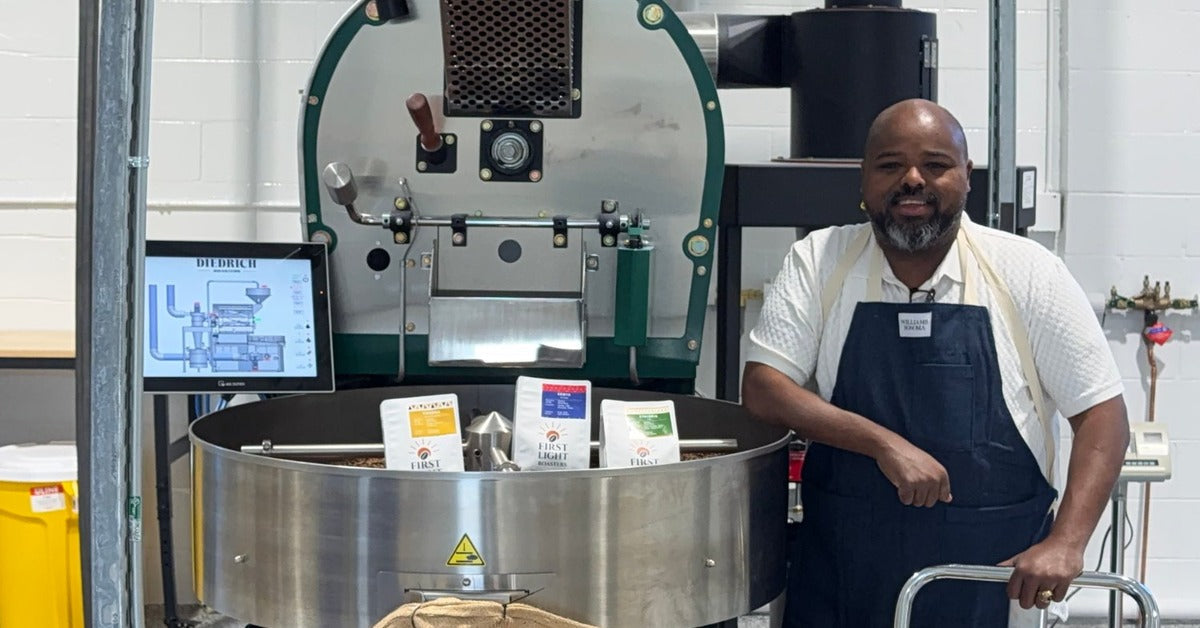
Co-founder Sam Noor at our Diedrich roaster in Livonia, with three finished bags standing on the cooling tray where every batch lands when it leaves the drum.
How do you brew Guatemalan coffee?
Use filtered water, a scale and a 1:16 ratio (1 gram of coffee to 16 grams of water) as your starting point. This is a medium roast, so use water just off the boil, around 205°F. If your tap water is hard, read our guide to the best water for coffee first. Hard water flattens the orange note before anything else.

Five starting recipes for our Guatemala. Save it, then adjust the grind by taste.
| Method | Coffee | Water | Grind | Temp | Time |
|---|---|---|---|---|---|
| Drip machine | 60 g | 1,000 g (1 liter) | Medium, like coarse sand | Machine set | 4 to 6 min |
| Pour-over (V60, Kalita, Chemex) | 20 g | 320 g | Medium-fine, like table salt | 205°F | 2:45 to 3:15 |
| French press | 30 g | 450 g | Coarse, like sea salt | 205°F | 4:00 steep |
| AeroPress | 15 g | 240 g | Medium-fine | 200°F | 2:00 total |
| Espresso | 18 g in | 38 g out | Fine | 200°F | 27 to 32 sec |
Pour-over, step by step
Pour-over shows the cherry and orange most clearly.
- Rinse the paper filter with hot water and empty the rinse water.
- Add 20 g of medium-fine coffee and start a timer.
- Pour 50 g of water to wet all the grounds. Wait 35 seconds. This is the bloom, and it lets gas escape so the water can do its work.
- Pour slowly in circles to 180 g by 1:15.
- Pour to 320 g by 2:00, then let it drain. Aim to finish between 2:45 and 3:15.
French press, for the chocolate
If you want the heaviest, most chocolatey version of this coffee, use a French press. Steep 30 g of coarse coffee in 450 g of water for 4 minutes, break the crust with a spoon, skim the foam, and press gently. The metal filter lets the oils through, and the body goes up with them.
Buying ground? Tell us your brew method at checkout. We grind to order with a separate setting for each method.
Is Guatemalan coffee good for espresso?
Yes, and it is one of our favorite single origins for it. Start at 18 g in and 38 g out in 27 to 32 seconds at 200°F. Expect a chocolate-heavy shot with a cherry sweetness and a short citrus finish. In milk it tastes like a chocolate orange.
Roasters have long used Guatemalan coffee to add sweetness and structure to espresso blends. If you want crema and punch for milk drinks every day, our Signature Espresso is built for that. If you want to taste one origin on its own, pull this.
How do you fix a cup that tastes off?
| If the cup tastes | Likely cause | Fix |
|---|---|---|
| Sour, sharp, like orange peel | Under-extracted: grind too coarse, water too cool, or brew too fast | Grind finer, use water just off the boil, slow your pour |
| Bitter, drying, like baker's chocolate | Over-extracted: grind too fine or brew too long | Grind coarser or shorten the brew |
| Flat, chocolate only, no fruit | Water too hard, or coffee past its best | Try filtered water, check the roast date |
| Weak and watery | Not enough coffee | Move from 1:16 to 1:15 |
| Espresso sour and fast | Shot ran under 25 seconds, or the coffee is too fresh | Grind finer, and rest the bag a week after roast |
Change one thing at a time. Grind first, then ratio, then temperature.
What should you eat with it?
Dark chocolate, cherry and orange are already a dessert, so follow the notes:
- Michigan tart cherry pie. The cherry in the cup meets the real thing, and the chocolate note stands in for the crust. This is the pairing we would put on a table up north in July or at Thanksgiving.
- Brownie or flourless chocolate cake. Chocolate on chocolate, with the coffee's citrus cutting the richness.
- Cranberry orange scone or orange pound cake. Brings the orange finish forward.
- Cinnamon roll. Warm spice and a chocolatey coffee are an easy match.
- Banana bread with walnuts. Sweet and soft against a cup with some backbone.
- Champurradas. The Guatemalan way: a crisp, sesame-topped cookie made for dunking in coffee.
Coffee in Guatemala: a short history
Coffee came to Guatemala in the late 18th century, but for decades it was a garden plant, not a business. The country's exports were natural dyes. When that trade collapsed in the 1800s, growers needed a new crop, and coffee growing gained steam in the 1860s. By the late 1800s Guatemala was exporting nearly 300 million pounds of coffee a year (Cafe Imports, Guatemala).
In 1960 the country's growers organized into what became Anacafé, the national coffee association. Anacafé did something few origins had done at the time: it mapped the country into eight named coffee regions, each with its own climate and cup profile, and marketed them by name. That is why a bag today says Huehuetenango or Antigua and not just Guatemala.
Guatemala was Central America's largest coffee producer for most of the 20th century, until Honduras passed it in 2011. It is still a major origin: the USDA forecasts Guatemalan production at about 3.3 million bags for 2026/27 (USDA Foreign Agricultural Service, Coffee: World Markets and Trade).
What has not changed is the shape of the land. Guatemala is mountains, volcanoes and small farms, and the best of its coffee still comes from the places that are hardest to reach. Huehuetenango is the proof.
Frequently asked questions
What does Guatemalan coffee taste like?
Chocolate with fruit. A washed Guatemalan from Huehuetenango has a full body, a cocoa depth and a bright, clean acidity. Our Guatemala tastes like dark chocolate, cherry and orange.
What makes Huehuetenango coffee special?
Altitude and dry heat. Huehuetenango is the highest and driest of Guatemala's non-volcanic coffee regions. Dry, hot winds from Mexico's Tehuantepec plain protect the mountains from frost, so coffee can grow up to about 6,500 feet. Coffee grown that high ripens slowly and develops more sweetness and brighter fruit.
How do you pronounce Huehuetenango?
Way-way-teh-NAHN-go. Many roasters shorten it to Huehue, said way-way.
Is Guatemala in South America?
No. Guatemala is in Central America, just south of Mexico. Its coffee is usually grouped with other Central American origins such as Honduras, Costa Rica and El Salvador.
Is Guatemalan coffee good for espresso?
Yes. A medium roast Guatemalan pulls a chocolate-heavy shot with cherry sweetness and holds up well in milk. Start at 18 g in, 38 g out, in 27 to 32 seconds.
Is Guatemalan coffee strong or acidic?
Guatemalan describes where the coffee was grown, not how strong it is. Strength depends on how much coffee you use. Our Guatemala is a medium roast with a lively but balanced acidity: brighter than Brazil, calmer than Kenya.
First Light Roasters is co-founded by Sam Noor and Amal Almaflahi. Roasted for clarity. Crafted at first light.

Leave a comment
This site is protected by hCaptcha and the hCaptcha Privacy Policy and Terms of Service apply.