Rwanda Coffee Guide: Taste, Brewing, Roast and Where Ours Comes From
Our Rwanda is a washed Red Bourbon from the Gitwe washing station, roasted medium. It tastes like red currant, cocoa and orange zest, with a syrupy body and a clean finish. Brew it at 1:16 as a pour-over or Chemex with water around 205°F, or pull it as a single origin espresso for a sweet, fruit-forward shot.
This guide covers where the coffee comes from, what Rwandan coffee tastes like and why, how we roast it, a recipe for every brewer, how to fix a cup that tastes off, what to eat with it, and a short history of coffee in Rwanda.
Where does this coffee come from?
Rwanda is a small, landlocked country in East Africa, known as the land of a thousand hills. Those hills are the reason the coffee is good. Coffee here is grown high, on steep slopes, by people who farm very small plots.
Three facts explain most of what ends up in your cup.
- The farms are tiny. Rwanda has more than 400,000 smallholder coffee farmers, each with less than a quarter of a hectare, and no large estates (Sucafina, Rwanda origin report). No single farmer grows enough to fill a lot alone.
- The coffee is named for the washing station. Farmers carry ripe cherry to a central washing station, where it is sorted, processed and dried together. That is why our bag says Gitwe, the name of the station, and not the name of a farm.
- Almost all of it is Bourbon. Bourbon makes up about 95% of the coffee trees in Rwanda, according to the same Sucafina report. Ours is Red Bourbon, named for the color of the ripe cherry.
Bourbon is one of the oldest arabica varieties. French missionaries carried it from Yemen to Bourbon Island in the early 1700s, and it is known for excellent cup quality at high altitude (World Coffee Research, Bourbon). It yields less than modern varieties, which is one reason farmers elsewhere have replaced it. Rwanda kept it, and the sweetness in this coffee is the payoff.
We buy it as a traceable lot through an importer we trust, and we offer it as a limited release.

A sample roast of our Rwanda on the roastery table. The handwritten note reads "Rwanda, Red bourbon." Every coffee we sell starts in a tray like this one.
This coffee at a glance
| Origin | Gitwe washing station, Rwanda |
|---|---|
| Process | Washed |
| Variety | Red Bourbon |
| Roast | Medium |
| Tasting notes | Red currant, cocoa, orange zest |
| Best as | Pour-over, Chemex, single origin espresso |
| Sizes | 12 oz, 2 lb and 5 lb, whole bean or ground |
What does Rwandan coffee taste like?
Sweet, clean and gently fruity. A good washed Rwandan has red fruit up front, a cocoa or caramel middle, a citrus lift at the end and a body that feels heavier than you expect from a coffee this bright. It is an East African coffee that does not shout.
In our Rwanda that reads as red currant first: tart and sweet at the same time, like a berry jam. Cocoa sits underneath it. Orange zest shows up in the finish and keeps the cup lively as it cools. The body is syrupy, and the finish is clean.
It helps to place it next to our other East African coffees:
- Next to our Kenya, Rwanda is softer and rounder. Kenya is blackcurrant and grapefruit with a punch. Rwanda is red currant and cocoa with a smile.
- Next to our Ethiopia, Rwanda is deeper and sweeter. Ethiopia is jasmine, peach and black tea. Rwanda trades the florals for chocolate and body.
If Kenya is too sharp for you and Ethiopia too delicate, Rwanda is the one in the middle. It is also the East African coffee we would hand to someone who usually drinks Colombia or Guatemala.
What is a washing station, and why does it matter?
A washing station is a shared mill. During harvest, which runs roughly March through June in Rwanda, farmers pick ripe cherry and deliver it the same day. At the station the cherry is sorted, the skin and fruit are removed, and the seeds are fermented, rinsed and dried slowly on raised beds, where workers keep sorting by hand.
This is what "washed" means on our bag. Because the fruit comes off early, the cup tastes of the bean and the place: clean, with clear acidity.
The washing station changed Rwandan coffee. Before the first one opened in 2001, most farmers processed coffee at home, roughly pulping it and drying it on the ground, and it sold as low-grade commodity coffee. Today more than 300 washing stations operate across the country, and Sucafina reports that station processing added at least a 40% premium to the export value of the coffee. Better process, better price, better cup.
How do we roast it?
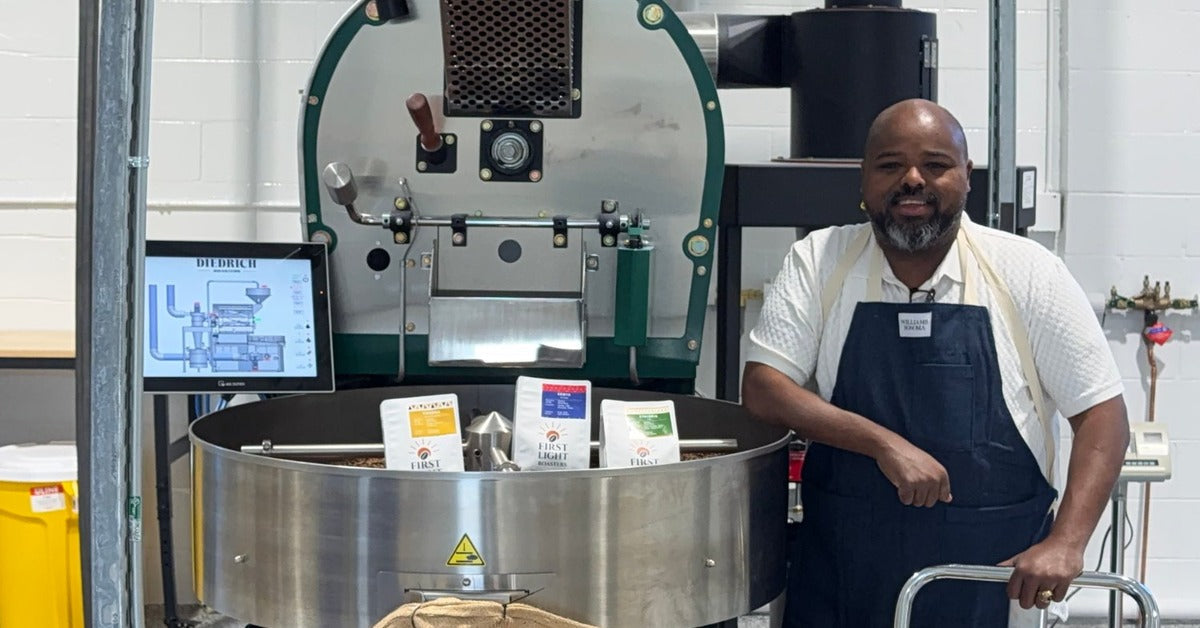
We roast in Livonia, Michigan on a Diedrich drum roaster, and we take this coffee to medium. Bourbon is a sweet variety, and the job of the roast is to turn that sweetness into cocoa without cooking off the fruit.
- Too light, and the red currant turns sour and grassy. The body thins out.
- Too dark, and the currant and orange disappear. You get a generic dark chocolate cup and lose the reason to buy a Rwandan in the first place.
- Medium is where the cocoa is developed, the body is syrupy and the fruit is still bright.
Every bag is roasted to order and ships within 48 hours of roast, with the roast date on the bag. For pour-over and drip it drinks well from about five days after roast. For espresso, give it a week to ten days.
How do you brew Rwandan coffee?
Use filtered water, a scale and a 1:16 ratio (1 gram of coffee to 16 grams of water) as your starting point. This is a medium roast, so use water just off the boil, around 205°F. If your tap water is hard, read our guide to the best water for coffee first. Hard water mutes the red currant before anything else.

Five starting recipes for our Rwanda. Save it, then adjust the grind by taste.
| Method | Coffee | Water | Grind | Temp | Time |
|---|---|---|---|---|---|
| Pour-over (V60, Kalita) | 20 g | 320 g | Medium-fine, like table salt | 205°F | 2:45 to 3:15 |
| Chemex | 30 g | 480 g | Medium, like coarse sand | 205°F | 4:00 to 4:30 |
| Drip machine | 60 g | 1,000 g (1 liter) | Medium | Machine set | 4 to 6 min |
| French press | 30 g | 450 g | Coarse, like sea salt | 205°F | 4:00 steep |
| Espresso | 18 g in | 40 g out | Fine | 201°F | 27 to 32 sec |
Pour-over, step by step
Pour-over is where the red currant and orange zest are clearest.
- Rinse the paper filter with hot water and empty the rinse water.
- Add 20 g of medium-fine coffee and start a timer.
- Pour 50 g of water to wet all the grounds. Wait 35 seconds. This is the bloom, and it lets gas escape so the water can do its work.
- Pour slowly in circles to 180 g by 1:15.
- Pour to 320 g by 2:00, then let it drain. Aim to finish between 2:45 and 3:15.
Chemex, for the cleanest cup
The thick Chemex filter holds back oils and fine particles, so the cup is very clear and the orange zest stands out. Use 30 g of coffee and 480 g of water. Bloom with 60 g for 40 seconds, then pour in two or three slow stages and let it finish around 4:00 to 4:30. This is the brew to make when you have a guest who says they do not like fruity coffee.
French press, for the cocoa
Want it heavier and more chocolatey? Steep 30 g of coarse coffee in 450 g of water for 4 minutes, break the crust with a spoon, skim the foam, and press gently. The fruit moves to the background and the syrupy body comes forward.
Buying ground? Tell us your brew method at checkout. We grind to order with a separate setting for each method.
Is Rwandan coffee good for espresso?
Yes, if you like a bright, sweet shot. Start at 18 g in and 40 g out in 27 to 32 seconds at 201°F. The slightly longer ratio and hotter water tame the acidity and bring out the cocoa. Expect a red fruit sweetness up front and an orange finish. In a cortado or a small latte it tastes like chocolate-covered berries.
If the shot is sour, do not updose. Grind a touch finer and let the shot run a few grams longer. If you want crema and punch for big milk drinks every day, our Signature Espresso is built for that.
How do you fix a cup that tastes off?
| If the cup tastes | Likely cause | Fix |
|---|---|---|
| Sour, like unripe berries | Under-extracted: grind too coarse, water too cool, or brew too fast | Grind finer, use water just off the boil, slow your pour |
| Bitter and drying | Over-extracted: grind too fine or brew too long | Grind coarser or shorten the brew |
| Flat, cocoa only, no fruit | Water too hard, or coffee past its best | Try filtered water, check the roast date |
| Weak and tea-like | Not enough coffee | Move from 1:16 to 1:15 |
| Espresso sharp and fast | Shot ran under 25 seconds, or the coffee is too fresh | Grind finer, and rest the bag a week after roast |
Change one thing at a time. Grind first, then ratio, then temperature.
What should you eat with it?
Red currant, cocoa and orange zest point straight at the pastry case:
- Chocolate croissant. The cocoa in the cup meets the chocolate, and the fruit cuts the butter.
- Cranberry orange scone. Tart berry and citrus on both sides of the table.
- Michigan dried tart cherries and dark chocolate. A handful of each next to a pour-over is the simplest pairing we know.
- Strawberry or raspberry danish. Red fruit with red fruit.
- Almond biscotti. Something dry and nutty to set off a syrupy cup.
- Orange olive oil cake. Brings the zest in the finish forward.
Coffee in Rwanda: a short history
German missionaries and settlers brought coffee to Rwanda in the early 1900s. Under Belgian colonial rule in the 1930s and 1940s, production was scaled up and coffee growing was made mandatory. The goal was volume, not quality. By 1970 coffee earned about 70% of the country's export revenue, and from 1973 it was illegal to pull a coffee tree out of the ground (Sucafina, Rwanda origin report).
For most of that century, Rwanda grew coffee to sell, not to drink, and it sold cheap. Then came the 1994 genocide against the Tutsi, and coffee exports collapsed along with nearly everything else.
What happened next is one of the great turnarounds in coffee. Rwanda rebuilt its coffee sector around quality. The first central washing station opened in 2001. In 2008 Rwanda held its first Cup of Excellence, the best known quality competition in specialty coffee. Farmers who deliver cherry to washing stations have, in many cases, seen their income more than double, according to Sucafina.
It is still not an easy origin. Rwanda has no port. Every sack travels about 1,500 kilometers overland to Mombasa in Kenya or Dar es Salaam in Tanzania before it ever sees a ship. When a bag of Rwandan coffee reaches a roaster in Michigan, a lot of people have carried it a long way.
We have written more about that story in The Rwanda Renaissance.

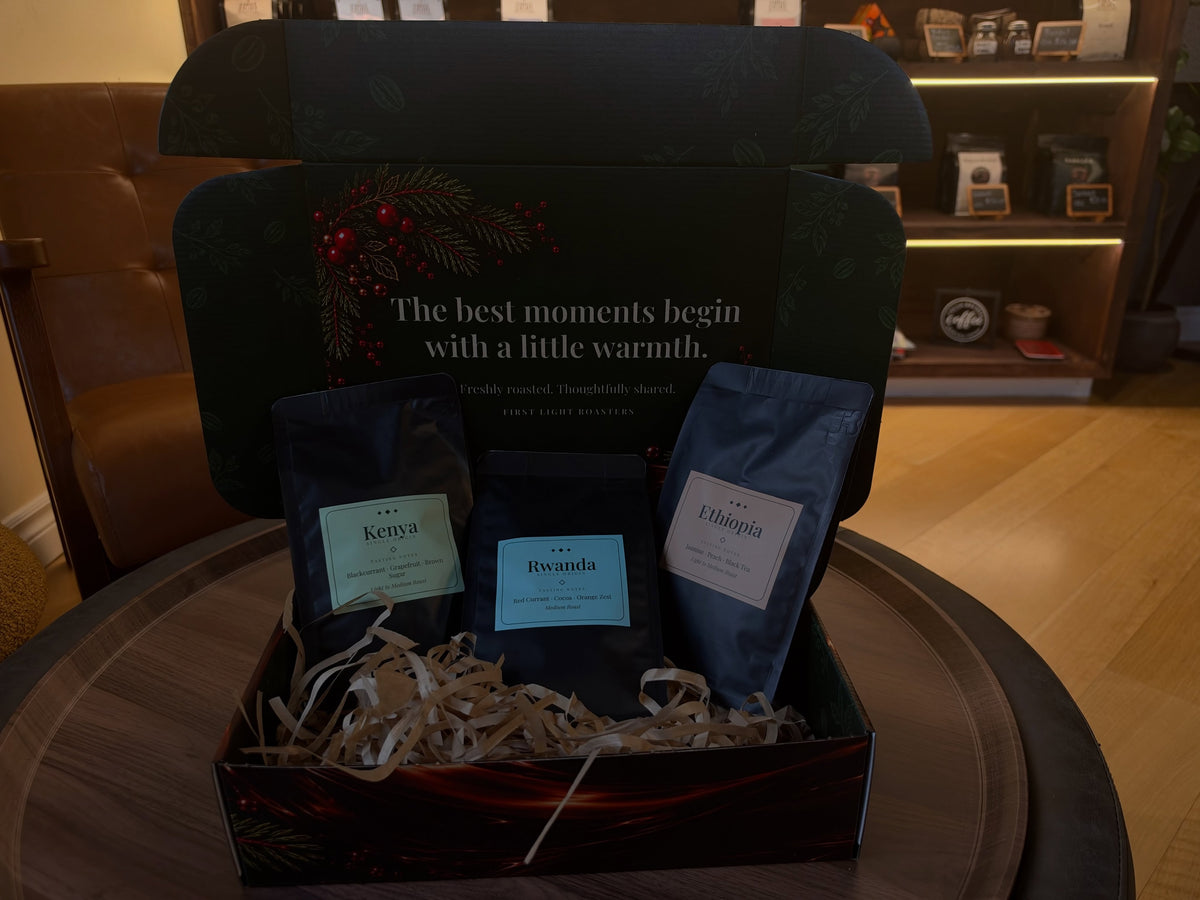
Rwanda in the middle, between Kenya and Ethiopia, in one of our gift boxes. The blue label lists its notes: red currant, cocoa, orange zest.
Frequently asked questions
What does Rwandan coffee taste like?
Sweet, clean and gently fruity, with red fruit, cocoa and citrus and a fuller body than most bright coffees. Our Rwanda tastes like red currant, cocoa and orange zest.
What is Red Bourbon coffee?
Bourbon is one of the oldest arabica varieties, prized for sweetness and cup quality at high altitude. Red Bourbon is Bourbon whose cherries ripen red. It makes up about 95% of the coffee trees in Rwanda.
Is Rwandan coffee similar to Kenyan or Ethiopian coffee?
It sits between them. Rwanda is softer and rounder than Kenya, and deeper and more chocolatey than a washed Ethiopia. If you like East African coffee but want less sharpness, start with Rwanda.
What is the potato defect in Rwandan coffee?
It is a rare off flavor found in coffee from Rwanda and neighboring Burundi that makes a cup smell like raw potato. It is linked to bacteria that get into the cherry, often after insect damage. It is harmless, and it affects single beans, not whole bags. Careful sorting at the washing station has made it much less common. If you ever get a cup that smells like potato peel, grind a fresh dose and brew again.
Is Rwandan coffee good for espresso?
Yes. A medium roast Rwandan pulls a sweet, bright shot with red fruit and cocoa. Start at 18 g in, 40 g out, in 27 to 32 seconds, and use it in small milk drinks such as a cortado.
Is Rwandan coffee high in acidity?
It is bright but balanced. The acidity is closer to red berries and orange than to lemon, and the syrupy body and cocoa note round it off. It is less sharp than Kenya.
First Light Roasters is co-founded by Sam Noor and Amal Almaflahi. Roasted for clarity. Crafted at first light.

Leave a comment
This site is protected by hCaptcha and the hCaptcha Privacy Policy and Terms of Service apply.