Article: Decaf Coffee Guide: Swiss Water Process, Taste, Caffeine and How to Brew It
Decaf Coffee Guide: Swiss Water Process, Taste, Caffeine and How to Brew It
Our Decaf is a medium roast decaffeinated with the Swiss Water Process, which uses water and carbon filters instead of chemical solvents. It tastes like cocoa, vanilla and caramel, with low acidity. Brew it at 1:16 for drip or pour-over with water around 200°F, and grind a step finer than you would for regular coffee if you pull it as espresso.
This guide covers how decaf is made, how much caffeine is left in the cup, what ours tastes like, how we roast it, a recipe for every brewer, how to fix a cup that tastes off, what to eat with it, and a short history of decaf.
What is Swiss Water Process decaf?
All decaf starts as ordinary green, unroasted coffee. The caffeine is taken out before the coffee ever reaches a roaster. The question is what does the taking out.
Much of the world's decaf is made with a chemical solvent that bonds to caffeine. The Swiss Water Process does the job with water, time and carbon. The company that runs it describes four steps (Swiss Water, decaffeination process):
- Clean and soak. The green coffee is cleaned and hydrated in water so the beans swell.
- Caffeine leaves. The beans sit in Green Coffee Extract, which is water already loaded with coffee's soluble flavor compounds but holding no caffeine. Because the water is already full of everything else, only the caffeine moves out of the bean.
- Dry. The decaffeinated beans are dried at low temperature, bagged and shipped to roasters.
- Filter and reuse. The extract runs through carbon filters that trap the caffeine, and the clean extract goes back to work on the next batch.
No solvents are added at any step. That is what the "Swiss Water Process" line on our bag means.

The Swiss Water Process in four steps. Step two is the clever part: the water is already full of coffee flavor, so only caffeine has anywhere to go.
This coffee at a glance
| Decaf method | Swiss Water Process, no chemical solvents |
|---|---|
| Roast | Medium |
| Tasting notes | Cocoa, vanilla, caramel |
| Acidity | Low |
| Best as | Drip, pour-over, espresso |
| Sizes | 12 oz, 2 lb and 5 lb whole bean, 12 oz ground |
How much caffeine is in decaf coffee?
Very little, but not zero. Three numbers are worth knowing:
- 99.9%. Swiss Water guarantees its decaffeinated green coffee is 99.9% caffeine-free (Swiss Water, How much caffeine is in decaf).
- 97%. That is the minimum caffeine reduction Swiss Water cites as the U.S. standard for calling a coffee decaf. So a decaf at 99.9% clears the bar with room to spare.
- 3 to 15 mg. The same source points to a 2006 University of Florida study that found brewed decaf carried roughly 3 to 15 milligrams of caffeine per cup, depending on cup size and brew method. Swiss Water puts a typical decaf at about a tenth of a regular cup.
What that means for you is a question for your doctor, not your roaster. If you have been told to avoid caffeine entirely, ask before you assume decaf is fine.
What does our Decaf taste like?
Cocoa, vanilla and caramel. It is a sweet, round, low-acid cup, the kind you can drink black after dinner or with a splash of cream.
Cocoa comes first, closer to hot chocolate powder than to dark chocolate. Vanilla sits in the aroma and the middle of the sip. Caramel is the finish, and it gets stronger as the cup cools.
People who say decaf tastes flat are usually remembering one of three things, and none of them is the caffeine:
- Old coffee. Decaf sells slowly in a lot of stores, so the bag on the shelf may have been there for months. Ours is roasted to order.
- Dark roasting to hide a cheap bean. A lot of decaf is roasted very dark, and all you taste is roast.
- Pre-ground coffee. Ground coffee loses aroma quickly, and decaf has less to spare. Buy whole bean and grind fresh if you can.
If you like our House Blend, with its milk chocolate, hazelnut and caramel, this is the coffee in our lineup that sits closest to it without the caffeine.

The bar at Detroit Halite, our cafe in front of the roastery. Look closely at the black mug on top of the pastry case: it reads "Death before decaf." This coffee is our answer to that mug.
How do we roast it?
We roast in Livonia, Michigan on a Diedrich drum roaster, and we take our Decaf to medium.
Decaf is a different animal in the roaster. Green coffee that has been through a water process is no longer green. It arrives tan to brown, and the soaking and drying leave the bean more porous. Two things follow:
- Color lies. A decaf bean looks darker than it is at every stage, so you cannot roast it by eye. You roast it by time, temperature and smell.
- It moves fast at the end. Decaf tends to take on heat quickly late in the roast. Go a little too far and the vanilla and caramel are gone, and you are back to the burnt decaf people complain about.
Medium is where the cocoa is developed, the caramel is sweet and the cup is still clean. Do not be surprised if the beans look a shade darker than our other medium roasts. That is the decaf process, not a darker roast.
Every bag is roasted to order and ships within 48 hours of roast, with the roast date on the bag.

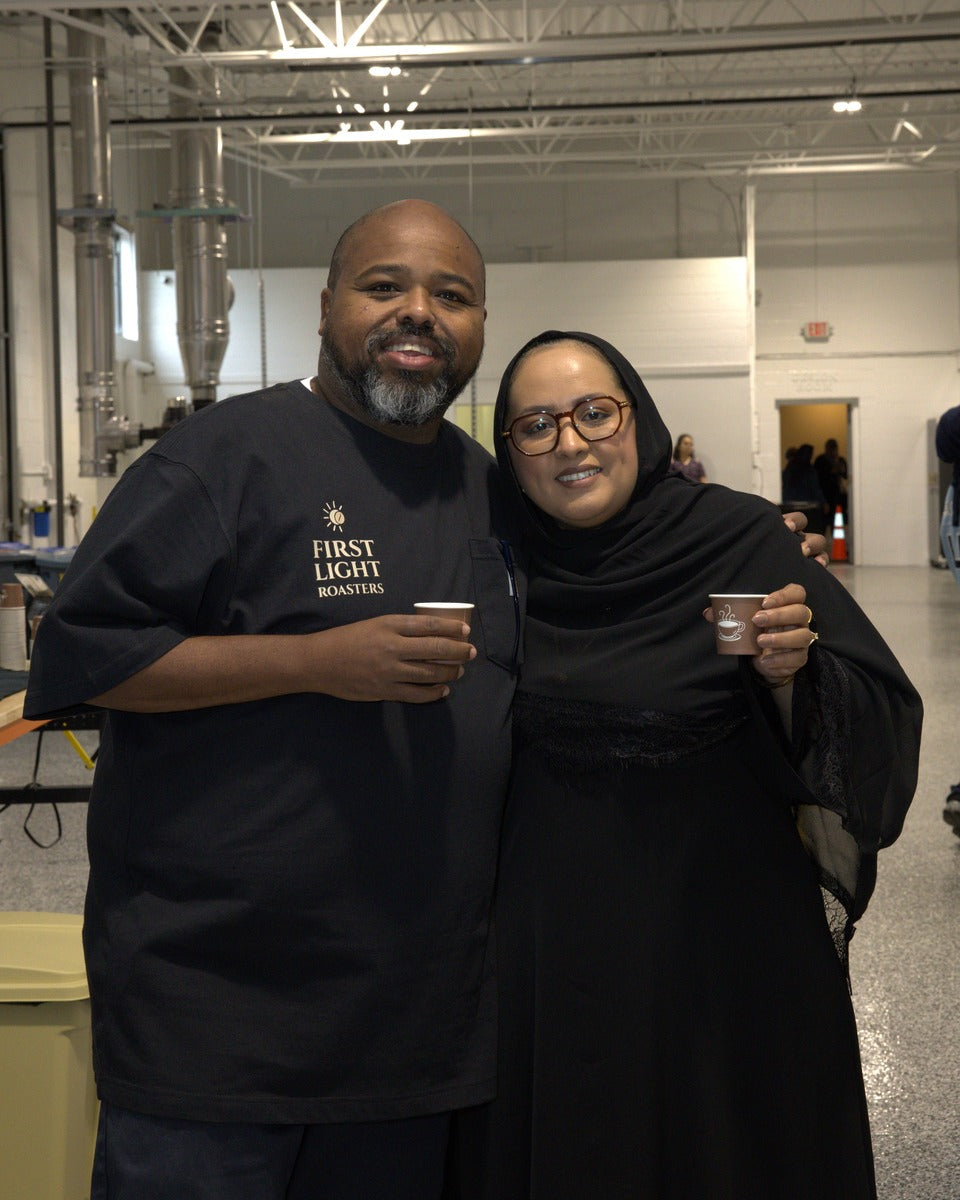
Sam and Amal on the roastery floor in Livonia, sample cups in hand. Behind them, stainless steel ductwork runs up to the roastery ceiling.
How do you brew decaf coffee?
The same way you brew regular coffee, with two small changes: use water a few degrees cooler, and be ready to grind a touch finer. Start at 1:16 (1 gram of coffee to 16 grams of water) with filtered water around 200°F. New to ratios? Our coffee to water ratio chart has the numbers for every brewer.

Five starting recipes for our Decaf. Save it, then adjust the grind by taste.
| Method | Coffee | Water | Grind | Temp | Time |
|---|---|---|---|---|---|
| Drip machine | 60 g | 1,000 g (1 liter) | Medium | Machine set | 4 to 6 min |
| Pour-over (V60, Kalita) | 20 g | 320 g | Medium-fine, like table salt | 200°F | 2:45 to 3:15 |
| French press | 30 g | 450 g | Coarse, like sea salt | 200°F | 4:00 steep |
| AeroPress | 15 g | 240 g | Medium-fine | 195°F | 2:00 |
| Espresso | 18 g in | 36 g out | Fine, a step finer than regular | 198°F | 25 to 30 sec |
Drip machine, for the evening pot
This is how most people drink decaf. Use 60 g of medium-ground coffee per liter of water. If your machine has no scale markings you trust, weigh the water once and mark the carafe. Drink it within half an hour, or move it to a thermal carafe. A hot plate cooks the caramel out of it.
Pour-over, step by step
- Rinse the paper filter with hot water and empty the rinse water.
- Add 20 g of medium-fine coffee and start a timer.
- Pour 50 g of water to wet all the grounds and wait 30 seconds. Decaf blooms less than regular coffee. A quiet bloom does not mean the coffee is stale.
- Pour slowly in circles to 180 g by 1:15.
- Pour to 320 g by 2:00 and let it drain. Aim to finish between 2:45 and 3:15.
French press, for dessert
Steep 30 g of coarse coffee in 450 g of water for 4 minutes, break the crust, skim the foam and press gently. The body gets heavier and the cocoa comes forward. This is the one to put on the table with dessert.
If your tap water is hard, read our guide to the best water for coffee. Hard water flattens a low-acid coffee quickly.
Is decaf good for espresso?
Yes, and it is the reason a lot of people buy it: a cappuccino at 8 pm. Start at 18 g in, 36 g out, in 25 to 30 seconds at about 198°F.
Expect to change your grinder. Decaf beans are more brittle and porous than regular beans, so water runs through them faster. If you switch from regular to decaf without touching the grinder, the shot will usually gush. Go a step or two finer and check the time again.
Two more things to know:
- Less crema. Decaf holds less gas, so the crema is thinner and fades sooner. Judge the shot by taste and time, not by looks.
- It shines in milk. Cocoa, vanilla and caramel are the flavors people add to lattes on purpose. In a flat white or a small latte, this coffee leans toward dessert with no syrup at all.
For a regular espresso built for crema and big milk drinks, see our Signature Espresso guide.
How do you make half-caff?
Mix it yourself. Weigh equal parts Decaf and a regular coffee, then grind and brew them together. A 50/50 mix cuts the caffeine roughly in half. Use one part regular to three parts Decaf if you want to cut it further.
Pick a partner with a similar roast so the two extract evenly. Our House Blend is the natural match: both are medium roasts with chocolate and caramel in the cup, so the mix drinks like one coffee, not two.
How do you fix a cup that tastes off?
| If the cup tastes | Likely cause | Fix |
|---|---|---|
| Thin and watery | Grind too coarse or too little coffee | Grind finer first, then move from 1:16 to 1:15 |
| Bitter, ashy | Water too hot or brew too long | Drop the water to 195°F or grind coarser |
| Flat, like cardboard | Coffee past its best, or ground too long ago | Check the roast date, grind right before brewing |
| Sour | Under-extracted | Grind finer and slow the pour |
| Espresso runs in 15 seconds | Grinder still set for regular beans | Go one or two steps finer |
Change one thing at a time. Grind first, then ratio, then temperature.
What should you eat with it?
Decaf is the after-dinner coffee, so pair it like one:
- Cheesecake. The caramel in the cup stands in for the sauce.
- Vanilla ice cream. Pour a decaf espresso over a scoop and you have an affogato that will not keep anyone up.
- Tiramisu. Cocoa on cocoa. You can also make the tiramisu itself with decaf.
- Butter cookies or shortbread. Plain, rich and exactly what vanilla wants.
- Pecan pie. Caramel and nuts on both sides of the table, and a good reason to brew a pot of decaf at Thanksgiving.
- A plain croissant. For the morning cup when you have already had your caffeine.
A short history of decaf
Decaf is more than a century old. The first commercial process was patented in Germany in the early 1900s by a coffee merchant named Ludwig Roselius. It worked, but it used benzene as the solvent, which nobody would accept today. Roselius sold his coffee across Europe, and the idea of coffee without the kick was here to stay.
For most of the twentieth century, decaf meant solvents of one kind or another, and it earned a reputation as the coffee you put up with. Two things changed that. One was water processing, an approach first developed in Switzerland in the 1930s and later scaled up in British Columbia, Canada, where Swiss Water is based. The other was specialty coffee itself. Once roasters started decaffeinating good coffee, not leftovers, decaf started to taste like coffee.
The reason people drink it has not changed: a second cup at 3 pm, a third after dinner, and a full night of sleep.
Frequently asked questions
Is decaf coffee completely caffeine free?
No. Swiss Water Process green coffee is 99.9% caffeine-free, and a study cited by Swiss Water found brewed decaf carried about 3 to 15 mg of caffeine per cup. That is roughly a tenth of a regular cup.
Is Swiss Water Process decaf chemical free?
The Swiss Water Process uses water, Green Coffee Extract and carbon filters to remove caffeine. No chemical solvents are added.
Does decaf coffee taste different from regular coffee?
A little. Decaf is usually softer, with lower acidity and a lighter aroma. Fresh, well-roasted decaf tastes sweet and full. Ours tastes like cocoa, vanilla and caramel.
Why does my decaf espresso run so fast?
Decaf beans are more brittle and porous, so water passes through them faster. Grind one or two steps finer than you do for regular beans and aim for 25 to 30 seconds.
Why do decaf beans look darker?
Water processing turns green coffee tan to brown before it is roasted, so decaf looks darker than a regular coffee at the same roast level. Our Decaf is a medium roast.
Can you mix decaf and regular coffee?
Yes. Weigh equal parts of each and grind them together for half-caff. Choose two coffees with a similar roast, such as our Decaf and House Blend.
First Light Roasters is co-founded by Sam Noor and Amal Almaflahi. Roasted for clarity. Crafted at first light.

Leave a comment
This site is protected by hCaptcha and the hCaptcha Privacy Policy and Terms of Service apply.