Introduction: The Molecular Shield of the Espresso
In the high-resolution world of 2026 specialty coffee, we have spent years perfecting the kinetics of extraction and the thermodynamics of the roast. But as the liquid exits the portafilter, it undergoes a radical phase transition: the creation of crema. At First Light Roasters, our motto: "Roasted for Clarity. Crafted at First Light": demands that we treat this foam not as a decoration, but as a critical sensory interface.
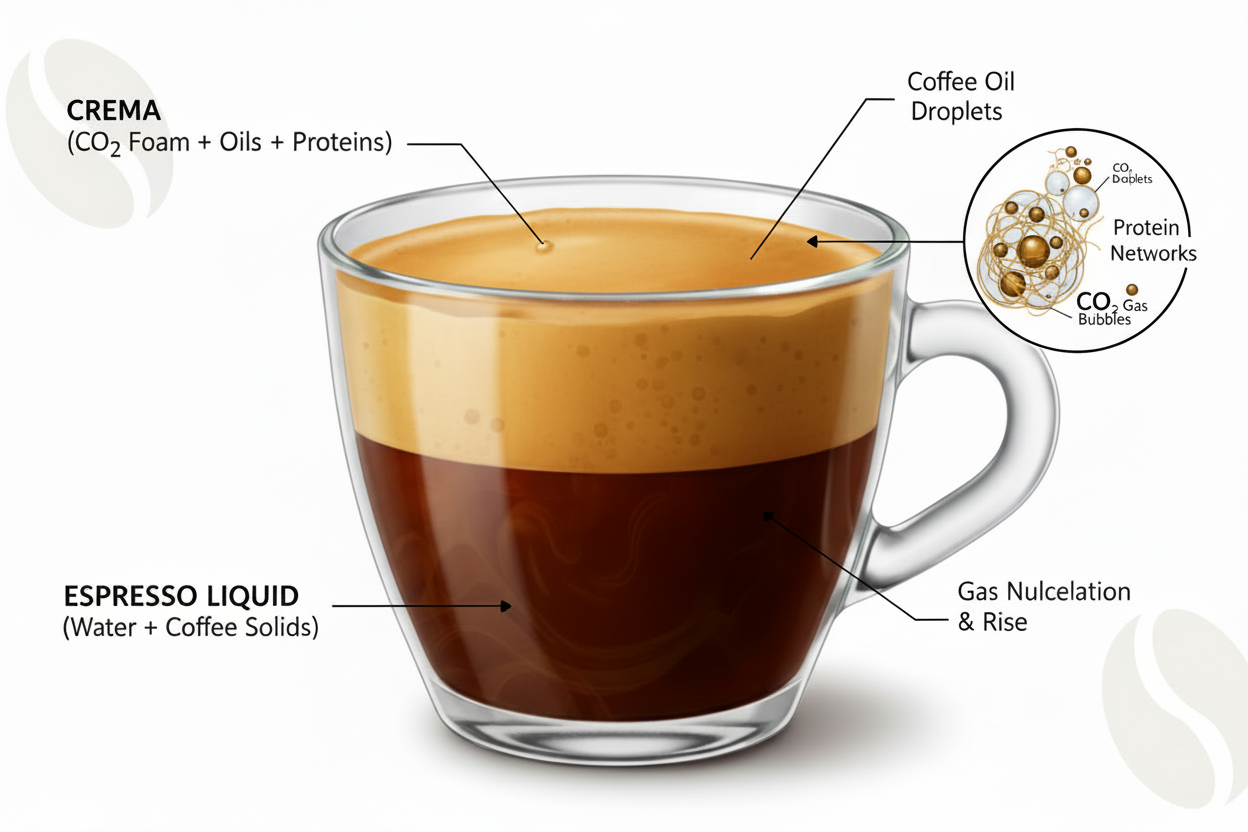
Crema is a colloidal foam consisting of carbon dioxide ($CO_2$) bubbles trapped in a liquid film of emulsified oils, proteins, and melanoidins. In 2026, we understand that this matrix acts as a "molecular shield" (it traps the volatile organic compounds that provide 80% of our flavor perception and prevents them from escaping into the atmosphere before they reach the palate). In this advanced technical guide, we explore the fluid dynamics of the foam matrix, the chemistry of the Marangoni effect, and how the pursuit of clarity is won or lost at the gas-liquid interface.
Master the Foam Matrix
Our 2026 roasts are engineered to produce the perfect lipid-to-gas ratio for maximum aromatic preservation. View our Espresso Collection
I. The Physics of the Colloidal Foam
To understand crema, one must first understand the physics of a colloid (a substance where microscopic particles are dispersed through another substance). In espresso, we are dealing with a triple-phase system: solid (micro-fines), liquid (water and oils), and gas ($CO_2$).
1.1 Surface Tension and Laplace Pressure
The stability of a crema bubble is governed by the relationship between the internal gas pressure and the surface tension of the liquid film. This is modeled by the **Young-Laplace Equation**:
$$\Delta P = \frac{2\gamma}{R}$$In this formula, $\Delta P$ is the pressure difference; $\gamma$ is the surface tension of the coffee-liquid; and $R$ is the radius of the bubble. In 2026, we aim for "Micro-Bubble Uniformity." If the bubbles are too large (high $R$), the internal pressure is too low to maintain the film, leading to rapid coalescence and a loss of the aromatic seal. By utilizing precision pressure profiling, we can manipulate $\Delta P$ to create a dense, persistent matrix that survives the journey to the tongue.
1.2 The Role of Melanoidins
Melanoidins are the brown, nitrogenous polymers produced during the Maillard reaction. In 2026, we recognize them as the primary "structural engineers" of the crema. They act as surfactants, reducing the surface tension ($\gamma$) of the water and allowing it to stretch into a thin film without breaking. A roast that is too light: lacking in developed melanoidins: will produce a "weak" crema that cannot protect the delicate floral esters of an Ethiopian lot.
II. The Marangoni Effect: Driving the Volatile Flow
One of the most complex phenomena in 2026 sensory science is the **Marangoni Effect** (the mass transfer along an interface between two fluids due to a gradient of surface tension).
2.1 Surface Tension Gradients
As the crema sits on top of the espresso, the evaporation of water and the cooling of the surface create a gradient in surface tension. This "Marangoni Stress" pull the liquid (and the flavor compounds trapped within it) toward areas of higher surface tension. This creates a "conveyor belt" of aromatics: constantly bringing fresh volatiles to the surface of the foam where they can be released retronasally during the sip.
2.2 Lipid Interaction and "Crema Cracking"
If the espresso has too many free lipids (fats), they can "poison" the Marangoni Effect. The fats lower the surface tension so dramatically that the gradient disappears, causing the foam to "crack" and collapse. At First Light, we manage the lipid development of our natural process lots to ensure that the crema remains a stable, active delivery system for the entire duration of the tasting experience.
III. Retronasal Efficiency: The Biology of the Slurp
As we established in the Barista Sommelier guide, flavor is 80% smell. The crema is the physical mechanism that delivers that smell to the olfactory bulb.
3.1 Atomization of the Matrix
When you take a "technical sip" (the slurp), you are not just drinking liquid; you are atomizing the crema matrix. The rapid intake of air breaks the micro-bubbles, releasing the trapped $CO_2$ and the concentrated volatiles directly into the back of the throat. Because the crema has "concentrated" these aromatics (a process known as froth flotation), the aromatic intensity is significantly higher than if you were to drink a filtered coffee.
3.2 The Bitterness Mask
In 2026, we utilize the crema's structure to manage the perception of bitterness. The thick colloidal film can actually coat the tongue, providing a physical barrier between the bitter alkaloids (like caffeine) and the taste receptors. This is why a high-clarity espresso can taste "sweet" even when its chemical composition suggests high bitterness; the pursuit of clarity is as much about physical delivery as it is about chemical extraction.
IV. Technical Variables: Engineering the Interface
To master the crema-volatile interface, the 2026 professional must manage three critical technical variables in the Home Lab.
4.1 Degassing Management
As we explored in the Chemistry of Freshness, $CO_2$ is the propellant of crema. If a coffee is too fresh (less than 5 days off-roast), the gas pressure is too high, leading to a "puffy," unstable foam that tastes of carbonic acid. Conversely, if it is too old, the lack of gas prevents the formation of a stable colloid. The 2026 "Sweet Spot" for the pursuit of clarity is typically 10 to 14 days post-roast.
4.2 The "Nine Bar" Fallacy
In 2026, we have moved beyond the "standard 9 bar" of pressure. High-pressure extraction can actually "emulsify" too many oils into the crema, leading to the Marangoni poisoning we discussed earlier. Many First Light roasts perform better at "Low-Pressure Declines" (starting at 8 bars and dropping to 4 bars), which creates a silkier, more stable volatile interface that highlights the mineral snap of the Rift Valley.
| Variable | Impact on Crema Matrix | Sensory Result |
| Higher Temperature | Increased lipid emulsion | Thicker body, potential bitterness |
| Finer Grind | Increased micro-fine suspension | Dense foam, reduced clarity |
| Longer Pre-infusion | Better $CO_2$ hydration | Uniform bubble size, high stability |
V. The Future of the Interface: Artificial Crema and Beyond
As we look toward the 2030 horizon, the industry is experimenting with "Enhanced Interfaces".
5.1 Acoustic Stabilization
New prototypes in 2026 are using ultrasonic transducers built into the portafilter to "vibrate" the crema as it forms. This acoustic stabilization breaks large bubbles into sub-micron sizes, creating a "Super-Colloid" that can trap 25% more volatiles than a standard extraction. This is the next frontier for the pursuit of clarity.
5.2 Synthetic Surfactants?
While First Light Roasters remains committed to pure, unadulterated bean science; some in the industry are experimenting with adding organic proteins to the roast to "supercharge" the foam. We believe the answer lies in the genetic heritage of the plant: by breeding for specific protein and lipid ratios, we can create the "Perfect Crema" without chemical intervention.
Conclusion: The Resolution is in the Foam
Crema is the most visible sign of an espresso's technical health: but its true value is invisible. It is the biological and physical gatekeeper of flavor. By understanding the Laplace pressure, the Marangoni effect, and the role of melanoidins, you elevate your espresso from a drink into a technical masterpiece.
At First Light Roasters, we provide the molecular foundation: but you are the architect of the interface. This is exceptional specialty coffee, crafted at first light, for a refined and full-bodied experience consistently delivered on a global scale. Watch the pour. Master the matrix. Experience the clarity.
Optimize Your Volatile Interface
Roasted to provide the ideal chemical precursors for a stable, high-resolution crema. Shop our Espresso Blends
FAQ: The Physics of Espresso Crema
Is crema actually good for flavor?
Yes and no. While the crema itself can be bitter if tasted in isolation, its primary function is to trap and deliver aromatic volatiles to the olfactory bulb. Without a stable crema, your espresso would lose its aromatic clarity almost instantly.
What is the "Marangoni Effect" in coffee?
The Marangoni Effect is the movement of fluid along an interface due to surface tension gradients. In a cup of espresso, it creates a circulation that brings fresh aromatics to the surface, enhancing the retronasal experience.
Why does my crema disappear so quickly?
This is usually caused by either using "stale" coffee that has lost its $CO_2$ propellant, or by extracting at too high a temperature, which over-emulsifies the lipids and "poisons" the foam matrix.
Does crema indicate quality?
Not necessarily. A very thick crema can be a sign of high-percentage Robusta or beans that are too fresh. In 2026, we look for "Quality of Structure" (uniform, microscopic bubbles) rather than sheer volume.
How does roast level affect crema?
Darker roasts produce more $CO_2$ and more melanoidins, which leads to a larger volume of crema. However, the First Light light-roast style focuses on "Structural Stability" (preserving the organic acids and lipids needed for a high-resolution aromatic seal).
Can I make espresso without crema?
Technically, yes (this is what happens in a "Salami Shot" or high-extraction filtered espresso). While this can result in extreme clarity of taste, it often lacks the "Aromatic Punch" and mouthfeel that a stable crema-volatile interface provides.
What are "Melanoidins"?
Melanoidins are brown polymers formed during the roasting process. They act as surfactants that stabilize the liquid film surrounding the $CO_2$ bubbles in crema, ensuring the foam doesn't collapse immediately.
What is "Froth Flotation" in coffee?
Froth flotation is the process by which gas bubbles (crema) carry lighter flavor compounds to the surface. This concentrates the aromatics at the top of the cup, which is why the first sip of an espresso is often the most intense.
How does water chemistry affect crema?
High Calcium levels can lead to a "chalky," unstable crema, while Magnesium helps to extract the proteins and lipids needed for a silkier, more persistent foam matrix.
Why is 2026 the year of "Sensory Architecture"?
The convergence of high-speed imaging, molecular analysis, and precision brewing has allowed us to understand the microscopic structures of coffee for the first time, moving us from "guessing" to "engineering" the cup.