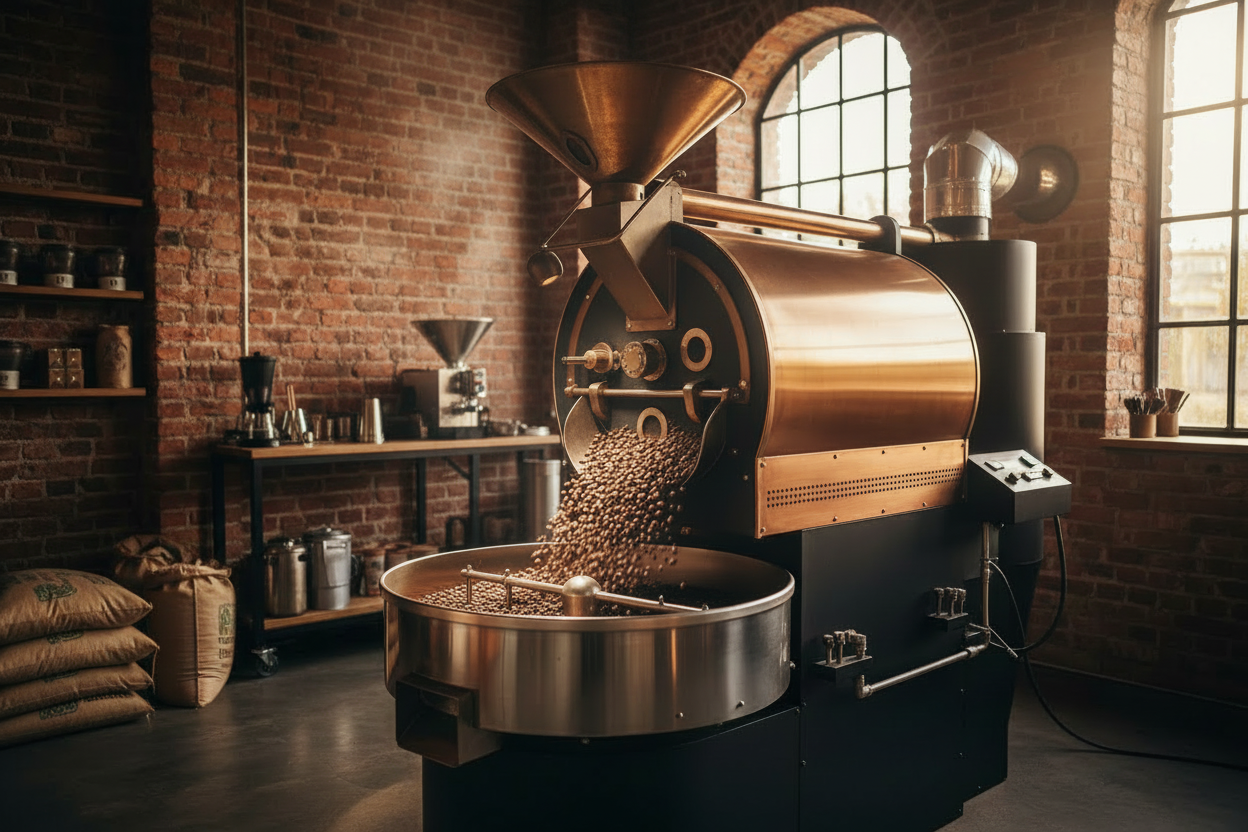
Introduction: Reinventing the Fire
For over a century, the specialty coffee industry has been tethered to a single mechanical concept: the gas-fired, rotating iron drum. While this method has produced billions of incredible cups, it is inherently limited by "thermal lag" and uneven heat distribution—variables that the 2026 market is no longer willing to accept. At First Light Roasters, our motto, "Roasted for Clarity. Crafted at First Light," drives us to embrace technologies that offer surgical control over the bean's chemical transformation.
Whether it is the penetrating power of Infrared radiation or the weightless precision of Fluid-Bed convection, the goal of 2026 roasting is **Molecular Specificity**. To honor the volcanic mineral integrity of our beans, we must use tools that can target specific chemical reactions—like the Maillard reaction and Strecker degradation—without "scorching" the delicate surface sugars. In this guide, we explore the physics of 2026 roasting technology and why your cup of Kenyan AA has never tasted more defined.
Experience the Next Generation of Roast
Our 2026 collection utilizes hybrid roasting technology to maximize aromatic preservation and flavor definition. View our Single-Origin Collection
I. The Thermodynamics of Heat Transfer: 2026 Standards
Roasting is fundamentally an exercise in managed thermodynamics. To move coffee from a green, grassy seed to a complex aromatic powerhouse, we must navigate three primary modes of heat transfer: **Conduction, Convection, and Radiation**.
1.1 Moving Away from Conduction: The End of Scorching
Traditional drum roasters rely heavily on conduction—the direct transfer of heat from the hot metal drum to the bean. In 2026, we view conduction as a "blunt instrument." Because the drum surface is significantly hotter than the target bean temperature, it creates a risk of "scorching" and "tipping". For clarity-focused roasts, scorching is a disaster; it introduces carbonized, ashy flavors that muffle the terroir-specific notes of the Rift Valley. Modern technology aims to minimize conductive contact in favor of more controllable energy sources.
1.2 Convection: The 2026 Convective Standard
Convection—heat transfer via a moving fluid (air)—is the heart of the specialty movement. By increasing the air-to-bean ratio, roasters can achieve a more uniform "envelope" of heat. In 2026, we use high-velocity convective systems that allow us to lower the overall roasting temperature while maintaining the same energy transfer rate, preserving the delicate volatile compounds.
II. Infrared Roasting: The Power of Radiant Energy
Infrared (IR) roasting represents the most significant leap in radiant heat technology in fifty years. Unlike traditional burners that heat the air inside the drum, IR waves transmit energy directly into the cellular structure of the bean via electromagnetic radiation.
2.1 The Physics of Core-First Development
Standard heat sources are "surface-in" heaters. They heat the exterior of the bean, and that heat must migrate to the center through the bean's own density. Infrared waves, however, have a specific wavelength that allows them to penetrate the bean's surface. This enables a "Core-First" roast. For the dense, high-altitude beans of the Ethiopian highlands, this is a game-changer. We can fully develop the internal sugars and organic acids without over-caramelizing the exterior, resulting in a cup with unparalleled sweetness and a clean, lingering finish.
2.2 Preserving the Volatile Mosaic
Infrared roasting is typically 20-30% more efficient than gas roasting. By reducing the total "time-on-heat," we minimize the "roast-born" flavors that can muddle a cup. As we explored in the Chemistry of Freshness, volatile compounds are sensitive to prolonged heat exposure. IR roasting effectively "catches" the flavor at its peak, locking in the jasmine and bergamot notes that make East African coffee the undisputed king of clarity.
III. Fluid-Bed Roasting: The New Standard for Uniformity
Fluid-Bed (or "Air") roasting has transitioned from an industrial niche to the cutting edge of specialty coffee in 2026. These machines operate on a principle of fluid dynamics: using a high-velocity stream of hot air to levitate the beans in a "fluidized" state.
3.1 Weightless Precision
In a fluidized bed, every single bean is surrounded by a constant, uniform stream of hot air. This eliminates the "mechanical hot spots" found in rotating drums. For natural processed coffees, which often have higher sugar content and varying moisture levels, this uniformity prevents the "muddled" or "burnt jam" flavors that occur when some beans roast faster than others.
3.2 The Chaff Extraction Advantage
Chaff—the silverskin that detaches from the bean during roasting—is a major source of bitter, "papery" off-flavors if it remains in contact with the beans for too long. In a drum roaster, chaff often lingers in the drum. In a Fluid-Bed roaster, the high-velocity air instantly carries the chaff away into a collection chamber. This results in a significantly higher "Perceived Clarity" in the cup, allowing the home lab technician to taste the terroir without environmental interference.
IV. AI and Molecular Modeling: The 2026 "Digital Twin"
The modern roaster no longer relies on intuition alone. In 2026, every roast at First Light is managed by an AI "Digital Twin" that models the chemical reactions inside the roaster in real-time.
4.1 Real-Time Maillard Tracking
By utilizing infrared sensors and gas chromatography, our systems monitor the concentration of sugars and amino acids. We can track the precise millisecond the Maillard reaction begins and the rate at which sugars are caramelizing. If the reaction progresses even 1.5% outside of our target "Clarity Curve," the AI automatically adjusts the energy input or air-flow to correct the trajectory. This level of technical innovation makes the pursuit of excellence repeatable across thousands of batches.
4.2 Acoustic Pattern Recognition
"First Crack" is the most critical moment in the roast—the point at which steam pressure within the bean causes the cell walls to burst. AI-driven microphones now analyze the acoustic frequency of the crack. By processing this audio data, the AI can predict the optimal "Development Time" to within 0.5 seconds, ensuring that a bright PB lot never loses its sparkling acidity to over-roasting.
V. The Sustainable Roastery: Electrification and Recapture
In 2026, the ethics of the roastery are inextricably linked to the ethics of the farm. Gas-fired roasting is being phased out in favor of high-efficiency electric and hydrogen-hybrid systems.
5.1 Decarbonizing the Pursuit of Clarity
Electric roasters, when powered by renewable energy, allow us to achieve a "Carbon Neutral" roast. This complements the regenerative forestry of our partners in the Rift Valley, creating a truly closed-loop specialty coffee ecosystem. Electric heating elements also provide a much more stable and "clean" heat source than fossil fuels, which can introduce combustion byproducts into the roasting chamber.
5.2 Closed-Loop Heat Recapture
Modern 2026 roasters utilize advanced heat exchangers to recapture the energy of the exhaust. We use the heat from one batch to pre-heat the next, reducing total energy consumption by up to 45%. This efficiency allows us to invest more into our farmers while maintaining the most technical roasting standards in the world.
Conclusion: The New Era of Definition
The technology of 2026 has finally caught up to the complexity of the bean. By moving beyond the mechanical limitations of the 19th-century drum, we are able to reveal the ancient soul of the Rift Valley with absolute digital precision.
At First Light Roasters, we are proud to lead this technical revolution. Whether it is IR waves or high-velocity air, we will use every tool at our disposal to fulfill our promise: exceptional specialty coffee, crafted at first light, for a refined and full-bodied experience consistently delivered on a global scale. The future of clarity has arrived.
Taste the Precision
Our beans are roasted using a hybrid of IR and Fluid-Bed technology for maximum flavor definition. Shop the 2026 Collection
FAQ: Roasting Technology in 2026
Is Infrared roasting better than gas?
IR roasting offers deeper heat penetration and faster roast times, which preserves more of the delicate aromatic volatiles compared to traditional gas-fired drums. It allows for a "cleaner" taste by reducing the risk of exterior scorching.
What is a Fluid-Bed roaster?
A Fluid-Bed roaster uses a stream of high-velocity hot air to levitate and roast the beans in a state of suspension. It provides absolute uniformity and instantly removes chaff, resulting in a very high-clarity cup profile.
Does AI change the taste of the coffee?
AI ensures technical consistency. By monitoring chemical reactions at a molecular level, AI can replicate a "perfect" roast profile every single time, ensuring that the bag of First Light you buy today is as technically perfect as the one you bought last month.
Why are electric roasters becoming more common?
Electric roasters are more energy-efficient, produce fewer emissions, and can be powered by renewable energy. They also offer more granular control over heat application compared to older gas systems.
What is "scorching" in roasting?
Scorching occurs when the bean's surface is charred due to excessive conductive heat from contact with a hot metal drum. This results in a bitter, ashy taste that masks the coffee's natural clarity.
What are "volatile compounds"?
VOCs are the chemical building blocks of flavor and aroma. The goal of 2026 roasting technology is to develop the sugars and acids while minimizing the loss of these heat-sensitive compounds.
Is drum roasting still relevant in 2026?
Yes; modern drum roasters have been updated with IR burners and sophisticated digital controls. While the core concept is old, the execution in 2026 is a high-tech hybrid that still produces world-class results.
How does roasting affect East African coffee specifically?
East African beans are high-density, meaning they require more energy to penetrate the core. Technology like IR and Fluid-Bed roasting is particularly well-suited for these "powerhouse" beans because it ensures internal development without burning the shell.