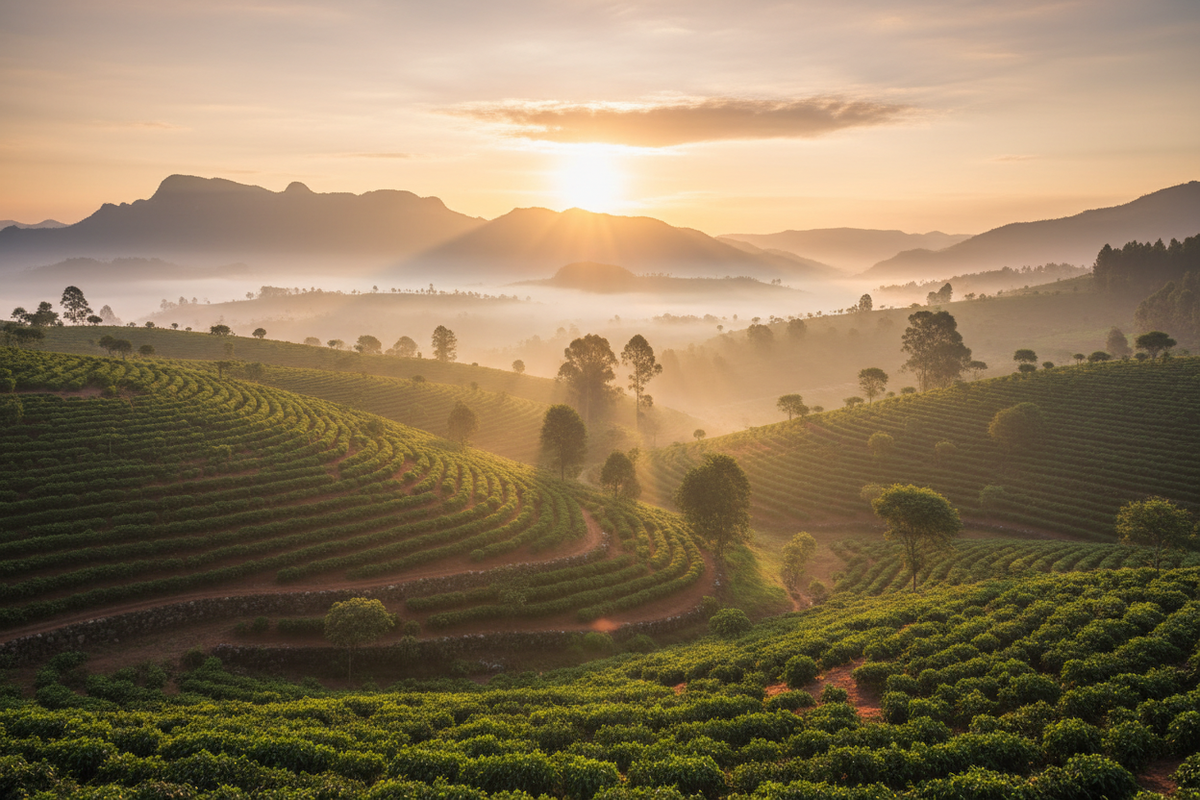
Introduction: The Philosophy of the First Light
In the global landscape of specialty coffee, there is a distinct hierarchy of complexity. While the vast plantations of the Americas often provide comforting, chocolatey, and nutty profiles, East African coffee exists on an entirely different sensory plane. It is frequently described as wine like, sparkling, or tea like, but for the true coffee connoisseur, these descriptors are merely the gateway to a deeper geological truth.
At First Light Roasters, our motto is "Roasted for Clarity. Crafted at First Light." This is a technical commitment to a specific roasting philosophy that honors the raw, volcanic potential of the bean. Clarity is the ability to distinguish the individual voice of the terroir: the jasmine of a high altitude Yirgacheffe or the deep blackcurrant of a Kenyan Nyeri. To achieve this in the roaster, we must first master the geological and chemical forces of the Great Rift Valley. We celebrate the unique taste of Great Rift Valley coffee, grown in the rich, volcanic soils that make it special, giving the coffee a clear and complex flavor profile that stands unmatched on the world stage.
I. The Geological Marvel of the Great Rift Valley
The Great Rift Valley is a massive geological scar stretching over 750 km in Ethiopia alone. Formed by extensive downfaulting of the Earth’s crust during the Tertiary and Pleistocene periods, it represents a series of fractures extending from the Dead Sea to Mozambique. The region's geological wonders create a unique terroir that makes the coffee experience both refined and full bodied.
1.1 Tectonic Forces and the Somali-Nubian Divergence
The valley was created by the pulling apart of the African tectonic plate into the Somali and Nubian plates. This tectonic activity triggered intense volcanism, depositing both alkaline (basaltic) and acidic (rhyolitic, pumice, and ash) rocks. For coffee cultivation, this diversity in parent material means that East African soils are among the most mineral rich on the planet.
1.2 The Timeline of Formation
The Great Rift Valley began forming around 20 million years ago, with the initial formation creating the highlands that now define Ethiopia and Kenya. Coffee cultivation in the region started thousands of years later, with Ethiopia's coffee history alone stretching back over 1,000 years. During the Pleistocene Period, intense volcanic eruptions blanketed the region in ignimbrites and ash, laying the foundation for the fertile environment we utilize today. This geological history and coffee cultivation practices have led to the renowned coffee quality we enjoy today, offering a variety of coffee types and flavors tailored by high altitudes and rich soils.
Taste the Volcanic Terroir
Experience the unique mineral complexity of the Rift Valley. Shop our current collection here
II. Why Volcanic Soil Creates Superior Coffee Beans
The Great Rift Valley's volcanic soil is key to making top notch coffee beans. This soil, often classified as Andosols, is packed with minerals that boost coffee's taste and quality. Andosols are crucial for groundwater storage and nutrient delivery due to their porous nature, developed primarily on basaltic outflows.
2.1 Essential Minerals: The Macro-Nutrient Profile
East African volcanic soils are full of Nitrogen and Phosphorus, which are crucial for coffee plants' health and growth.
-
Nitrogen (N): Nitrogen helps coffee plants grow, supporting leaf and chlorophyll development and driving the plant's metabolic energy.
-
Phosphorus (P): Phosphorus aids in root development, flower and fruit formation, and plant maturity. Interestingly, Phosphorus uptake by coffee plants often decreases with elevation, creating a metabolic stress that forces the plant to concentrate flavor precursors into the seed.
2.2 Trace Elements and Cation Exchange
Volcanic soils have a high Cation Exchange Capacity (CEC), allowing the plant to absorb vital trace elements like Potassium, Magnesium, and Calcium.
-
Potassium (K): Essential for water regulation, overall plant health, and disease resistance; its uptake tends to decrease with increasing elevation.
-
Magnesium (Mg): Crucial for photosynthesis and fruit growth, contributing to the sweetness and body of the coffee.
-
Calcium (Ca): Vital for cell wall structure and the long term physical stability of the green bean.
| Mineral | Role in Production | Impact on Flavor |
| Nitrogen | Promotes leaf growth and chlorophyll production | Contributes to overall plant health and bean development |
| Phosphorus | Supports root development and fruit formation | Enhances bean maturity and flavor complexity |
| Potassium | Essential for water regulation and plant health | Improves disease resistance and bean quality |
| Magnesium | Crucial for photosynthesis and fruit development | Contributes to the sweetness and body of coffee |
III. The Science Behind High-Altitude Coffee Beans
High altitude coffee beans have unique traits because of their elevation. At higher elevations, coffee plants face special conditions: cooler temperatures and thinner air: that greatly affect how their beans develop.
3.1 Elevation and Slow Maturation
Coffee grown at high altitudes (above 1,500m) takes longer to mature because of cooler temperatures. This slower growth lets sugars and organic acids, such as Citric and Malic acids, develop more fully within the bean.
-
Respiration and Metabolism: Slower maturation means the plant's respiration rate is reduced, allowing for a higher accumulation of complex flavor compounds.
-
Cellular Architecture: This results in a bean with a tightly packed cellular structure, known as Strictly Hard Bean (SHB).
3.2 Temperature Fluctuations: The Day-Night Differential
The big temperature gap between day and night at high elevations adds to the coffee's bright acidity and fruit notes.
-
Nighttime Hibernation: Cooler nights prevent the plant from burning off its daytime energy (sugars), preserving the bean's sweetness.
-
Daytime Photosynthesis: Intense equatorial sunlight in regions like Kenya and Ethiopia drives rapid sugar production.
-
Seasonal Variations: The Rift Valley has clear wet and dry seasons, which influence the coffee's growth cycle and flavor profile by altering when it flowers and is harvested.
IV. Bean Density: The Hidden Quality Indicator
Bean density is key to coffee quality; it shows the effort put into making coffee. Coffee beans differ in density due to altitude, processing, and type. Denser beans usually have more complex flavors, more sugars, and better acidity.
4.1 Measuring Coffee Bean Density at Home
While professional labs use precise mass to volume calculations, you can measure coffee bean density at home using a simple cylinder and scale:
-
Preparation: Weigh an empty measuring cylinder or a cup with a known volume (100 mL works best).
-
The Test: Fill the cylinder with green beans up to exactly 100 mL without shaking or compressing them.
-
Analysis: Weigh the full cylinder and subtract the empty weight to get the mass of the beans.
-
Formula: Use the formula: $Density (g/cm^3) = \frac{Mass of beans (g)}{Volume (cm^3)}$. Since 100 mL = 100 $cm^3$, the weight in grams directly equals the density value.
4.2 Density and Roasting Chemistry
Denser coffee beans are more resistant to heat, requiring a higher charge temperature in the roaster to penetrate the core. However, they reward the roaster with a richer, more satisfying profile once the sugars are developed. Knowing about bean density helps you value high quality coffee more and appreciate the effort in making dense, specialty grade beans.
V. The Chemical Signature of East African Coffee
East African coffee is special because of its unique chemical makeup, thanks to the area's geology, climate, and how coffee is grown.
5.1 Unique Acids That Create Bright Flavor Profiles
East African coffee is known for its bright acidity due to specific acids like Citric, Malic, and Phosphoric acid.
-
Citric Acid: Common in Ethiopian Yirgacheffe and Kenyan Nyeri; provides sharp lemon or citrus flavor notes.
-
Malic Acid: Dominant in regions like Kirinyaga and Rwanda; brings a green apple like tartness and crisp finish.
-
Phosphoric Acid: An inorganic acid absorbed from volcanic soil, particularly prevalent in Kenyan Arabica (SL-28 and Batian varieties). It creates a sparkling or effervescent sensation on the tongue that is prized globally.
5.2 Chlorogenic Acid and Antioxidant Properties
Chlorogenic acid (CGA) is key in East African coffee, offering health benefits and subtle bitterness as an antioxidant. Interestingly, CGA concentrations typically decrease as growing altitude increases, which helps maintain the clarity of flavor in high altitude beans.
5.3 Aroma Compounds and Volatile Esters
The aroma of East African coffee is unique, with floral, fruity, and wine like notes. These scents come from compounds like Trigonelline, which breaks down during roasting to produce fragrant aldehydes (pyridines) that define the coffee's smell and provide subtle bitterness to balance acidity.
| Acid Type | Flavor Profile | Influencing Factors |
| Citric Acid | Citrus flavor (lemon/lime) | Soil type, altitude |
| Malic Acid | Green apple like tartness | Processing, climate |
| Phosphoric Acid | Sparkling/Effervescent sensation | Volcanic mineral content |
| Chlorogenic Acid | Subtle bitterness / Antioxidant | Altitude, roast level |
VI. Mapping Specialty Terroir Across East Africa
East Africa's coffee terroir is incredibly rich. From Ethiopia's ancient forests to Kenya's high farms, each country has its own unique taste.
6.1 Ethiopia's Diverse Coffee Landscapes
Ethiopia is the genetic birthplace of Arabica coffee, famous for its ancient forests and over 10,000 landrace varieties.
-
Yirgacheffe and Sidama: Known for floral, tea like structures and top notch quality with intense citrus acidity.
-
Guji and Odo Shakiso: Regions producing unique flavors ranging from floral to fruity, seeing significant production boosts in 2026.
6.2 Kenya's High-Elevation Growing Regions
Kenya's high regions, such as Nyeri, Kiambu, and Kirinyaga, are known for bright acidity and complex flavors. The rich volcanic soil and high altitude (often 1,700m+) make their coffee highly sought after for its phosphoric driven brightness. Grade AA Kenyan coffee continues to dominate due to its large cup size and high end quality profile.
6.3 Tanzania and Rwanda's Emerging Coffee Territories
Kilimanjaro in Tanzania and the hills of Rwanda are becoming key players, producing unique coffee flavors like stone fruit and honey, adding to the region's diverse terroir.
VII. Deep Dive: The 2025/2026 Ethiopia Harvest
The current 2025/2026 season in Ethiopia is one of the most significant in recent history, marked by record production and historic pricing volatility.
7.1 Record Production and Rejuvenation
Ethiopia's coffee production for the 2025/26 season is projected to reach a record 11.6 million bags, an increase of 500,000 bags over the previous year. This growth is largely driven by a massive project that replaced over half of the cultivated area with higher yielding coffee varieties over the last three years.
7.2 The Labor and Pricing Crisis
Despite the record harvest, the season is running later than usual, a trend seen every second year.
-
Cherry Prices: Production costs have surged, with cherry prices increasing significantly (more than doubled) compared to last season.
-
Shift to Naturals: Because of the high cost and speculator influence, many smallholder farmers are choosing to dry cherries at home rather than delivering them to washing stations. This has reduced the volume of washed coffees available early in the 2026 season.
-
Export Prices: Exporters anticipate FOB (Free On Board) prices will be around $1.00 to $1.50 per pound higher than last year depending on quality.
Support Sustainable Quality
Our sourcing directly supports the farmers of the Rift Valley. View our single-origin offerings
VIII. Roasting for Clarity: The First Light Philosophy
At First Light Roasters, our goal is to improve your coffee experience. We aim to deliver exceptional specialty coffee consistently and on a large scale. Our unique roasting science for clarity shows our dedication to every bean we source and roast.
8.1 The Maillard Reaction and Development
To maintain Clarity, we must manage the Maillard Reaction (where sugars and amino acids react) with extreme precision.
-
Density and Heat: Low density coffee conducts heat slower to the bean center than high density coffee. For our dense East African beans, we use higher temperatures and shorter roasting times to produce the desired flavor and avoid inconsistency.
-
Avoiding Defects: If the roast is drawn out too long, the coffee becomes baked and loses its terroir clarity. We manage heat carefully to optimize for flavor during the dry phase, browning phase, and first crack.
8.2 The "Clarity" Standard
Most of our East African lots are roasted to a Light or Light-Medium level. This maximizing of origin characteristics ensures that the volcanic integrity of the Rift Valley is what you taste: not the smoke of the roaster.
IX. Brewing Guide: Extracting the Best from the Rift
To get the most out of Great Rift Valley coffee, you need the right brewing method. This region's unique soil and top notch beans require careful extraction.
9.1 Water Temperature and Quality
The perfect water temperature for brewing Great Rift Valley coffee is between 195°F and 212°F (90°C to 100°C). Because these beans are dense, they require hotter water to extract their complex sugars.
-
Water TDS: Use fresh, filtered water with a TDS of 75 to 250 mg/L. Hard water will neutralize the vibrant Citric and Malic acids.
9.2 Grind Size and Extraction Times
The grind size is crucial for flavor:
-
Pour-Over (V60/Chemex): Medium-fine (like table salt). Aim for an extraction time of 3 to 4 minutes to highlight bright acidity.
-
French Press: Coarse grind with a 4 minute extraction for a fuller body.
-
Espresso: Fine grind for intense fruit concentration.
| Method | Grind Size | Brew Time | Ratio |
| Pour-Over | Medium-Fine | 3 to 4 mins | 60g coffee per 1L water |
| French Press | Coarse | 4 mins | 60g coffee per 1L water |
| Espresso | Fine | 25 to 30 secs | 18g coffee per 36g water |
X. The Future: Climate Change in the Rift Valley
The Great Rift Valley faces big challenges from climate change. Rising temperatures and changes in rain patterns are messing with the perfect conditions for growing coffee.
10.1 Shifting Growing Zones
Warmer weather is moving coffee's traditional growing areas to higher, cooler places. This change can alter the soil composition and the variety of plants available, which might change the coffee's taste over the next decade. In Kenya, projections indicate up to 90% of prime coffee land may become unsuitable by 2050.
10.2 Adaptation Strategies
Coffee farmers are finding ways to deal with these changes:
-
Climate-Resilient Varieties: Planting types that handle heat and drought better.
-
Shade Trees: Using trees to help regulate microclimates and improve soil health.
-
Irrigation: Installing new systems to manage water during the dry seasons.
Conclusion: The Undeniable Superiority of East African Coffee
East African coffee is unmatched due to its unique convergence of volcanic soil, high altitude climate, and a thousand year old coffee culture. The Great Rift Valley provides the foundation for unique flavors and top notch quality that we celebrate in every bag.
As we delve deeper into specialty coffee, East African coffee shines for its clarity, complexity, and consistency. By choosing First Light, you help preserve the region's coffee culture and support sustainable practices. Whether you're a professional or just starting your journey, try East African coffee for its richness and variety: experience the pursuit of clarity.
Ready to experience the brightness?
Shop the East African Collection
Roasted for clarity, delivered fresh to your door.
FAQ
What makes East African coffee so unique?
It is known for its bright acidity and complex flavors, thanks to the region's volcanic soils, high altitudes, and the genetic diversity of its heirloom varieties.
How does the Great Rift Valley contribute to production?
Its unique geology creates mineral rich Andosol soils, and its high altitudes slow down bean maturation, enhancing flavor complexity.
What is the impact of the 2025/26 Ethiopia harvest?
Expect record breaking production (11.6 million bags) but with historic pricing volatility and a tighter supply of washed coffees due to home processing trends.
How should I brew these beans for maximum clarity?
Use the pour over method (V60) with filtered water at 205°F to allow the delicate floral and phosphoric notes to shine.