

The Home Barista’s Lab: Advanced Brewing for Clarity
Introduction: The Final Link in the Quality Chain
You have explored the geological foundations of the Rift Valley, mastered the chemistry of roasting, and understood the ethics of 2026 sourcing. However, the most critical transformation happens in your kitchen. At First Light Roasters, we believe that even the most technically perfect roast can be muted by poor extraction. Our motto, "Roasted for Clarity. Crafted at First Light," requires a final partnership: the home barista as a lab technician.
In 2026, brewing for clarity is no longer a matter of guesswork: it is a scientific pursuit of precision. In this comprehensive guide, we treat brewing as a controlled experiment. We will examine the molecular impact of water chemistry, the physics of grind particle distribution, and the thermal stability required to unlock the jasmine of an Ethiopian heirloom or the phosphoric snap of a Kenyan AA lot. This is the definitive manual for the home coffee lab.
Equip Your Lab for Clarity
Start with the right beans. Our 2026 collection is roasted specifically for high-extraction clarity. View our single-origin offerings
I. Water Chemistry: The Solvent of the Soul
A cup of coffee is approximately 98% water. If your water is "empty" (too soft) or "crowded" (too hard), it cannot effectively pull the target flavor compounds out of the coffee grounds. To brew for clarity, we must move beyond basic filtration and into the realm of **Mineral Stoichiometry**.
1.1 The Role of Magnesium and Calcium
Not all minerals are created equal. Magnesium (Mg2+) is a "sticky" ion. It is highly effective at pulling out sharp, fruity acids and complex sugars due to its high charge density. This makes it the best friend of natural processed Gujis where sweetness is the priority.
Calcium (Ca2+), while necessary for body and a rounded mouthfeel, tends to highlight heavier, chocolatey notes. In the pursuit of clarity, we recommend a water profile that favors Magnesium over Calcium. This prevents the "muddled" taste that occurs when too much Calcium competes with the delicate organic acids of the Rift Valley.
1.2 Buffer, Alkalinity, and the Citric Curve
Alkalinity acts as a buffer against acidity. If your water has too much bicarbonate, it will neutralize the vibrant Citric and Malic acids we worked so hard to preserve in the roaster. However, if alkalinity is too low (as in distilled water), the coffee will taste sharp, thin, and metallic. We recommend a target alkalinity of **40 to 65 ppm** to allow the coffee's natural brightness to shine without being muted or tasting "chalky".
II. The Physics of the Grind: Particle Distribution Dynamics
Your grinder is the most important piece of technology in your lab. When you grind coffee, you are actually performing a brittle fracture of a complex cellular matrix. The result is never uniform: it is a "distribution" of sizes, from large "boulders" to microscopic "fines".
2.1 The Fines Problem: Bitterness and Clogging
Fines have a massive surface-area-to-volume ratio. They over-extract almost instantly, releasing bitter Quinic acids and astringent tannins. In a V60 or Chemex, fines also migrate to the bottom of the filter, creating a "mud" that stalls the brew and leads to uneven extraction. For maximum clarity, your goal is a **Unimodal Distribution**: a graph where most particles fall within a narrow micron range.
2.2 Burr Geometry: The Flat Burr Revolution
In 2026, flat burr grinders have become the standard for the pursuit of clarity. Flat burrs, especially those with unimodal geometry, produce a more uniform grind with fewer fines. This highlights the "layered" flavor notes of East African beans, allowing you to distinguish the bergamot from the lemon. While conical burrs are excellent for producing the texture needed for traditional espresso, they often produce a "muddled" profile in filter coffee that masks technical precision.
III. Thermal Stability and Slurry Fluid Dynamics
Temperature is the engine that drives extraction. However, most baristas focus on the water in their kettle rather than the temperature inside the brewer: the **Slurry Temperature**.
3.1 Thermal Sinks and Preheating Protocols
Ceramic, glass, and even some heavy plastic brewers act as "heat sinks." They steal thermal energy the moment your water touches the coffee. To brew for clarity, you must aggressively preheat your equipment. A cold brewer can drop your 205°F water down to 185°F instantly, leading to a "sour" under-extraction that tastes like under-ripe fruit. In the lab, we recommend using plastic brewers like the Hario V60 (Switch or 02) because plastic has lower thermal conductivity, keeping more heat in the coffee bed.
3.2 Turbulence and Agitation Control
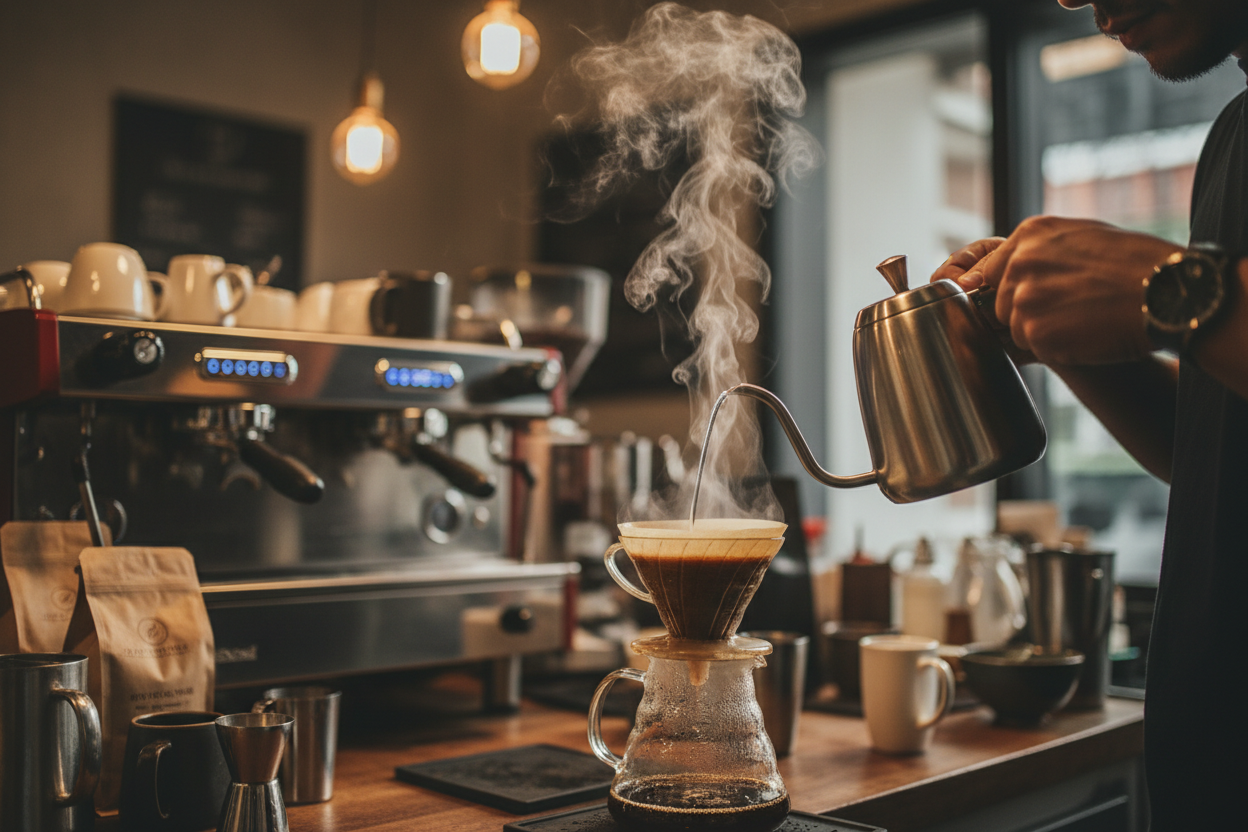
How you pour matters. Every time you pour water, you create **turbulence** that moves the coffee grounds around. Controlled turbulence is your friend: it ensures that every ground is saturated. However, too much agitation (like heavy stirring) forces fines into the pores of the paper filter, which stalls the brew. We recommend a gooseneck kettle for a gentle, consistent stream that manages the "extraction energy" without over-extracting the bottom of the coffee bed.
IV. The Recipe Matrix: Origin-Specific Lab Protocols
Just as we adjust our roast profiles in the roastery, you must adjust your recipes based on bean density and process.
4.1 The Kenya AA "Phosphoric" Protocol
Because of its high density and sparkling phosphoric acidity, Kenya AA needs high heat and a faster flow rate.
- Ratio: 1:16 (15g coffee to 240g water)
- Water Temp: 205°F (96°C)
- Grind: Medium (Sand-like)
- Protocol: 45g Bloom for 45 seconds, followed by two large, fast pours. The high heat unlocks the blackcurrant, while the fast flow preserves the snap.
4.2 The Ethiopia Heirloom "Floral" Protocol
Ethiopian heirlooms are smaller and often more delicate. To protect the jasmine and bergamot, we need a "gentle" extraction.
- Ratio: 1:17 (15g coffee to 255g water)
- Water Temp: 198°F (92°C)
- Grind: Medium-Fine (Table salt)
- Protocol: 30g Bloom for 30 seconds, followed by four smaller, slow pours. This "pulse" method builds sweetness and highlights the perfume-like volatiles.
V. Advanced Troubleshooting: Dialing in for the 2026 Connoisseur
Even with a recipe, you must listen to the coffee. If the cup isn't perfect, use this technical troubleshooting matrix to adjust your variables.
| Sensory Cue | Chemical Issue | Lab Adjustment |
| Sour, Sharp, Thin | Under-Extraction (Incomplete sugar pull) | Grind Finer / Increase Water Temp |
| Bitter, Dry, Hasty Aftertaste | Over-Extraction (Tannin release) | Grind Coarser / Decrease Water Temp |
| Muddled, Lacks Definition | Uneven Extraction / Fines migration | Use a Better Grinder / Lower Agitation |
| Weak, "Boring" | Low Strength (Not enough TDS) | Increase Coffee-to-Water Ratio |
Conclusion: The Mastery Cycle Complete
This guide concludes our ten-pillar mastery series. By transforming your kitchen into a technical lab, you become the final guardian of the Rift Valley’s genetic and geological soul. You have moved from a daily habit into a lifetime of discovery.
At First Light Roasters, we provide the technical foundation: but you create the final masterpiece. We invite you to continue your education, refine your palate, and join our community of clarity-seekers. This is exceptional specialty coffee, crafted at first light, consistently delivered on a global scale. Experience the brightness.
The Final Step is Yours
Ready to start your experiment? Roasted for clarity, delivered fresh to your door. View our single-origin offerings
FAQ: Technical Home Brewing for Clarity
Why is my coffee bitter despite using good beans?
Bitterness is the hallmark of over-extraction. This often occurs when your grind is too fine (creating too much surface area) or your water temperature is too high for the bean's density. If the bitterness feels "dry," you are likely tasting tannins from over-agitated grounds.
What is "TDS" and why does it matter?
TDS stands for Total Dissolved Solids. It measures the concentration of solubles in your final brew. In a lab setting, monitoring TDS helps you ensure that you are hitting the "Sweet Spot" of extraction (typically 1.2% to 1.4% TDS) where clarity and body are in perfect balance.
Can I use tap water for brewing?
We do not recommend it. Tap water mineral content is highly inconsistent and often contains chlorine, which destroys the delicate organic acids of a high-end Ethiopian heirloom. For clarity, use a water mineralization kit or a high-quality filter like a ZeroWater combined with a tailored mineral packet.
What is the best brew method for clarity?
The Hario V60 with a paper filter is the undisputed king of clarity. The conical shape and spiral ribs encourage a consistent flow rate, while the paper filter removes oils and micro-fines that would otherwise muddle the cup.
Does grind size really change the flavor that much?
Yes: grind size is your primary lever for controlling extraction speed. A single "click" on a professional burr grinder can be the difference between a cup that tastes like lemon juice (too coarse) and a cup that tastes like ash (too fine).
How often should I clean my equipment?
In a technical lab, you should clean your brewer and carafe after every use with hot water. Your grinder burrs should be cleaned every 4 weeks to prevent old, oxidized coffee oils from contaminating the fresh volatiles of your new beans.
What is the "Bloom" and why is it necessary?
The bloom is the initial wet of the coffee grounds, usually with 2x the weight of the coffee in water. It allows CO2 to escape the cellular matrix. If you don't bloom, the gas will push your brewing water away from the grounds, leading to "channeling" and an uneven, muddled extraction.

Leave a comment
This site is protected by hCaptcha and the hCaptcha Privacy Policy and Terms of Service apply.