

The Art of the Natural Process: Why Fruit-Forward Coffees are Dominating 2026
Introduction: The Return of the Sun-Dried Tradition
In the specialty coffee world of 2026, a significant shift is occurring. While the technical "Double Wash" process remains the gold standard for Kenyan technical precision, the **Natural Process**—the oldest method of coffee preparation—is seeing a massive resurgence. At First Light Roasters, we view Natural processing as a bold celebration of sweetness and body, perfectly aligned with our motto: "Roasted for Clarity. Crafted at First Light."
Historically, naturals were often criticized for being "funky" or inconsistent. However, thanks to the mineral-rich soils of the Great Rift Valley and modern innovations in drying technology, today's naturals offer a clean, explosive fruit profile that challenges even the best washed coffees. In this guide, we explore the science of fruit-to-bean sugar transfer, the microbial world of the drying bed, and why the 2025/2026 harvest is defining a new era of "Clean Naturals."
Taste the Fruit Explosion
Experience the sweetness of the sun. View our Natural Processed Collection
I. The Science of the Seed: What is Natural Processing?
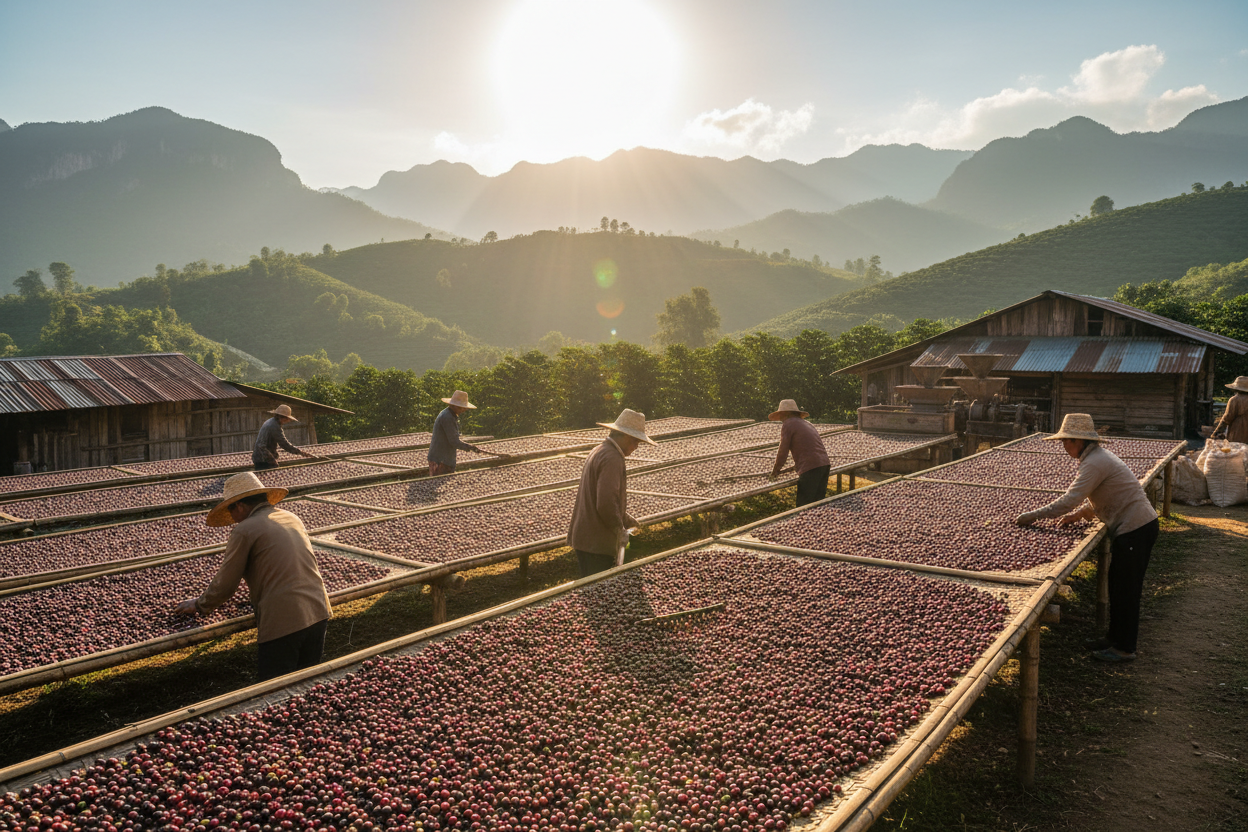
Unlike washed coffee, where the fruit is removed immediately, natural processing involves drying the entire coffee cherry intact with the seed inside. This method relies on the sun to slowly remove moisture while a complex biological exchange happens between the fruit and the bean. To understand why this creates a sweeter cup, we must look at the anatomy of the coffee cherry.
1.1 Sugar Translocation and Osmotic Pressure
As the cherry dries on raised African beds, the mucilage—a sugary, pectin-rich layer—begins to break down. Through a process of osmosis, these sugars and organic acids are absorbed into the coffee seed. This creates the heavy, syrupy mouthfeel and intense berry notes characteristic of high-end Ethiopian heirlooms.
During this phase, controlled fermentation occurs within the fruit skin. If the temperature and airflow aren't managed with the technical precision we demand at First Light, the coffee can develop "boozy" or "vinegary" defects. We prioritize naturals that utilize slow drying techniques, often extending the period to 21 or even 30 days to allow for deep flavor maturation without microbial spoilage.
1.2 Chemical Precursors and Aromatic Evolution
The chemical signature of a natural coffee is significantly different from a washed one. The extended contact with the fruit pulp leads to higher concentrations of esters and aldehydes in the green bean. These are the primary precursors to the "floral" and "fruity" aromas that define our roasts. Specifically, the degradation of carbohydrates into simple sugars during the drying phase provides the fuel for the Maillard reaction during roasting, leading to a more intense caramelization and a rounder, sweeter finish.
II. The Microbial World of the Drying Bed
Natural processing is a living, breathing microbial event. It is not merely a "dry" process; it is a long, low-impact fermentation that occurs inside the skin of the cherry. The primary actors in this process are indigenous yeasts and lactic acid bacteria (LAB) present in the Rift Valley environment.
2.1 The Role of Indigenous Yeasts
As the moisture content of the cherry drops, specific yeasts like *Saccharomyces cerevisiae* begin to consume the available glucose and fructose. This metabolic activity produces ethanol and various esters, which contribute to the "tropical fruit" and "winey" notes found in Guji and Sidama naturals. At First Light, we seek out lots where this microbial activity is stalled early through rapid cooling at night, ensuring that the fruit flavors remain "clean" and do not drift into over-fermented territory.
2.2 Lactic vs. Acetic Fermentation
The balance between lactic acid (which provides a creamy, yogurt-like mouthfeel) and acetic acid (which can taste like vinegar) is critical. Modern 2026 processing techniques often involve "shaded drying," where the cherries are covered during the hottest part of the day to prevent the temperature from spiking. This encourages a slow, lactic fermentation that enhances body without compromising the clarity of the underlying acidity.
III. The 2026 Shift: Economics and Environment
Why are we seeing more naturals in the 2025/2026 season? The answer lies in the intersection of climate change and economics in the East African highlands.
3.1 Water Scarcity and Sustainability
Traditional washing processes can consume up to 40 liters of fresh water per kilogram of dried coffee. As rain patterns become more erratic in regions like Yirgacheffe, natural processing offers a sustainable, water-free alternative. By utilizing the natural energy of the sun, producers reduce their environmental footprint while preserving local water supplies, a crucial adaptation for the future of the Rift Valley.
3.2 The Cherry Price Crisis and Home Processing
In the current harvest, cherry prices have surged to historic highs, sometimes reaching 250 ETB/kg. Because selling fresh cherry to washing stations involves immediate labor and transport costs, many smallholders are choosing to dry cherries at home. This has led to a record-breaking volume of natural processed coffee available in the 2026 market. This "empowerment of the smallholder" means we are seeing more micro-lots with highly specific, family-tended profiles than ever before.
IV. Roasting Naturals for Clarity: The Technical Challenge
Naturals are a roaster's greatest challenge. Because they contain higher concentrations of simple sugars, they are far more susceptible to scorching and "baked" flavors than washed beans.
4.1 Heat Application for High-Sugar Beans
When roasting a natural, we must adjust our thermal energy curve. Because the sugars are already partially caramelized during the drying process, they require a lower charge temperature. At First Light, we pull back the energy earlier in the roast to ensure a gentle development that preserves the "clean fruit" profile. If the roast progresses too quickly, the sugars will burn, replacing the blueberry and strawberry notes with a generic, bitter char.
4.2 The Maillard Balancing Act
We monitor the Maillard reaction with absolute precision. For a natural, we aim for a shorter time between the first crack and the finish. This "shorter development" catch is what keeps the top notes intact. We target an Agtron color that is slightly lighter than our washed counterparts to ensure that the volcanic mineral integrity is never lost in the smoke.
V. The 2026 Brewing Guide: Unlocking the Fruit
Brewing a natural requires a different approach than brewing a washed coffee. Because they are often more brittle and less dense, they tend to produce more "fines" when grinding.
5.1 Grind Size and Agitation
We recommend grinding slightly coarser for natural coffees to compensate for their faster extraction rate. To maintain clarity, use less agitation during your pour-over: gentle, circular motions help prevent the extra fines from clogging your filter and stalling the brew.
5.2 Water Temperature and Extraction
To highlight the sparkling acidity of a Rift Valley natural, use water between 195°F and 200°F. Lower temperatures help avoid over-extracting the intense sugars, which can lead to a "heavy" or "muddied" cup profile. For those who find naturals troublesome on pour-over, an immersion method like the French Press is far more forgiving, allowing the body and sweetness to shine through without the risk of stalling.
Conclusion: The Future of Flavor
Natural processing is no longer the "unrefined" cousin of the washed process. In 2026, it represents the cutting edge of sustainable, flavor-dense specialty coffee. By focusing on Clean Naturals from the Rift Valley, we are able to offer a cup that is both wildly complex and impeccably clear.
Whether you crave the floral elegance of a washed Yirgacheffe or the jammy intensity of a sun-dried Guji, First Light Roasters is dedicated to revealing the true potential of every bean. This is exceptional specialty coffee, crafted at first light, for a refined and full-bodied experience consistently delivered on a global scale.
Ready to experience the brightness?
Shop the Natural Collection: View our single-origin offerings
Roasted for clarity, delivered fresh to your door.
FAQ: Understanding Natural Processed Coffee
Is natural coffee more caffeinated?
No, the processing method does not change the caffeine content of the seed. However, the perceived "energy" of the cup is often higher due to the robust fruit aromatics and sugars.
Why does natural coffee taste like fruit?
As the cherry dries with the bean inside, sugars and acids from the fruit mucilage are absorbed into the seed through translocation, imparting flavors like blueberry, strawberry, and tropical fruits.
What is a "Clean Natural"?
A Clean Natural refers to coffee dried with such scientific precision that it lacks the "boozy," "winey," or earthy defects sometimes found in traditional dry processing.
Does natural coffee have more body?
Yes, natural processed coffees typically have a fuller body and a syrupy mouthfeel due to the extended contact between the bean and the fruit sugars during the drying phase.
How should I brew Natural processed coffee?
We recommend using a slightly coarser grind and a slightly lower water temperature (around 198°F to 200°F) to avoid over-extracting the intense sugars and maintaining the clarity of the fruit notes.
Why is there more natural coffee available in 2026?
Rising labor costs and historic highs in cherry prices have led many smallholders to dry coffee at home rather than delivering it to industrial washing stations.
Is natural processing better for the environment?
Yes, it is a water-free method that is essential for regions facing water scarcity due to climate change in the Rift Valley.


Leave a comment
This site is protected by hCaptcha and the hCaptcha Privacy Policy and Terms of Service apply.