


Emerging Coffee Regions of 2026: Climate Resilience and New Origins | First Light Roasters
Introduction: The Great Geographic Shift
The specialty coffee map of 2026 looks fundamentally different than it did even five years ago. We are currently witnessing the largest geographic shift in coffee production since the 1870s. As traditional growing regions face unprecedented temperature shifts and erratic rainfall, the industry has pivoted from theoretical sustainability messaging to active climate adaptation strategies. At First Light Roasters, we view this transition as an opportunity to discover new terroirs that uphold our motto: "Roasted for Clarity. Crafted at First Light."
While the Great Rift Valley remains a cornerstone of our collection, climate volatility has made specialty coffee scarcer and more valuable. Research indicates that up to 50% of land currently suitable for Arabica production could be lost by 2050. In response, we are exploring "New Frontiers": regions that were once too cold for coffee or are utilizing advanced agroforestry to create stable microclimates. This guide explores the emerging origins, the science of climate resilience, and why your favorite flavor profiles are moving to higher ground.
Explore the Future of Flavor
Discover the first arrivals from 2026's emerging origins. View our New Frontier Collection
I. The Science of Resilience: Adapting to a +2°C World
Climate volatility is no longer theoretical: it is the primary operating environment for coffee in 2026. With temperature increases of 2°C projected to reduce Arabica yields by 25%, the pursuit of clarity now requires a scientific focus on resilience.
1.1 Upslope Migration and New Altitudes
Because coffee thrives in cooler climates, many producers are moving their plantations upslope to find the narrow temperature range (18°C to 21°C) required for slow cherry development. In Kenyan highlands and Tanzania, optimum zones are forecast to shift 150 to 200 meters higher. While this movement preserves the technical brightness and acidity we prize, it also opens up previously unviable high altitude areas in East Africa that were historically too cold for cultivation.
1.2 The Rise of F1 Hybrids
For decades, the specialty market was hesitant to accept hybrid varieties, fearing a loss of flavor complexity. In 2026, that perception has vanished. New F1 hybrids like **Starmaya**, **Centroamericano**, and **Mundo Maya** are achieving cupping scores above 85 to 90 while surviving heat and disease that would devastate traditional Typica or Bourbon plants.
- Starmaya: The first seed propagated F1 hybrid, offering complex flavor profiles and even ripening even in frost prone conditions.
- Centroamericano: Known for altitude adaptation and exceptional disease resistance, regularly scoring 85 to 91 on the sensory scale.
- Mundo Maya: Specifically bred for high yields and hot climate suitability without compromising the clean finish required for specialty grade coffee.
II. Emerging Origins: The New Stars of the 2026 Market
As traditional regions in Brazil and Central America face up to 80% suitability loss, new players are entering the global coffee map. We are seeing a "Deep Deep Dive" into origins that were once considered niche but are now essential for supply chain stability.
2.1 China and Southeast Asia: The Arabica Renaissance
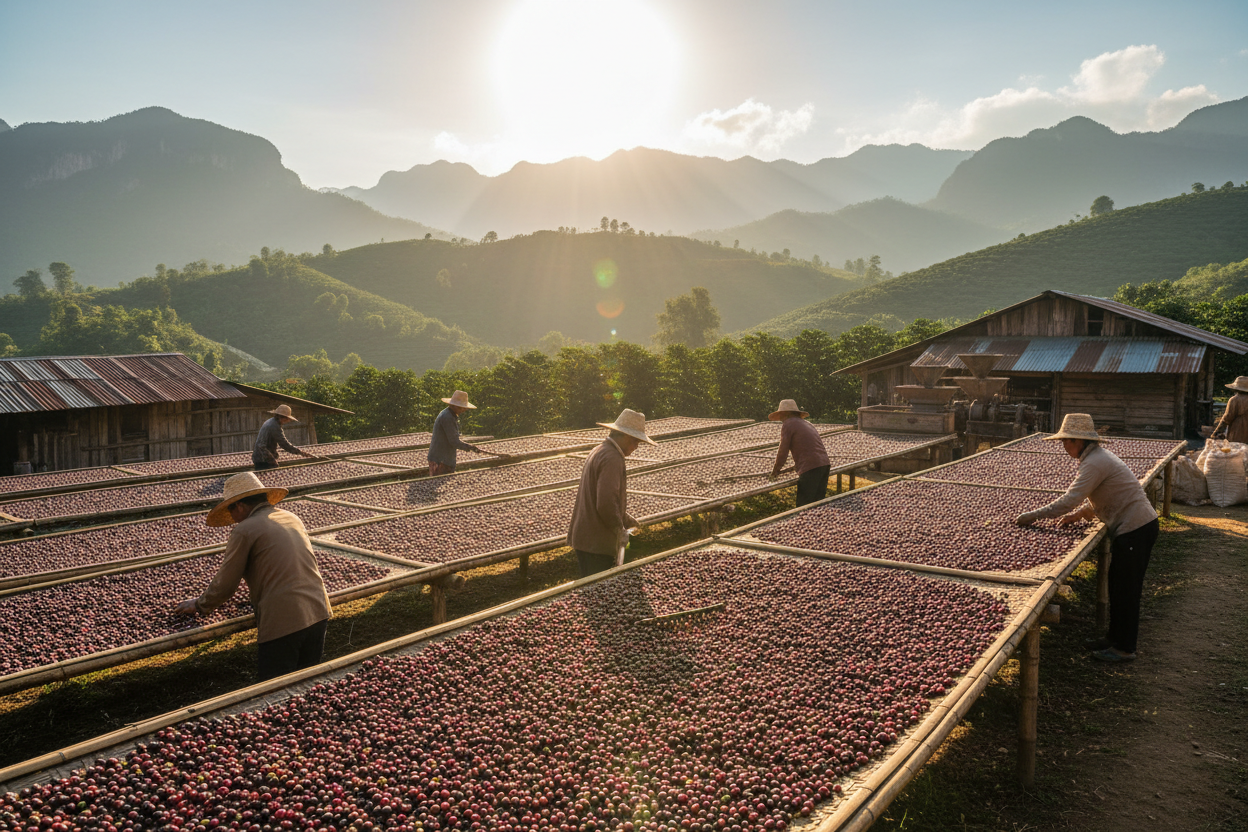
Asia is the fastest growing consumer and producer market in 2026. Beyond the high volume Robusta of Vietnam, the Arabica segment is growing rapidly in Laos, North Vietnam, and the Philippines. Investments in agroforestry and precision farming are helping these regions produce specialty lots with a clean, stone fruit acidity that rivals many Central American origins.
2.2 Nepal and the Himalayan Terroir
Nepal is emerging as a premier source for extreme high altitude Arabica. Growing at the very northern edge of the coffee belt, Himalayan beans mature incredibly slowly, resulting in a dense seed with a distinctively crisp, herbal clarity. For First Light, these lots represent the new "High Altitude Powerhouse" category.
2.3 The Resilience of Papua New Guinea
Papua New Guinea (PNG) is proving to be one of the most climate resilient origins of the 2020s. Its unique red fruit profiles are currently trending due to their high antioxidant content, appealing to a 2026 consumer base that views coffee as part of a wellness ritual.
Roasted for the Connoisseur
Experience the clean, herbal clarity of high-altitude Himalayan Arabica. View our single-origin offerings
III. Technology as Infrastructure: Precision at the Source
In 2026, technology has moved from a novelty to a necessity across the supply chain. Precision agriculture is helping smallholder farmers boost yields by 25% while cutting input costs by 15%.
3.1 AI Driven Crop Monitoring
Drones equipped with NDVI sensors are now used to detect plant stress 3x faster than manual scouting. This allows farmers in emerging regions to identify disease outbreaks or drought stress before they become visual, preserving the genetic potential of the 2026 harvest.
3.2 Smart Irrigation Systems
With water stress impacting 2.4 billion people by 2025, systems like Netafim’s NetBeat use soil moisture sensors to deliver water precisely when the plant needs it. This technology is essential for maintaining the clarity of flavor in hot, dry regions that would otherwise produce "baked" or "muddled" profiles.
IV. The Consumer of 2026: Value and Intent
The rise of New Frontiers is being driven by a consumer base that prioritizes traceability over price. For Gen Z, who represent a leading force in coffee culture, sustainability is no longer a marketing claim: it is a requirement.
4.1 Identity and Provenance
Coffee has shifted from a habit to a hobby with provenance. Consumers want to know the exact altitude, varietal, and drying method of their beans. They are increasingly drawn to the "geopolitical stories" of smallholder resilience in emerging regions like Yemen or Nepal.
4.2 The Wellness Ritual
Functional coffee has become a mainstream segment. Whether it is adaptogen enhanced blends or coffees chosen for their natural antioxidant profiles, consumers in 2026 view coffee as nourishment, not just stimulation. This has increased the value of New Frontier lots that offer unique chemical signatures.
Conclusion: Curating the Million Year Legacy
The future of specialty coffee is defined by preservation, not just trendiness. While climate change has made our traditional regions more vulnerable, it has also sparked a global wave of innovation. At First Light Roasters, we are committed to following the clarity wherever it grows: from the ancient forests of Ethiopia to the new high altitude farms of the Himalayas.
By supporting these emerging origins and the technology that sustains them, we ensure that the pursuit of excellence continues. This is exceptional specialty coffee, crafted at first light, for a refined and full bodied experience that consistently delivers on the global scale. Explore the new frontiers with us and taste the evolution of the Rift Valley legacy.
Ready to experience the brightness?
Shop the New Frontier Collection: View our single-origin offerings
Roasted for clarity, delivered fresh to your door.
FAQ: Navigating the New Coffee Map
Why are new coffee regions emerging in 2026?
Rising global temperatures are making traditional lower altitude regions unsuitable for specialty Arabica. Conversely, previously unviable regions at higher altitudes or more northern latitudes are becoming suitable for high quality cultivation.
What are F1 hybrids, and do they taste good?
F1 hybrids like Centroamericano are bred for high yields and climate resilience. Unlike older hybrids, these varieties consistently achieve specialty cupping scores between 85 and 91, offering excellent clarity and complexity.
How is AI helping coffee farmers?
AI integration helps predict harvest timing, identify disease outbreaks before visual symptoms appear, and optimize water use. This technology has improved yields by an average of 18% in water stressed areas.
Will my favorite coffee origins disappear?
Traditional regions like Brazil and Central America face up to 80% suitability loss by 2050 without significant adaptation. However, regions around the equator with constant temperatures, like Ethiopia and Kenya, are predicted to remain more effective for growing.
What are "functional" coffees?
This is a growing segment where coffee is blended with adaptogens like lion's mane or chaga mushrooms to provide cognitive and immune support alongside the traditional caffeine boost.
Why is specialty coffee becoming more expensive?
Prices now reflect the true cost of producing coffee responsibly in a volatile climate. As high quality Arabica becomes scarcer, pricing reflects the investment required in long term farmer relationships and climate strategy.
Which emerging origin is the most exciting for First Light?
We are particularly focused on high altitude Nepal and the climate resilient lots from Papua New Guinea, both of which offer the pristine clarity and structural acidity that define our roasting philosophy.

Leave a comment
This site is protected by hCaptcha and the hCaptcha Privacy Policy and Terms of Service apply.