

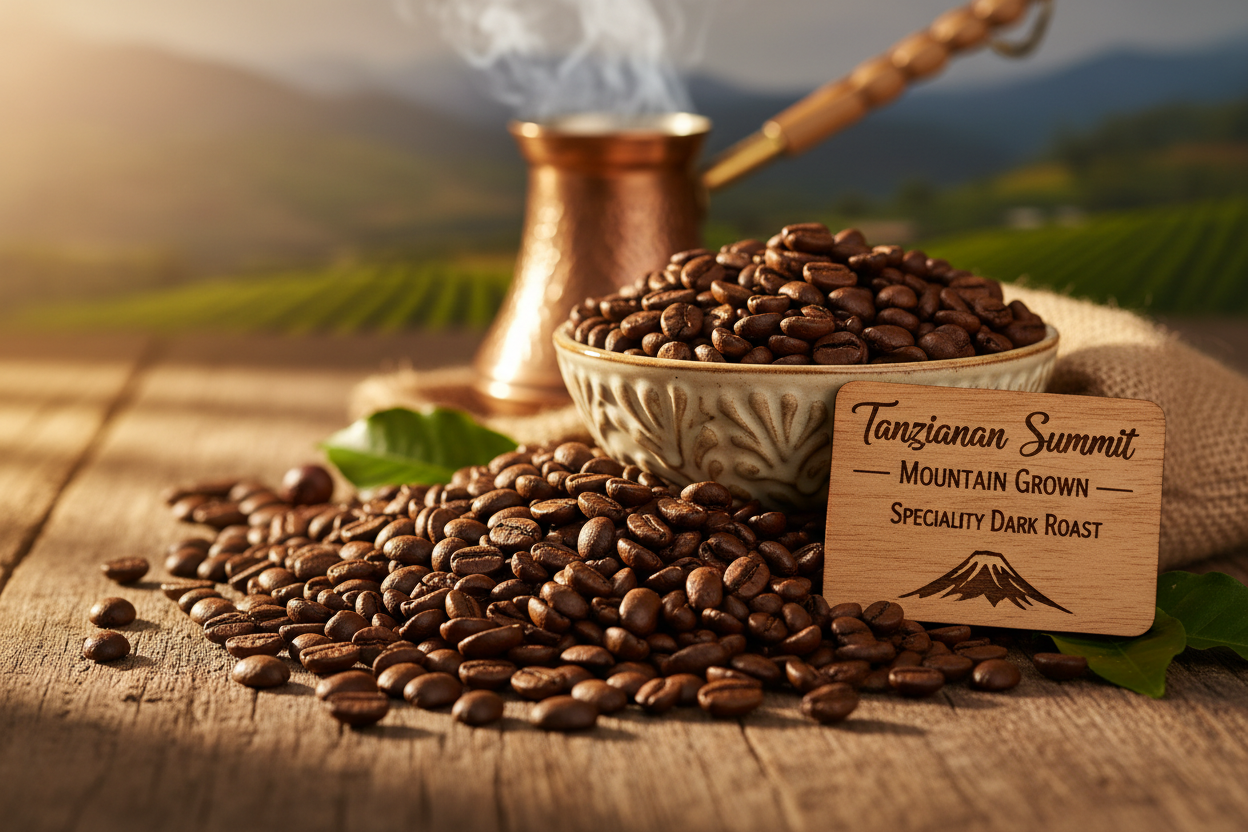
The Tanzanian Summit: Kilimanjaro & Peaberry Science
Introduction: The Vertical Sovereign of the South
In the high-resolution world of 2026, we have mapped the ancient soul of Ethiopia, the intensity of Kenya, and the resilient renaissance of Rwanda. But to finalize the East African Biographic Series, we must travel to the literal roof of the continent: **Tanzania**. At First Light Roasters, our motto: "Roasted for Clarity. Crafted at First Light": finds its most elevated expression in the volcanic shadows of Mt. Kilimanjaro and Mt. Meru.
Tanzania is a nation defined by extreme verticality and biological diversity. It is the home of the world's most famous "Peaberry" culture (a rare mutation that concentrates the bean's metabolic energy) and a unique colonial history that brought the Red Bourbon varietal to the slopes of the highest free-standing mountain on earth. In 2026, the Tanzanian specialty market has undergone a radical shift: moving away from the "Kilimanjaro-only" narrative and into the **Southern Highlands Renaissance** (where the regions of Mbeya and Mbinga now produce the majority of national specialty output). In this technical manual, we explore the 19th-century arrival of the Spiritan missionaries, the molecular physics of the Peaberry mutation, and the neuro-economics of why the 2026 professional prizes Tanzania for its complex, cedar-sweet, and tea-like clarity. This is the Tanzanian Summit.
I. The Anthropology of Migration: From Reunion to Kilimanjaro
The history of Tanzanian coffee is a story of a biological journey that began in the Indian Ocean. Unlike the wild forests of Ethiopia, Tanzania's Arabica identity was forged through migration and the determination of indigenous farmers.
1.1 The Spiritan Missionaries (1890s)
In the late 19th century, German and French Spiritan missionaries brought coffee seeds from the island of Reunion (formerly Bourbon) to the coastal region of Bagamoyo. These were the original **Bourbon** seeds. As the missionaries moved inland, they realized that the coastal humidity was unsuitable for high-quality production. They carried the seeds to the northern highlands: specifically the lush, volcanic foothills of Mt. Kilimanjaro and Mt. Meru: where the combination of high altitude and rich volcanic soil allowed the Bourbon varietal to flourish. By the early 1900s, large plantations managed by settlers were established; however, the true technical future lay with the smallholders.
1.2 The Kilimanjaro Native Planters' Association (1925)
A critical moment in Tanzanian coffee anthropology occurred in 1925 with the formation of the **Kilimanjaro Native Planters' Association (KNPA)**. This was the first ever agricultural cooperative in Africa. It allowed Chaga farmers to pool their resources, access technical training, and negotiate fairer prices in a market dominated by colonial interests. This cooperative spirit remains a core pillar of Tanzanian coffee in 2026 through the AMCOS model (Agricultural Marketing Cooperative Societies), which ensures that the **pursuit of clarity** is a community-owned effort.
II. The Science of the Mutation: The Peaberry (PB) Culture
Tanzania is the global headquarters for the **Peaberry** (a unique botanical mutation that has become a technical obsession for the 2026 connoisseur).
2.1 The Molecular Physics of the Single Seed
Normally, a coffee cherry contains two seeds (beans) that grow face-to-face, creating the flat side we recognize. In approximately 5% to 10% of cases, a natural mutation or insufficient pollination causes only one seed to fertilize. Without a partner to press against, this single seed grows into a round, dense "Peaberry". In 2026, we understand that the tree concentrates its entire metabolic energy (all the organic acids and sugar precursors) into this single seed. This results in a bean with a higher density and a more concentrated flavor profile than its "flat" counterparts.
[Image showing a cross-section comparison of a standard coffee cherry with two seeds vs. a Peaberry cherry with one round seed]2.2 Roasting the Sphere
From a technical roasting perspective, the Peaberry is a masterpiece. Because of its round shape, it rolls more efficiently in our infrared roasting drums, leading to a perfectly uniform heat transfer. This spherical geometry allows us to reach a higher Extraction Yield without the risk of scorching edges. For the 2026 First Light roast, the Tanzanian Peaberry is the ultimate tool for delivering a "Focused" flavor profile.
III. Regional Terroir: The North vs. The Southern Highlands
In 2026, we have moved beyond the "Kilimanjaro" monolith to explore the two distinct technical provinces of Tanzania.
3.1 The Northern Highlands: Cedar and Citrus
The regions of Arusha and Moshi (Mt. Meru and Kilimanjaro) are the traditional heartland. The soil here is young, volcanic, and rich in minerals like Magnesium and Potassium. These beans are characterized by a unique **Cedar** or "Forested" aroma paired with a bright, **Citric Acidity**. In 2026, we prize the North for its "Classic" East African elegance.
3.2 The Southern Highlands: The Mbeya Renaissance
The most exciting development in 2026 is the rise of the **Southern Highlands** (Mbeya, Mbinga, and Njombe). This region sits at extreme altitudes (up to 2,000 meters) and features a cooler, more stable climate than the North. As we noted in our technical comparison guides, this slow ripening produces a cup with a **Tea-Like Clarity** and notes of **Blackberry** and **Cane Sugar**. The South is where the modern "Pursuit of Clarity" is being won in Tanzania.
IV. 2026 Logistics: Freshness and the TCB Auction
The Tanzania Coffee Board (TCB) manages the weekly auction in Moshi. In 2026, this system has been modernized through the Nairobi Standard influenced reforms.
4.1 Digital Traceability
Every lot of First Light Tanzania coffee is now integrated into a 2026 blockchain ledger. This ensures that we can track the coffee from the southern "Collines" of Mbeya through the central logistics hub of Dodoma and finally to our roastery. Transparency is the mandatory foundation for quality in the current decade.
4.2 The Vertical Freshness Window
Because of Tanzania's geographic length, the harvest season spans from July (the North) all the way to December (the South). In 2026, this allows First Light to offer "Fresh-Crop Clarity" almost year-round by rotating through the different Tanzanian provinces. We utilize autonomous climate-controlled shipping to ensure that the delicate citrus volatiles of the Kilimanjaro lots are preserved during transit.
Conclusion: The Summit of Clarity
Tanzania is a nation of technical extremes and sensory surprises. From the historical Bourbon migration to the molecular concentration of the Peaberry and the modern renaissance of the Southern Highlands, it is a mandatory chapter in the **pursuit of clarity**.
At First Light Roasters, we are proud to stand at the Tanzanian summit. We roast to reveal the cedar, the blackberry, and the concentrated Peaberry soul of every bean. This is exceptional specialty coffee, crafted at first light, for a refined and full-bodied experience consistently delivered on a global scale. Experience the summit. Experience the clarity.
Experience the Concentrated Clarity of the Peaberry
Sourced from the volcanic slopes of the Northern and Southern Highlands. Shop our Tanzanian Collection
FAQ: Tanzania Coffee and Peaberry Science
What is a Peaberry?
A Peaberry is a natural mutation where only one round seed develops inside the coffee cherry instead of two. In 2026, they are prized for their high density and their ability to roast with extreme uniformity.
Does Tanzania coffee taste like Kenya coffee?
They share the Rift Valley heritage, but Tanzania coffee is generally described as having a more "Refined" and "Balanced" acidity, often with tea-like notes and a cedar-sweet finish, compared to the intense blackcurrant "Snap" of Kenya.
Why is Mt. Kilimanjaro so famous for coffee?
The volcanic soils (Andisols) of Mt. Kilimanjaro are rich in minerals and provide excellent drainage. Combined with the high altitude and the historic "Red Bourbon" genetic heritage, this terroir produces some of the world's most elegant specialty coffee.
What are the "Southern Highlands"?
The Southern Highlands (Mbeya, Mbinga, and Njombe) are the rising stars of Tanzanian coffee in 2026. They offer higher altitudes and cooler climates than the traditional northern regions, resulting in high-clarity coffees with complex berry and stone-fruit notes.
Is Tanzanian coffee "Bourbon"?
Yes; the majority of Tanzanian Arabica is derived from the "French Mission" Bourbon seeds brought to the country in the late 19th century. This varietal is known for its deep sweetness and complex organic acids.
What is the "First Ever Cooperative in Africa"?
The Kilimanjaro Native Planters' Association (KNPA), formed in 1925, was the first agricultural cooperative on the continent, allowing small-holder farmers to achieve global market access and technical quality control.
How should I brew Tanzanian Peaberry?
To highlight the concentrated acidity and technical clarity, we recommend a **Pour-Over** (V60) or an **Aeropress**. This allows the uniform density of the Peaberry to be fully extracted without the muddiness of a filterless method.
What is the 2026 TCB Auction?
The Tanzania Coffee Board (TCB) auction in Moshi has been digitalized in 2026, providing real-time price discovery and ensuring that specialty premiums reach the producers in the Northern and Southern Highlands immediately.
Why is 2026 an important year for Tanzania?
The convergence of autonomous logistics and the opening of new specialty corridors in the Southern Highlands has made 2026 the year that Tanzania officially rivals its more famous East African neighbors for quality.
Is Tanzanian coffee good for "Deep Work"?
Yes; the clean, tea-like energy and the lack of "Processing Noise" make it a favorite choice for the productivity-conscious professional.

Leave a comment
This site is protected by hCaptcha and the hCaptcha Privacy Policy and Terms of Service apply.