

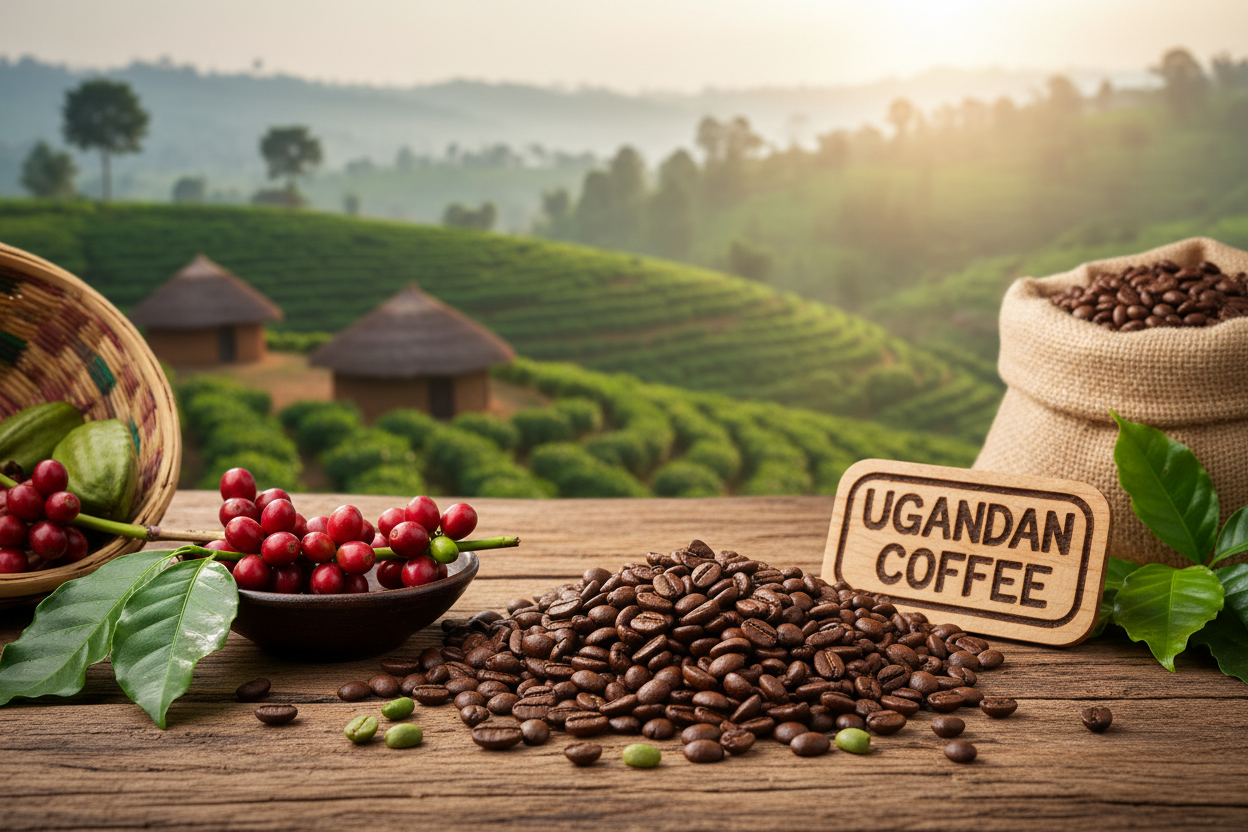
The Ugandan Apex: Mt. Elgon & Volcanic Savory
Introduction: The Western Anchor of the Rift
In the specialty coffee landscape of 2026, we have meticulously analyzed the genetic birthplace of Ethiopia, the hybrid precision of Kenya, and the resilient renaissance of Rwanda. But to truly complete the architecture of the Great Rift Valley, one must look to its western anchor: **Uganda**. At First Light Roasters, our motto: "Roasted for Clarity. Crafted at First Light": refers as much to the technical transparency of our process as it does to the volcanic purity of the Ugandan highlands.
Uganda is a unique sovereign in the coffee world because it is one of the few places on earth where coffee is truly indigenous (Robusta specifically has grown wild in the Lake Victoria basin for millennia). However, the 2026 story of Uganda is the story of the **Arabica Apex** (a movement that has transformed the country from a high-volume commodity exporter into a high-definition specialty producer). In this final, exhaustive chapter of our Biographic Series, we explore the anthropology of the Blood Brotherhood ritual, the mineralogy of the extinct Mt. Elgon volcano, and why the 2026 connoisseur prizes Uganda for its "Volcanic Savory" profile: a sophisticated blend of stone fruit, nougat sweetness, and herbal clarity. This is the Ugandan Apex.
I. The Anthropology of Origin: Two Species, One Nation
The history of Ugandan coffee is a tale of two identities: the ancient indigenous past and the imported specialty future. To understand the pursuit of clarity in Uganda, we must understand the duality of its biology.
1.1 The Indigenous Robusta Heritage
Unlike most coffee nations, Uganda does not need to look far for its coffee roots. Robusta coffee (Coffea canephora) is native to the Ugandan forests and grows wildly around the Kampala forest. For centuries, long before the first Arabica seed arrived, the Baganda people integrated coffee into their social fabric. In the "Blood Brotherhood" ceremony, coffee cherries were a central element of celebrations and rituals; two people would exchange coffee cherries, bite the seeds, and consume them together to seal a sacred pact. This deep cultural connection ensures that coffee is not just an export for Uganda; it is a national heritage. While 2026 has seen the rise of "Fine Robusta," First Light Roasters remains focused on the elite Arabica lots that thrive in the western mountains.
1.2 The Arabica Migration (1912)
Arabica coffee was officially introduced to the Bugisu region by the British Colonial Government around 1912. The first coffee nursery bed was established at Masekele in 1915. These early varietals (mostly Nyasaland, which was brought from Malawi) found an ideal home in the volcanic soils and high-altitude mist. By the 1920s, Uganda had established its dual-identity: the high-volume Robusta of the lowlands and the high-quality Arabica of the highlands. This duality reached its biggest economic boom in the mid-1970s when Brazilian frost caused a massive demand for Ugandan supply.
II. Terroir: The Mineralogy of Mt. Elgon and the Rwenzoris
The technical secret to Ugandan specialty coffee is the geology of its two primary mountain ranges. In 2026, we recognize these peaks as the world's most consistent flavor incubators.
2.1 The Volcanic Savory Profile of Mt. Elgon
Mt. Elgon possesses some of the most fertile volcanic soils in East Africa. These soils are rich in organic matter and minerals, providing a unique foundation for the "Volcanic Savory" profile. A First Light Ugandan lot from this region is defined by:
- Stone Fruit Density: Intense notes of Mandarin, Peach, and Red Berries.
- Nougat and Spice Sweetness: A creamy, stable sweetness with hints of star anise, vanilla, and caramel.
- Herbal Clarity: Subtle notes of white tea or black tea that add a savory layer to the finish.
2.2 The Sipi Falls Microclimate
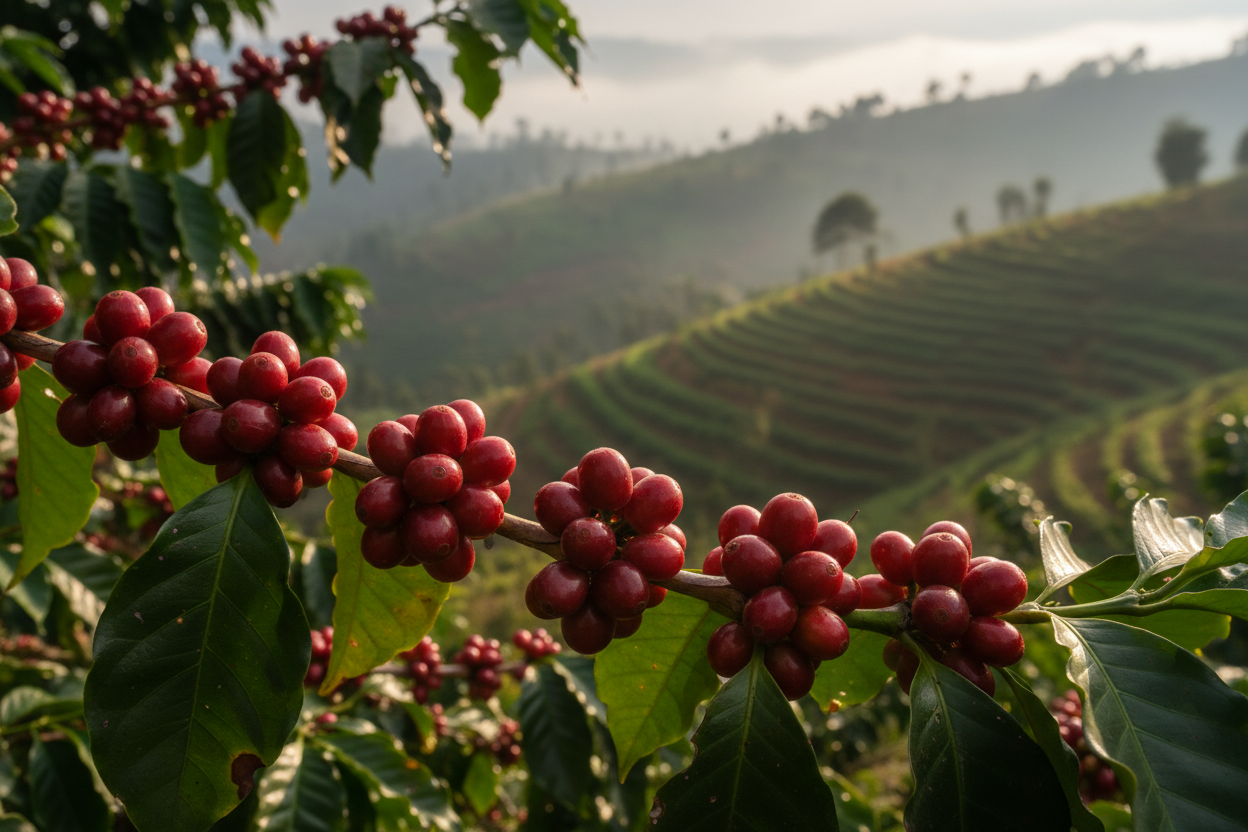
Sipi Falls, located on the base of Mt. Elgon, consists of three spectacular waterfalls that create a constant misting effect across the coffee hills. The steep elevation (ranging from $1,300$ to $2,240 \text{ masl}$) creates a natural cooling system that slows cherry maturation. This slow ripening is essential for building the cell density required for $85$-plus point lots. The volcanic loam soil, combined with this cooler climate, is the perfect recipe for superior quality beans.
2.3 The Rwenzori Mountains (Mountains of the Moon)
In the west, the Rwenzori Mountains provide another extreme terroir. Up to 70% of the Rwenzori range sits above $2,500 \text{ masl}$, making it some of the highest coffee-growing land in Africa. Historically, the natural coffee from this region, known as **DRUGAR** (DRy UGandan ARabica), had a reputation for low quality. However, since the liberalization of the sector in 1992, private farms have introduced experimental processing that has transformed Rwenzori coffee into a complex, wine-like masterpiece.
III. The 2026 Shift: Technical Processing and Traceability
For decades, Uganda suffered from a "Quality Gap" due to poor processing infrastructure and government monopolies. In 2026, that gap has been permanently closed.
3.1 Liberalization and the Power of Private Farms
Up until 1990, Uganda's coffee production was owned by the Coffee Marketing Board. The liberalization in 1992 allowed farmers to break free from tight government control that emphasized mass production over quality. Today, private farms can be more experimental, focusing on selecting only the ripest cherries and mastering specific fermentation profiles. This shift enabled the reputation of Ugandan coffee to flourish.
3.2 Centralized Washing Stations
Following the success of communal models elsewhere, Uganda has invested heavily in centralized washing stations like the Sipi Falls Wash Station. These stations buy cherry directly from more than $8,600$ organic and diversified farms, ensuring a volume of quality that smallholders could not achieve alone. They utilize modern pulpers and eco-friendly water recycling systems to reduce greenhouse gas emissions. By moving away from fragmented "Home Processing," Uganda has achieved a level of uniformity that allows for the absolute technical clarity we require for the First Light roastery.
3.3 Anaerobic and Honey: The New Frontier
In 2026, Uganda has also become a leader in "Controlled Natural" and "Anaerobic" processing. By utilizing airtight storage vessels and temperature-controlled drying beds, Ugandan producers are creating "Fruit Bombs" that rival the best of the Rift Valley. These lots offer sweetness profiles like strawberry syrup and balsamic vinegar, with a deep creaminess that feels like citrus ice cream or fruit candy. This is an incredible experience where prime terroir is finally unlocked through quality processing.
IV. The Entrepreneur’s Perspective: Uganda as the Resilient Asset
In the volatile 2026 economy, the high-performance professional looks for stability and value. Uganda provides this through its dual-crop resilience and technical ascent.
4.1 Africa's Leading Exporter
In May 2025, Uganda reached a historic milestone by emerging as Africa's leading coffee exporter, surpassing Ethiopia's previous achievements. With an annual export value exceeding $\$2 \text{ billion}$, coffee generates approximately $20\%$ of Uganda's foreign exchange earnings. As the Ugandan specialty brand ascends, the 2026 connoisseur can access $85$-plus point lots at a more accessible luxury price point. This makes Ugandan coffee the ideal choice for a consistent, high-leverage "Daily Ritual" that supports cognitive focus.
4.2 Blockchain Registration and Ethical Security
The 2026 Uganda Coffee Development Authority (UCDA) has implemented digital traceability solutions to comply with global regulations like the European Union Deforestation Regulation (EUDR). This ensures that every bag of First Light Uganda coffee is fully traceable and verified as deforestation-free using high-resolution satellite imagery and machine learning. In the pursuit of clarity, transparency is our most valuable asset.
Conclusion: The Peak of the Pearl
Uganda is the final, essential piece of the East African puzzle. By merging its ancient indigenous heritage with modern technical precision and the unique terroir of Mt. Elgon and the Rwenzoris, Uganda has created a specialty identity that is both savory and sweet: both wild and refined.
At First Light Roasters, we are proud to stand at the Ugandan Apex. We roast to reveal the mandarin, the caramel, and the volcanic soul of every bean. This is exceptional specialty coffee, crafted at first light, for a refined and full-bodied experience consistently delivered on a global scale. Experience the Pearl. Experience the clarity.
Experience the Savory Clarity of Mt. Elgon
Sourced from the high-altitude Sipi Falls region. Shop our Ugandan Collection
FAQ: The History and Science of Ugandan Coffee
Is coffee native to Uganda?
Yes; Robusta coffee (Coffea canephora) is indigenous to the Lake Victoria basin in Uganda and has been part of the country's cultural rituals for centuries. Arabica coffee, however, was introduced around 1912.
What makes "Mt. Elgon" coffee special?
Mt. Elgon is a massive extinct volcano with mineral-rich volcanic loam soils and high-altitude microclimates reaching up to $2,300 \text{ masl}$. This creates the "Volcanic Savory" profile, a unique blend of Mandarin sweetness and herbal complexity.
What is "Bugisu" coffee?
Bugisu refers to the washed Arabica coffee grown on the slopes of Mt. Elgon. It is named after the Bugisu people who are native to the northwestern districts of the mountain and is prized for its round body, floral notes, and clean finish.
How does Ugandan coffee compare to Kenyan coffee?
While Kenya is known for its intense "Sparkling" acidity, Uganda offers a more "Savory" and "Balanced" profile with notes of dried fruit, chocolate, and caramel. Many Ugandan Arabicas show bright citrus notes and wine-like qualities similar to other East African origins.
What is "Sipi Falls"?
Sipi Falls is a trio of majestic waterfalls on the base of Mt. Elgon. The surrounding high-altitude area (up to $2,240 \text{ masl}$) is one of Uganda's premier specialty regions, known for its slow-ripened cherries and high-clarity anaerobic naturals.
Is Robusta used in specialty coffee?
Yes; in 2026, "Fine Robusta" that scores above $83$ points has emerged as a high-quality category. It is smooth, bold, and satisfyingly heavy with notes of chocolate and spice, packing twice the caffeine of Arabica.
What is the "Direct Settlement System" in Uganda?
Similar to other technical reforms, Uganda's 2026 landscape utilizes digital settlement and pre-financing to reduce the financial burden on farmers and ensure they receive higher farm-gate prices for their specialty crops.
How should I brew Ugandan coffee?
To highlight the savory herbs and mandarin sweetness, we recommend a **Pour-Over** (V60) with $95^\circ\text{C}$ water. This allows the balanced complexity and low malic acidity of the Mt. Elgon terroir to shine through.
Why is 2026 an important year for Uganda?
2026 marks the point where Uganda’s investment in centralized washing stations and digital traceability for EUDR compliance has fully matured, allowing the entire production area to be assessed as deforestation-free.
What are SL14 and SL28 varietals?
These were selections made at the Scott Agricultural Laboratories in Kenya in the late 1930s. SL14 is known for its drought resistance and Typica-related genetics, while SL28 is prized for its exceptional cup quality and pleasant acidity.

Leave a comment
This site is protected by hCaptcha and the hCaptcha Privacy Policy and Terms of Service apply.