

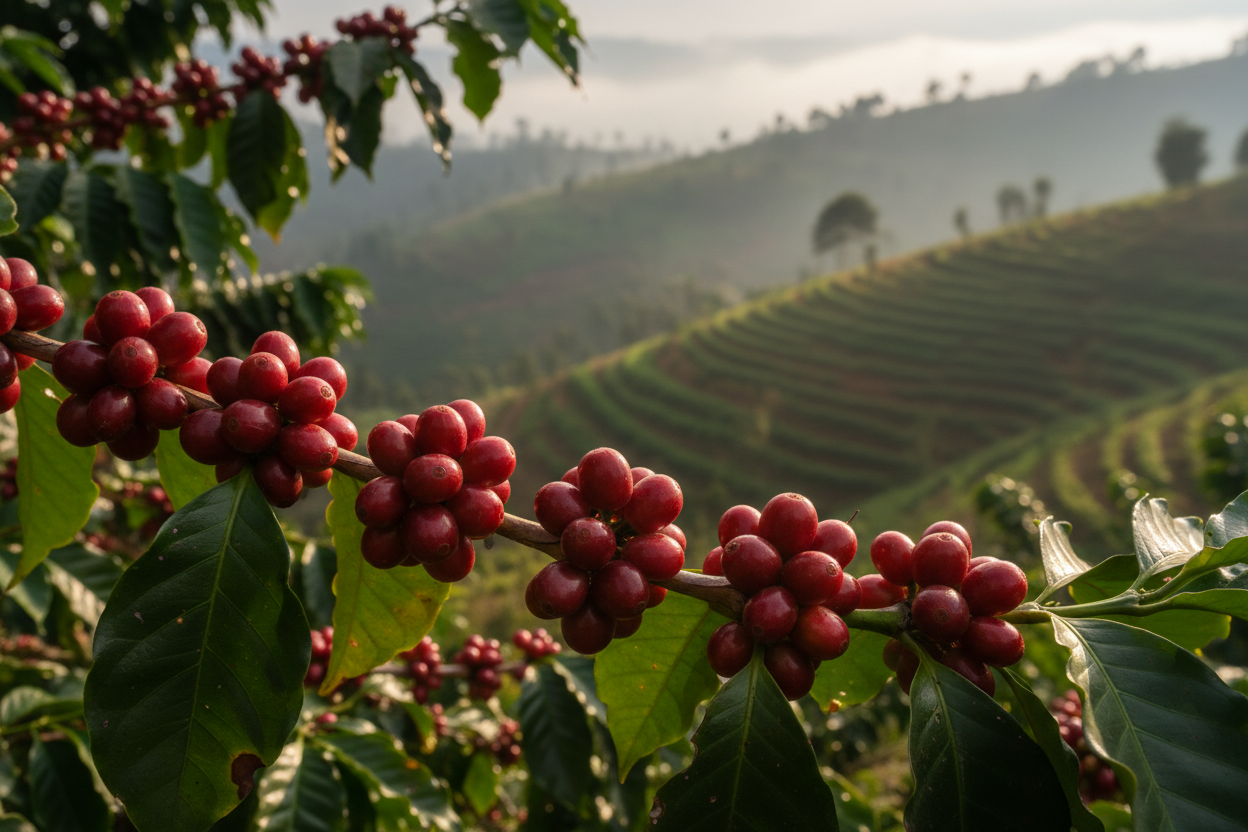
The Rwanda Renaissance: Red Bourbon Mastery
Introduction: The Hidden Heart of the Rift
In the specialty coffee landscape of 2026, we have mapped the genetic birthplace of Ethiopia and the silky resilience of Rwanda. But there is a region that remains the "secret weapon" for the high-resolution palate: **Burundi**. At First Light Roasters, our motto: "Roasted for Clarity. Crafted at First Light": refers as much to our roasting technicals as it does to the technical transparency of the Burundi hills.
Burundi is a nation of "Thousand Hills" (collines) where coffee is not just a crop: it is the primary economic engine for over 600,000 small-holder families. While it shares much of its terroir with Rwanda, Burundi coffee offers a "wilder" chemical profile characterized by honey-like sweetness and complex, savory spices. In this fourth chapter of our Biographic Series, we explore the "Forced to Flourish" history of the 1930s, the physics of the **Double-Wash** system, and why the 2026 connoisseur views the northern regions of Kayanza and Ngozi as the ultimate frontier of clarity. This is the Burundi Synthesis.
I. The History of "Forced to Flourish": 1920 to 1962
The anthropology of Burundi coffee is marked by a history of systemic imposition that eventually yielded biological excellence. Unlike the wild forests of Ethiopia, coffee in Burundi was a colonial architecture.
1.1 The Belgian Mandate
In the 1920s and 30s, under Belgian colonial rule, coffee was introduced as a mandatory cash crop. Every rural peasant was legally required to plant at least 50 coffee trees. This "50 Tree Mandate" was often enforced through physical force, leaving a complex emotional legacy on the land. However, this mandate also ensured that the **Bourbon** varietal: brought from the Reunion Islands: was distributed to every corner of the high-altitude hills, setting the stage for the 2026 quality boom.
1.2 Decolonization and Decline
Following independence in 1962, the industry swung between privatization and state control. Decades of civil war and political instability in the 1990s led to many plantations being neglected or destroyed as farmers focused on survival crops like potatoes and beans. In 2026, we view the current "Specialty Era" as a second renaissance (a movement led by private washing stations and cooperatives that prioritize quality over the state-mandated quantity of the past).
II. The Technical Engine: The Double-Wash Signature
The "Clarity" of Burundi coffee is not just a product of soil (it is a product of the most meticulous processing in East Africa).
2.1 The Physics of the 12-12-12 Fermentation
In 2026, the **Double-Wash** method is the technical standard for the First Light collection. This process involves:
- The Dry Ferment (12 Hours): The pulped beans sit in tanks to break down the initial mucilage.
- The Wet Ferment (12-24 Hours): The beans are submerged in clean water, allowing for a deep, secondary breakdown of proteins and sugars.
- The Final Soak: The beans are washed again and soaked in clean mountain water to stabilize their water activity ($a_w$) before drying.
This intensive cleaning removes every trace of "Processing Noise". It is the reason why a First Light Kayanza lot offers such high transparency: it allows the underlying molecular volatiles of the Bourbon seed to be perceived without interference.
III. Regional Terroir: Kayanza and Ngozi
The topography of Burundi rises from the shores of Lake Tanganyika (772m) to the summits of the Nile-Congo watershed (2,600m+). We focus our 2026 sourcing on the high-altitude north.
3.1 Kayanza: The Acidic North
Kayanza is the most famous region in Burundi for specialty excellence. With altitudes ranging from 1,700 to 2,000 meters, it produces the highest acidity in the country. Look for notes of **Red Currant**, **Citrus**, and a vibrant **Winey Acidity**. In 2026, Kayanza lots consistently score 88+ on the SCA scale, making them a foundational asset for any high-performance productivity stack.
3.2 Ngozi: The Balanced Northwest
Ngozi offers a more "Balanced" profile than Kayanza. The terroir here produces a deeper sweetness: reminiscent of **Honey** or **Caramel**: and a fuller mouthfeel. As we noted in our Barista Sommelier guide, Ngozi is the preferred choice for those who value refined "Stone Fruit" notes (like peach and apricot) over sharp intensity.
IV. The Bourbon Mosaic: Genetic Clarity
Burundi is almost entirely (96%) **Arabica Bourbon**. In 2026, we utilize this genetic purity to perform a "Molecular Deep-Dive" into the varietal.
4.1 The High-Sucrose Advantage
Bourbon varietals naturally contain 20-30% higher sucrose levels than ancestors like Typica. The high-altitude volcanic soil of Burundi provides the Potassium ($K$) necessary to catalyze this sugar production. This is why Burundi coffee possesses its signature "Wild Honey" sweetness. When we apply our Infrared Roasting protocol, we are essentially caramelizing these sugars at a microscopic level to provide absolute definition.
4.2 The Spicy Secret
A unique technical marker of Burundi coffee is its "Spicy" finish. This is driven by specific organic compounds: often reminiscent of **Clove** or **Cinnamon**: that are rare in other Rift Valley origins. For the Sommelier, this spicy-sweet tension is the hallmark of a world-class Burundian lot.
Conclusion: The Frontier of Excellence
Burundi is a nation that has taken a difficult history and transformed it into a sensory masterpiece. By mastering the high-altitude collines, the Bourbon genetics, and the Double-Wash system, Burundi has earned its place as a sovereign of the specialty world.
At First Light Roasters, we are honored to bring the spicy soul of Burundi to your cup. We roast to reveal the honey, the citrus, and the technical clarity that only the Heart of Africa can provide. This is exceptional specialty coffee, crafted at first light, for a refined and full-bodied experience consistently delivered on a global scale. Join us on the frontier. Experience the clarity.
Experience the Spicy Soul of Burundi
Sourced from the high-altitude washing stations of Kayanza. Shop our Burundian Collection
FAQ: The Science of Burundi Coffee
What makes Burundi coffee taste like "honey"?
The high sweetness is a result of the Bourbon varietal (which has high natural sucrose content) combined with mineral-dense volcanic soil that allows the tree to maximize sugar development during the long ripening phase.
What is "Double-Washed" coffee?
Double-washing is an intensive processing method that involves two separate fermentation stages (dry and wet) followed by a clean soak. This removes all residual fruit matter, resulting in an exceptionally "clean" and transparent flavor profile.
How does Burundi compare to Rwanda?
They share the same Bourbon genetic heritage, but Burundi coffee is often described as "wilder" and more complex, featuring a unique spicy-savory tension that is less prevalent in the silky, red-fruit profiles of Rwanda.
Why is Kayanza the most famous region?
Kayanza boasts some of the highest altitudes in Burundi (up to 2,000 meters) and a temperate climate that is ideal for producing bright, high-acid coffee with distinct citrus and red berry notes.
What is a "Colline"?
"Colline" is the French word for "hill". In Burundi, the hill is the fundamental geographic and social unit; coffee lots are typically named after the specific colline where the farmers live and harvest their cherries.
Is coffee in Burundi still grown "by force"?
No (while the industry began under a colonial mandate in the 1930s, the modern specialty era is driven by private investment, cooperatives, and the 2026 Direct Settlement System that empowers farmers through quality-based premiums).
What is "Potato Taste Defect" (PTD)?
PTD is an occasional defect in East African coffee that smells like raw potatoes. In 2026, this is managed through meticulous hand-sorting and infrared technology at the washing station to ensure zero defects in the final cup.
How should I brew Burundi coffee?
To highlight the spicy honey sweetness and high-altitude acidity, we recommend a **Pour-Over** (V60 or Kalita Wave) with high water temperatures ($94^\circ\text{C}-96^\circ\text{C}$). This maximizes the extraction kinetics for these dense beans.
Why is 2026 the year of the "Burundi Frontier"?
The convergence of blockchain-verified logistics and a global shift toward complex origin profiles has allowed Burundi to finally showcase its unique technical excellence to a global audience.
What is the "First Light" standard for Burundi?
We roast our Burundian lots to a light-medium level to ensure the Bourbon sugars are fully caramelized without obscuring the delicate, spicy volatiles that make this origin unique.


Leave a comment
This site is protected by hCaptcha and the hCaptcha Privacy Policy and Terms of Service apply.