


The Malawi Legacy: Geisha & High-Altitude Excellence | First Light Roasters
I. Introduction: The Refined Sovereign of the South
In the specialty coffee landscape of 2026, we have meticulously analyzed the ancient soul of Ethiopia, the precision of Kenya, and the resilience of Rwanda. But to complete the Southern Rift map, we must address the "Warm Heart of Africa": **Malawi**. At First Light Roasters, our motto: "Roasted for Clarity. Crafted at First Light": finds its most delicate manifestation in the high-altitude micro-lots of the Northern Region.
Malawi is a unique sovereign in the coffee belt because it has never pursued mass-market volume. While neighboring Tanzania and Kenya produce tens of thousands of tons, Malawi’s total annual output remains low (averaging approximately 1,500 to 2,000 metric tons). However, what it lacks in quantity, it makes up for in absolute **Quality and Precision**. In 2026, the global coffee price index has nearly tripled, and the "Malawian Profile" (soft, smooth, and tea-like) has become a prized luxury asset for those seeking clarity over intensity. In this chapter of our Biographic Series, we explore the 1891 arrival of the Edinburgh seeds, the specific biology of the Malawi Gesha, and why the 2026 pursuit of clarity is redefined by the smallholders of the Misuku Hills. This is the Malawi Legacy.
II. The Anthropology of Origin: Scottish Missionaries and the Edinburgh Connection
The history of coffee in Malawi is not one of indigenous discovery, but of a specific botanical migration.
2.1 The 1891 Arrival: John Buchanan and the Royal Botanic Garden
While coffee was first introduced to British-held Malawi in the 1880s, the official commercial spark occurred in 1891. A Scottish missionary named John Buchanan brought a single coffee plant from the Royal Botanic Garden in Edinburgh, Scotland. This seed: a variety of Arabica: was planted in the southern regions of Thyolo and Mulanje. For the first half of the 20th century, coffee was an "Estate Crop," grown alongside tea, tobacco, and macadamia nuts. It wasn't until post-independence in the 1960s that the industry began to shift toward the high-altitude smallholder model we prize today.
2.2 The Mzuzu Cooperative Union (1946 to 2026)
The true technical driver of Malawian clarity is the **Mzuzu Coffee Planters Cooperative Union**. Formed in 1946 (and rebranded in 2007), the union now represents over 2,700 to 4,000 small-scale farmers, with more than 30% being women. This organization provides the necessary "Technical Bridge" (providing cupping classes, marketing support, and centralized processing) that allows a farmer with only 200 trees to compete on the global specialty stage. In 2026, Mzuzu has become a model for supply chain transparency: helping farmers navigate the 2026 digital traceability standards while increasing yields through organic fertilization.
III. Terroir: The High-Altitude Pillars of the North
Malawi is a landlocked nation defined by the Mulanje Massif and the deep waters of Lake Malawi. For the specialty market, we focus exclusively on the high-altitude "Islands of Clarity" in the north.
3.1 The Misuku Hills: The Best in the Country
The Misuku Hills are located at the extreme northern tip of Malawi, bordering Tanzania along the Songwe River. This region consists of four parallel ridges and plateaus rising to altitudes between $1,700$ and $2,000 \text{ meters}$. Because the temperatures are notably stable (ranging from $9.9^\circ\text{C}$ to $21.9^\circ\text{C}$) and rainfall is dependable ($1,500$ to $2,000 \text{ mm}$), the coffee cherries undergo a prolonged maturation period. This slow ripening is the catalyst for the "Misuku Profile": a sweet, balanced cup with medium acidity and notes reminiscent of a washed Ethiopian Yirgacheffe.
3.2 The Phoka Hills and the Nyika Plateau
Located on the eastern face of the Nyika escarpment, the Phoka Hills feature even more dramatic verticality (rising to $2,500 \text{ masl}$). The acidic red clay and loamy sand soils here are ideal for Arabica root development. In 2026, we prize Phoka lots for their high-definition stone fruit notes: such as peach and apricot: and a silky, tea-like body that remains clean through the final sip.
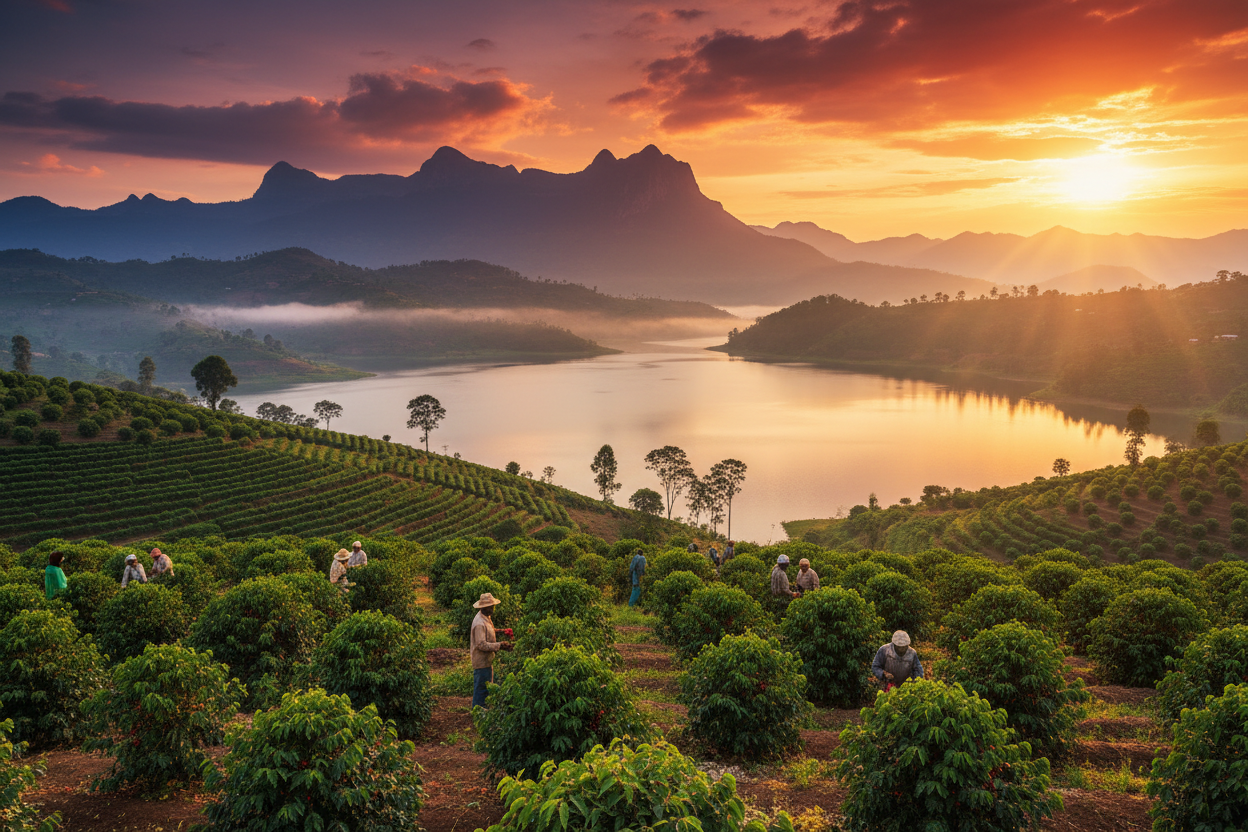
[Image showing the volcanic red clay soil of the Phoka Hills coffee terraces]
IV. Botanical Mastery: The Geisha of Malawi
While the world looks to Panama for "Geisha" (Gesha), the 2026 connoisseur knows that Malawi possesses its own unique and ancient lineage of this elite varietal.
4.1 The Geisha Lineage: VC-496
The Geisha varietal was originally identified in the 1930s in the Gesha region of Ethiopia. Before it ever reached Central America, seeds were sent to the Lyamungu Research Station in Tanzania (recorded as VC-496). From there, seeds were imported to Malawi by researchers seeking a variety resistant to Fusarium Wilt. In 2026, the "Malawi Gesha" is prized for its specific aromatic signature: jasmine, bergamot, and delicate floral sweetness: but with a softer, more balanced acidity than its Panamanian counterparts. At First Light Roasters, we select these heritage Geisha lots for our reserve-tier collections.
4.2 The Resilience of the Catimor
Due to the persistent threat of Coffee Leaf Rust (roya) and Coffee Berry Disease, Malawi has also leaned heavily into the **Catimor 129** and **Nyika Catimor** varieties. These hybrids: which combine the disease resistance of Robusta with the cup quality of Arabica: produce a remarkably clean and sweet profile with a smooth, chocolatey finish. In 2026, we utilize our infrared roasting technology to develop the sugars in these Catimors, proving that resilience and clarity can coexist.
V. Technical Processing: The "Mizuku" Wash
In 2026, all specialty coffee in Malawi is processed using the wet (washed) method to ensure the highest level of aromatic transparency.
5.1 The Fully Washed Protocol
The Malawian washed process follows a strict technical hierarchy:
- Meticulous Sorting: Cherries are hand-sorted to ensure only perfectly ripe fruit enters the pulper.
- Fermentation (12-36 Hours): Pulped beans are fermented in tanks to break down the mucilage, often using mechanical demucilaging in modern estates like Sable Farms.
- Sun Drying: The parchment is dried on raised African beds for $15$ to $21 \text{ days}$, where it is turned every thirty minutes to ensure uniform water activity ($a_w$) reduction.
5.2 The Clean Finish
This rigorous washing removes all "Processing Noise," resulting in a cup with medium acidity and a "Clean, Milk Chocolate Finish". It is the technical definition of a balanced East African profile: softer than Kenya but more structured than Ethiopia.
Conclusion: The Future of the Warm Heart
Malawi is a nation that has chosen the path of excellence over the path of volume. By mastering the high-altitude terroir of the Misuku Hills, the genetics of the heritage Geisha, and the organizational precision of the Mzuzu Union, Malawi has established itself as an essential sovereign for the 2026 connoisseur.
At First Light Roasters, we are honored to translate the delicate clarity of the Malawian highlands for your cup. We roast to reveal the jasmine, the peach, and the chocolate soul of every bean. This is exceptional specialty coffee, crafted at first light, for a refined and full-bodied experience consistently delivered on a global scale. Experience the Warm Heart. Experience the clarity.
Experience the Refined Clarity of Malawi
Sourced from the high-altitude Misuku Hills Geisha lots. Shop our Malawian Collection
FAQ: Malawi Coffee and Geisha Mastery
What makes Malawi coffee taste different from Kenya coffee?
While Kenyan coffee is known for its intense "Sparkling" acidity and blackcurrant snap, Malawian coffee is typically softer and smoother. It offers more balance, featuring tea-like complexity, floral sweetness (especially in Geisha lots), and a clean milk-chocolate finish.
What is "Malawi Geisha"?
Malawi Geisha refers to a specific heritage lineage of the Gesha varietal (originally Ethiopian stock via Tanzania) that has been grown in Malawi for decades. In 2026, it is prized for its delicate notes of jasmine, bergamot, and stone fruit.
Which region produces the best coffee in Malawi?
The **Misuku Hills** in the Northern Region are widely considered to produce the best coffee in the country. Located at altitudes of up to 2,000 meters along the border with Tanzania, the region's stable climate and dependency of rainfall are ideal for high-definition specialty Arabica.
How much coffee does Malawi produce?
Malawi is a small producer, yielding approximately $1,500$ to $2,000 \text{ metric tons}$ annually. Production is split between a few high-volume estates (like Sable Farms) and thousands of smallholders organized into cooperatives.
What is the Mzuzu Coffee Planters Cooperative Union?
Formed in 1946, Mzuzu is the primary organization representing smallholder coffee farmers in northern Malawi. It provides technical training, centralized processing, and marketing support, allowing farmers to access the specialty market and achieve Fair Trade and Organic certifications.
Is Malawian coffee "Organic"?
Many Malawian smallholders use organic fertilizers (such as manure and compost) and integrated pest management because they rarely have access to or cannot afford synthetic chemicals. Through the Mzuzu Union, many of these lots are officially certified Organic and Fair Trade.
Why is 2026 a landmark year for Malawi?
In 2026, the global coffee market remains sensitive to weather disturbances and supply shortages in traditional regions. Malawi's stable microclimates and its growing reputation for high-quality, traceable micro-lots have turned it into a "Safe Haven" for specialty roasters seeking clarity.
How should I brew Malawian coffee?
To highlight the delicate florals and bright acidity, we recommend a **Pour-Over** (V60) or an **AeroPress**. For Geisha lots, allow the coffee to cool slightly before tasting to fully appreciate the evolving complexity of its aromatics.
What is "Nyika" variety?
Nyika is a local Catimor-based variety that has been evolved to suit Malawi's specific growing conditions. It is known for its resistance to leaf rust and its balanced profile featuring chocolate and fruit notes with a smooth, creamy body.
Is Malawian coffee good for "Deep Work"?
Yes; the clean energy profile and the "tea-like" smoothness make it a favorite choice for the productivity-conscious professional who needs focus without the intense jitter of high-acid roasts.


Leave a comment
This site is protected by hCaptcha and the hCaptcha Privacy Policy and Terms of Service apply.