

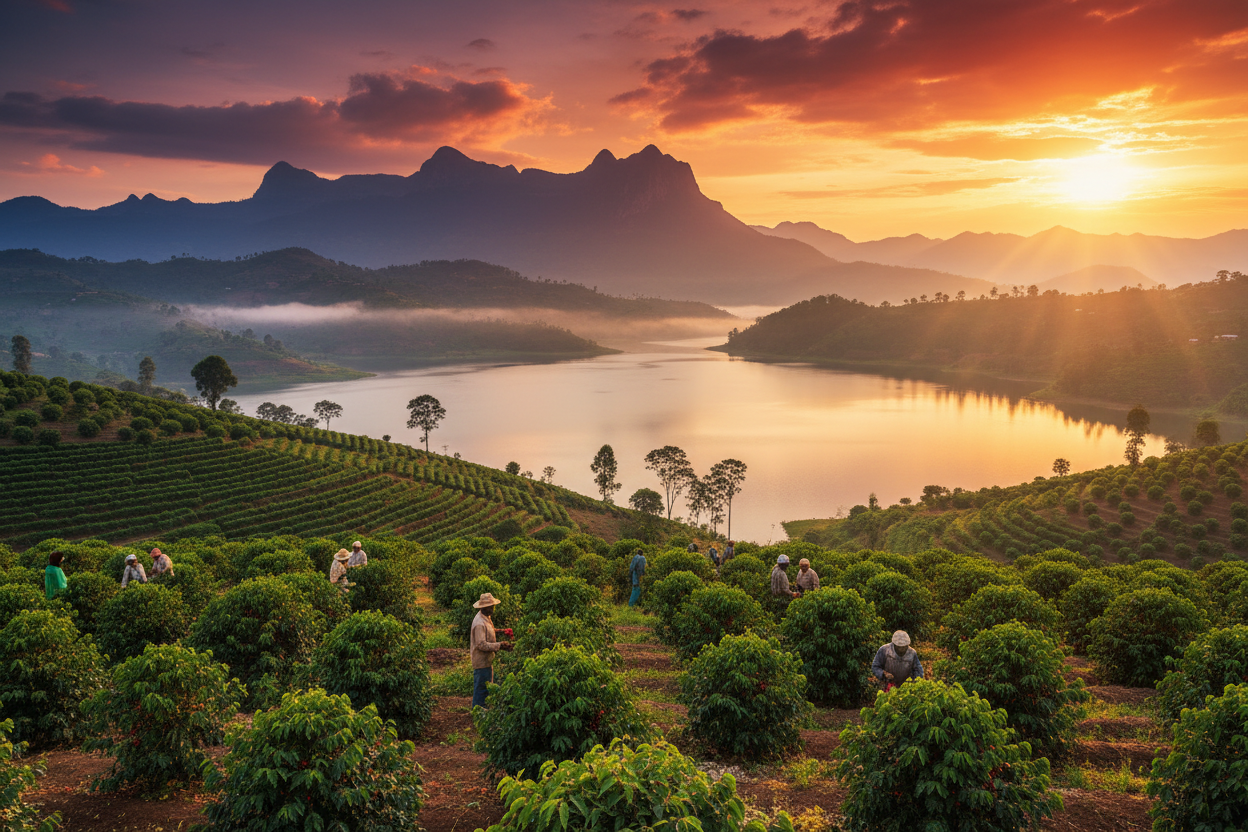
The Congo Frontier: Kivu Lake & Arabica Revival
I. Introduction: The Rebirth of the Breadbasket
In the high-resolution specialty market of 2026, we have analyzed the ancient soul of Ethiopia and the precision of Kenya. But to truly understand the future of the Great Rift Valley, we must look to its largest and most complex sovereign: the **Democratic Republic of Congo (DRC)**. At First Light Roasters, our motto: "Roasted for Clarity. Crafted at First Light": finds its most profound challenge and reward in the eastern provinces of the Kivu region.
The DRC is a nation of staggering potential (possessing over 75 million hectares of arable land). While it was once a top global producer, decades of conflict and neglect saw production collapse from 120,000 tons in 1993 to a mere 8,000 tons in 2016. However, the 2026 reality is a story of a "Specialty Renaissance". Driven by international partnerships and a $20 million investment to revive specialty coffee by 2026, the DRC is reclaiming its title as a producer of the world's finest Arabica. In this fifth chapter of our Biographic Series, we explore the 1881 arrival of the bean, the mineralogy of the Virunga volcanic range, and the technical shift toward micro-washing stations. This is the biography of the Congo Frontier.
II. The Anthropology of the Frontier: 1881 to 2026
The history of coffee in the DRC is a journey from colonial extraction to community-led peacebuilding.
2.1 The Belgian Era (1881 to 1960)
Coffee production in the Congo began circa 1881 under Belgian colonial rule. King Leopold II identified the eastern highlands: specifically the provinces of North Kivu, South Kivu, and Oriental: as a "paradise for coffee" due to the fertile volcanic soils and high altitudes. During this era, coffee was established as a large-scale cash crop on massive plantations. By the 1950s, the Congo was a major global supplier, providing the European market with high-density Bourbon beans.
2.2 The Era of Turmoil and Collapse (1960 to 2016)
Independence in 1960 brought immediate political disruption. While the end of the state monopoly in 1972 initially boosted production (reaching an average of 2 million bags annually by the mid-1970s), the regime of Mobutu Sese Seko and subsequent civil wars obliterated the sector. Farmers were forced to abandon their lands, trees were left to rot, and production plummeted. By 2016, the industry was a shadow of its former self, with many farmers resorting to smuggling their beans into neighboring Rwanda or Uganda to avoid high export taxes and lack of infrastructure.
2.3 The 2026 Reviving Origins Program
The turning point came with the 2020 launch of the "Reviving Origins" program in the Kivu region. In 2026, this initiative has channeled $20 million into purchasing specialty coffee, providing technical assistance, and building community infrastructure. For many Congolese families, coffee has become more than an export; it is a "Tool of Peacebuilding," providing ex-combatants with a viable alternative to militias and reintegrating them into civil society through steady livelihoods.
III. Terroir: The Volcanic Soul of the Great Lakes
The DRC possesses some of the most dramatic topography in the world, with coffee growing in the shadow of the Ruwenzori and Virunga mountains.
3.1 Lake Kivu and the Virunga Range
The eastern provinces of North and South Kivu are the heart of Congolese Arabica.
- North Kivu: Borders the Rwandan coffee regions and shares a remarkably similar profile. At altitudes of 1,500 to 2,000 meters above sea level (masl), the volcanic soil and frequent rains create a fertile, misty terroir ideal for Bourbon and Blue Mountain varietals.
- South Kivu: Centered around the city of Bukavu, this region features dizzying altitudes of 1,600 to 2,100 masl. The high altitude slows the maturity of the coffee cherries, allowing for a deeper concentration of sugars and a more nuanced flavor development.
3.2 The Oriental Province and Ituri
The northern reaches of the Arabica belt include the Ituri province, located near the Rwenzori Mountains. These coffees are known for their herbal complexity and "forest-like" aromatics (a byproduct of the rich biodiversity and high humidity of the Congo Basin). In 2026, these regions are the focus of new cooperative mapping projects aimed at ensuring absolute traceability for the specialty market.
IV. Varieties and Chemistry: The Bourbon of the Highlands
Like its neighbors, the DRC relies primarily on the **Bourbon** varietal for its high-clarity Arabica output.
4.1 The Sensory Signature: Chocolate and Dark Fruits
Technical cupping for Congolese coffee consistently reveals a profile that is "Rich and Indulgent".
- Primary Notes: Dense chocolate, zesty lemon, and blackberry.
- Secondary Notes: Ripe tropical fruits, raisins, and plums.
- Mouthfeel: A full-bodied cup with a bright, citric acidity that is perfectly balanced by the deeper chocolate undertones.
4.2 Molecular Markers: Flavonoids and Acids
In 2026, we utilize **Gas Chromatography** to map the specific molecular markers of the Kivu terroir. We have identified high concentrations of **Ethyl Butyrate** (the "Blackberry" marker) and specific **Monoterpenes** that provide the floral top notes often found in North Kivu lots. This chemical complexity is a direct result of the slow maturation at 2,000+ meters.
V. The Technical Shift: Micro-Washing Stations and Cooperatives
The greatest challenge in the DRC has been the lack of centralized infrastructure. In 2026, the industry has solved this through the **Micro-Washing Station** model.
5.1 The 100-Member Section
Historically, every farmer processed coffee on their own farm (leading to highly variable quality). Today, cooperatives like **Muungano** (Togetherness) and **SOPACDI** have established 123 micro-washing stations, each serving approximately 100 farmers. This allows coffee to be washed centrally: using modern pulping machines and controlled fermentation: ensuring the "fully washed" type that buyers pay premiums for.
5.2 Precision in Post-Harvest
In 2026, cooperatives are no longer just collecting points; they are data hubs. Staff are trained in coffee tasting and equipped with hygrometers to measure water activity and moisture content before the beans begin their long journey to the port of Mombasa in Kenya. This technical oversight is the mandatory foundation of the pursuit of clarity.
VI. The 2026 Socio-Economic Reality: Taxes and Smuggling
Despite the quality renaissance, the DRC remains a challenging environment for the agricultural entrepreneur.
6.1 The 18 Percent Barrier
One of the most significant hurdles for Congolese coffee is the cost of export. Formal coffee exports attract fees, taxes, and duties totaling 14 to 18 percent of shipment values (a whopping amount that often pushes farmers toward smuggling their crop into Rwanda). In 2026, international NGOs are working with the government to reduce these fees to ensure that the DRC can compete fairly on the global stage.
6.2 Gender Equality and Domestic Consumption
A bright spot in the 2026 landscape is the rise of women-led cooperatives. On Idjwi Island (Peace Island) in Lake Kivu, over 2,400 former dissidents and women work together on coffee plantations, receiving training in farming and processing that has more than doubled household incomes. Furthermore, a new wave of local coffee consumption: driven by young urban professionals in cities like Goma: is creating a stable domestic market that protects farmers from the fluctuations of the New York Coffee Exchange.
Conclusion: The Final Frontier of Clarity
The Democratic Republic of Congo is a nation of technical extremes and resilient spirits. By mastering the volcanic terroir of Lake Kivu, the Bourbon genetics, and the micro-washing station model, the DRC has earned its place as a mandatory pillar of specialty coffee.
At First Light Roasters, we are honored to showcase the "Rich Indulgence" of the Congo frontier. We roast to reveal the chocolate, the plum, and the technical clarity that only the Breadbasket of Africa can provide. This is exceptional specialty coffee, crafted at first light, for a refined and full-bodied experience consistently delivered on a global scale. Experience the frontier. Experience the clarity.
Experience the Indulgent Clarity of the Kivu Shores
Sourced from the high-altitude micro-washing stations of South Kivu. Shop our Congolese Collection
FAQ: DRC Coffee and Technical Revival
What makes Congo coffee taste different from Rwanda or Kenya?
While it shares the volcanic soil of the Rift Valley, Congolese coffee is renowned for its much "richer" profile (often featuring dense chocolate and dark fruit notes like plum and raisin) compared to the "sparkling" acidity of Kenya or the "silky" red apple of Rwanda.
Why is the Kivu region the main area for Arabica?
The Kivu provinces (North and South Kivu) offer the perfect combination of altitude (1,400 to 2,100 masl) and rich volcanic soil from the Virunga mountains, which provides the necessary nutrients for the Bourbon varietal to produce high-density, complex seeds.
What is the "Reviving Origins" program?
Initiated in 2020, this program is a major international investment (targeting $20 million by 2026) to restore specialty coffee production in regions like the DRC where it has been threatened by conflict and instability.
What is a "Micro-Washing Station"?
A micro-washing station is a centralized processing facility that serves a small group of approximately 100 farmers. This model ensures that cherries are processed with uniform technical standards (pulping, washing, and drying), which is essential for achieving specialty-grade quality.
Is Congo coffee "ethical"?
In 2026, coffee is a primary tool for peacebuilding in the DRC. By working with cooperatives like SOPACDI and Muungano, specialty buyers provide steady livelihoods for thousands of families and ex-combatants, contributing to regional stability and gender equality.
Why is smuggling a problem for Congolese farmers?
High export taxes (up to 18%) and a lack of formal infrastructure often mean that farmers receive higher prices by smuggling their beans into neighboring countries. Modern cooperative projects are working to reduce these barriers and ensure that the value stays with the producers.
How should I brew Congolese coffee?
To highlight the rich chocolatey flavors and dark fruit complexity, we recommend a **Pour-Over** or a **French Press**. The full-bodied nature of the Kivu Bourbon also makes it an exceptional choice for a high-definition **Espresso**.
What is "Idjwi Island" (Peace Island)?
Idjwi is a large island in Lake Kivu that has become a model for peaceful coffee production. Over 2,400 farmers work here to produce organic, specialty-grade Arabica, providing a blueprint for the future of the Congolese coffee renaissance.
Why is 2026 a landmark year for the DRC?
2026 marks the culmination of the $20 million investment phase to restore specialty production and the point where the DRC has officially returned to the global stage as a reliable producer of world-class, high-clarity Arabica.
What is the "pursuit of clarity" for the DRC?
For the Congo, clarity refers as much to the sensory profile as it does to the supply chain. It is about achieving a transparent, traceable connection from the mist-covered volcanic hills to the final cup, ensuring that every sip supports peace and excellence.


Leave a comment
This site is protected by hCaptcha and the hCaptcha Privacy Policy and Terms of Service apply.