

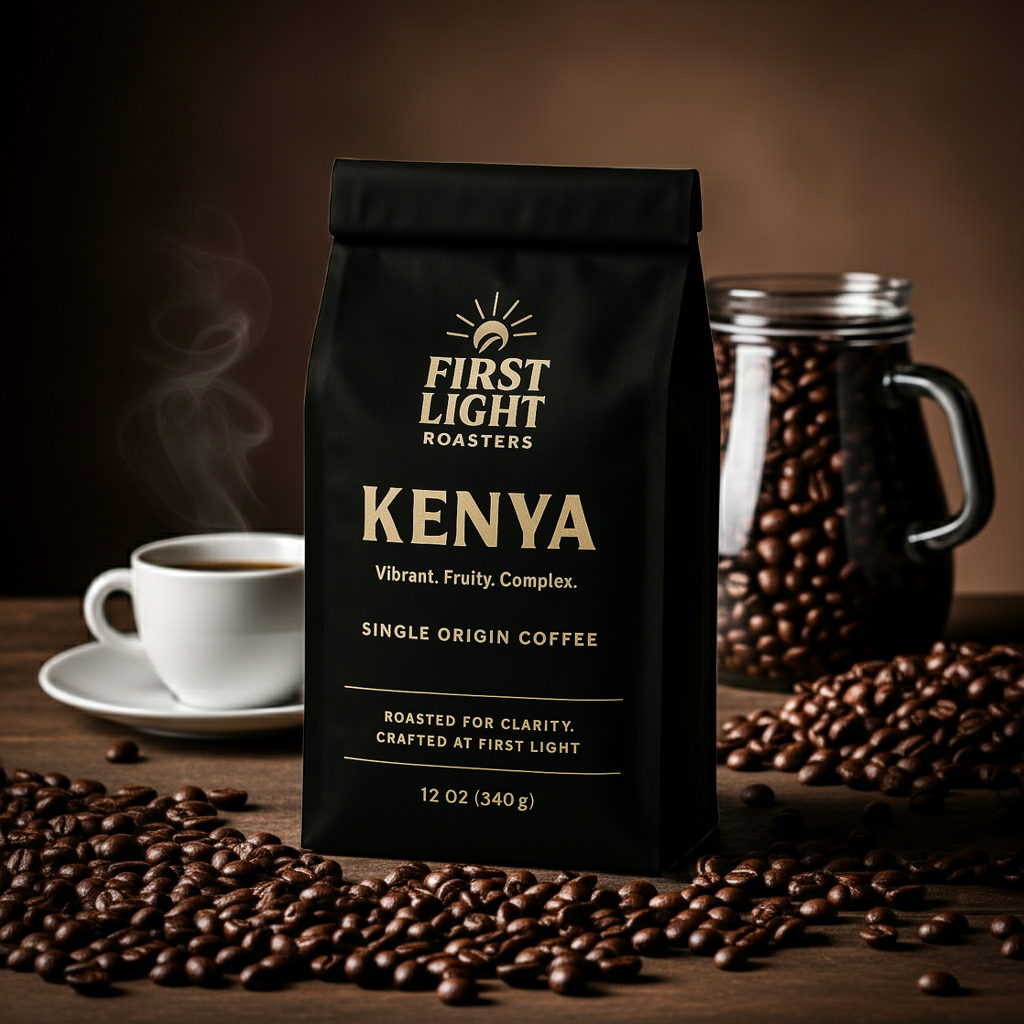
The Queen of Coffee: Why Kenyan Coffee Rules the Specialty World
When you wake up in the quietest part of the morning, before the rest of the world has started demanding your attention, you are looking for more than just a dose of caffeine. You are looking for a ritual that centers you. At First Light Roasters, we believe that the first cup of the day sets the frequency for everything that follows. If you want that frequency to be one of clarity, brilliance, and sophisticated power, there is only one origin that truly fits the throne.
In the specialty coffee industry, we often hear people call Kenyan coffee the Champagne of Coffee. It is a fine comparison because of the acidity and the prestige, but it feels a bit too dainty for what this coffee actually achieves. When you drink a high-quality Kenyan AA, you are not just drinking something bubbly and light. You are drinking something with a commanding presence. This is why we call it the Queen of Coffee.
The Royal Geography of Mt. Kenya
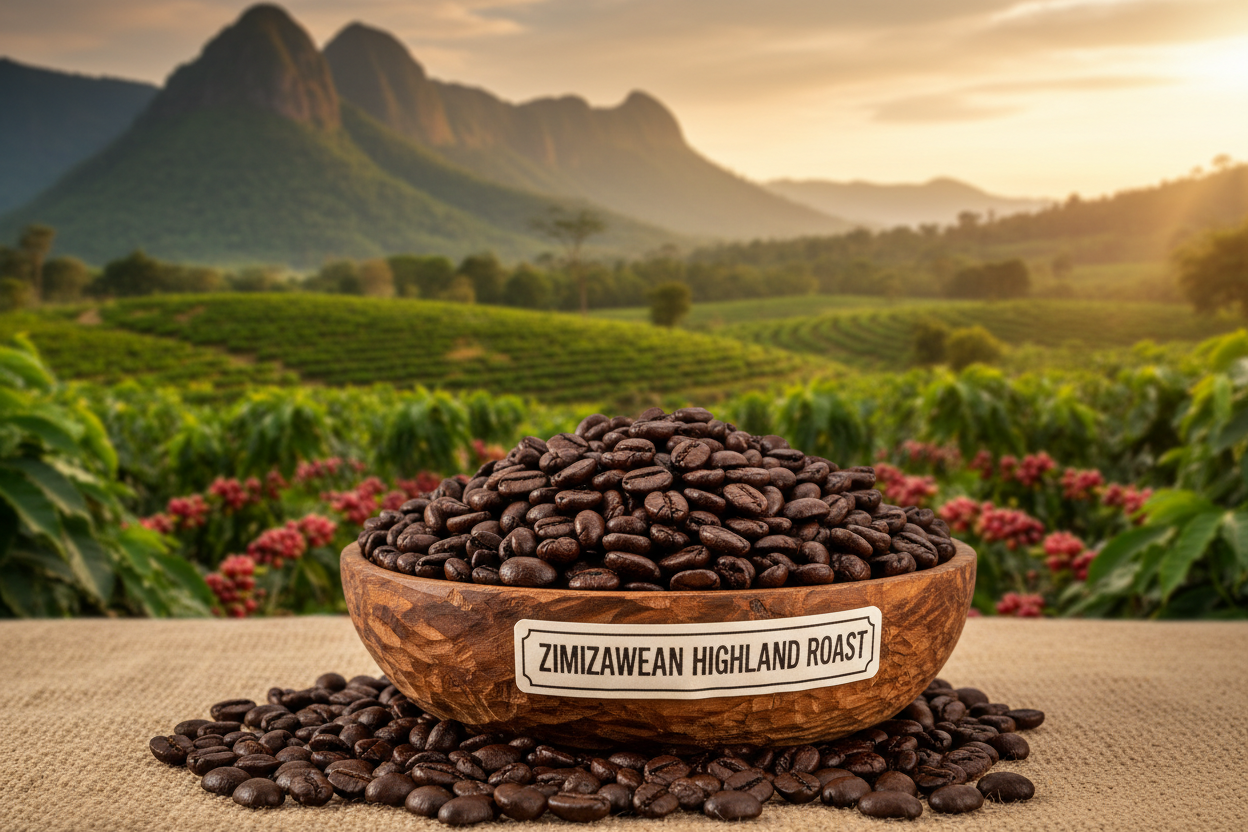
To understand why this coffee sits on a throne, we have to look at where it is born. Most of the world’s most famous Kenyan lots come from the high-altitude regions surrounding Mt. Kenya. This is a massive, extinct stratovolcano, and its legacy is written in the dirt. The soil here is deep, reddish-brown, and packed with phosphoric acid.
Volcanic soil is a gift to coffee trees. It is incredibly porous and rich in minerals, which allows the roots to dive deep and pull up nutrients that simply do not exist in other parts of the world. But the soil is only half of the story. The elevation is the other half. Many of these farms sit between 1,500 and 2,100 meters above sea level. At this height, the air is thin and the nights are cold.
Why does this matter for your morning cup? It matters because the coffee cherry is forced to grow slowly. In the heat of lower elevations, cherries ripen quickly, often leading to a simple, sugary taste. In the high altitudes of Kenya, the plant has to struggle. This struggle results in a much denser bean that is packed with complex acids and sugars. When we roast these beans at First Light Roasters, we are essentially unlocking a treasure chest of flavor that took months of slow, patient growth to create.
Experience the Heights: Our current Kenyan AA offering is a direct reflection of this volcanic terroir. It is a single-origin experience designed for those who value clarity above all else. > [Taste Our Signature Kenya AA]
The Mystery of the SL Varieties
If the soil is the palace, then the SL-28 and SL-34 varieties are the royal lineage. In the 1930s, a group called Scott Agricultural Laboratories was tasked with finding coffee varieties that were hardy and flavorful. They ended up selecting these two specific strains, and they have become the gold standard for Kenyan coffee ever since.
SL-28 is particularly famous for its drought resistance and its incredible flavor profile. It is the reason you taste those deep blackcurrant and citrus notes. It is a variety that does not apologize for its intensity. When you drink a cup of our SL-28 heavy lots, you are tasting a genetic history that has been preserved and perfected for nearly a century. This consistency of quality is part of what makes Kenyan coffee so reliable for the specialty enthusiast. You know that when you buy a bag of Kenyan beans, you are getting a specific, elite level of craftsmanship.
The Double Washed Process: A Royal Bath
One of the most unique things about Kenyan coffee is the way it is processed after it is picked. In many parts of the world, coffee is either dried in the sun with the fruit still on it or washed once and sent to dry. Kenya takes it a step further with a process often called double washing or double fermentation.
After the cherries are depulped, they are fermented in tanks for up to 24 hours. Then, they are washed and fermented a second time for another 12 to 24 hours. Finally, they are soaked in clean water. This sounds like an exhausting amount of work, and it is. However, this obsessive level of cleaning is what gives Kenyan coffee its legendary clarity.
When we talk about clarity in coffee, we are talking about a lack of static. Some coffees taste muddy or earthy, which can be nice in its own way. But a Queen doesn't do muddy. She is sharp and clear. The double washing process strips away every hint of fermented fruit or dirt, leaving only the pure, vibrant flavors of the bean itself. This is why Kenyan coffee is so beloved by those who use pour-over methods like the Hario V60 or the Chemex. The brew is so clean that you can taste every individual note as it hits your tongue.
The AA Standard: Why Size Equals Superiority
There is a reason why the letters AA are the most sought after in the coffee world. In Kenya, coffee is graded by screen size, and AA represents the largest and most developed beans in the entire harvest. While other grades like AB or C can be delicious, they simply cannot match the physical potential of the AA bean.
Because these beans are the largest, they have had the most time to absorb the nutrients from that rich volcanic soil. They are significantly denser than smaller beans. In the roasting world, density is everything. A dense AA bean can withstand the intense heat of our roaster more effectively, allowing the sugars to caramelize deeply without the bean becoming bitter or smoky. This density is what creates that heavy, wine-like mouthfeel that defines the best Kenyan coffee.
When you choose an AA lot, you are choosing a bean that has been meticulously sorted by hand and machine to ensure absolute perfection. There is no room for error here. These are the beans that fetch the highest prices at auction because they are the most flavor-dense gems a coffee tree can produce. At First Light Roasters, we don't settle for the smaller, less developed grades. We believe your morning deserves the peak of the harvest.
The Gold Standard: Not all beans are created equal. Our AA-graded Kenyan lot is hand-sorted for size, density, and perfection. This is the highest tier of Kenyan coffee available. > [Shop the Premium Kenya AA Selection]
The Philosophy of the First Light Roast
At First Light Roasters, we approach Kenyan coffee with a deep sense of responsibility. You cannot treat a bean this complex with a heavy hand. If you roast a Kenyan coffee too dark, you destroy the very things that make it special. The delicate floral aromas and the bright phosphoric acidity are the first things to disappear when the roast goes too long.
We use a light to medium roast profile that we call The Clarity Roast. Our goal is to stay out of the way. We want the volcanic soil, the high altitude, and the double washing process to speak for themselves. When you open a bag of our Kenyan coffee, the smell should remind you of a basket of fresh berries and a hint of jasmine.
We believe that coffee is a medium for mindfulness. The world is loud and chaotic, but the process of brewing a Kenyan coffee requires you to slow down. You have to watch the bloom. You have to monitor the temperature of your water. You have to pour with intention. By the time the coffee is in your mug, you have already spent five minutes in a state of focused calm. That is the First Light experience.
Tasting the Notes: A Royal Palette
When you take your first sip of a Kenyan coffee, you might be surprised by the acidity. In the coffee world, acidity is not a bad thing. It isn't like the acid in your stomach. It is more like the brightness in a piece of fruit. Think of the difference between a dull, mealy apple and a crisp, tart green apple. That snap is what we are looking for.
In a Kenyan Queen, that acidity usually presents as blackcurrant. This is the signature note of the region. It is a deep, purple fruitiness that is both sweet and tart. You might also find notes of grapefruit, which provide a pleasant bitterness that balances out the sugar. On the finish, a great Kenyan coffee will often leave you with a lingering taste of tomato or spice, which sounds strange until you actually experience how savory and complex it makes the cup.
Why It Belongs in Your Morning Ritual
We often get asked if Kenyan coffee is too much for an everyday morning cup. People are used to more chocolatey, nutty coffees from Brazil or Central America. While those have their place, the Queen of Coffee offers something different. She offers a wake-up call for your senses.
Drinking a bright, vibrant coffee in the morning is like opening the curtains and letting the sunlight hit your face. It wakes up your palate and your brain in a way that a darker, heavier roast cannot. It is a sophisticated start to the day. It tells your brain that today is not just another day to get through, but a day to be experienced with clarity and sharpness.
The Subscription Ritual: The Queen demands freshness. Join our First Light subscription and get our signature Kenya AA delivered to your door the moment it leaves the roaster. > [Subscribe and Save 15%]
The Impact on the Kenyan Community
Beyond the flavor, choosing Kenyan coffee is about supporting a very specific agricultural system. Most Kenyan coffee is grown by smallholder farmers who bring their cherries to a central factory, which is what they call their washing stations. These factories are often cooperatives owned by the farmers themselves.
When you buy a premium Kenya AA lot, you are supporting a system that rewards quality. Because Kenyan coffee is sold through a transparent auction system, the highest quality lots fetch significantly higher prices. This means that the farmers who put in the extra work to double wash their beans and sort them by hand are actually being paid for their expertise. At First Light Roasters, we are proud to be a part of this cycle. We believe that if a farmer produces a world-class product, they deserve a world-class price.
How to Brew Like a Pro
To get the most value out of your bean, we need to talk about the technical side of the Queen. If you are going to invest in a bag of First Light Kenyan AA, you should know how to treat it.
First, use good water. Coffee is 98 percent water. If your water tastes like chlorine, your coffee will taste like chlorine. We recommend using filtered water or even a specific mineral recipe for coffee.
Second, check your temperature. Because Kenyan AA beans are so dense, they can handle a bit more heat than a fragile natural-process coffee. We like to brew our Kenyan lots at around 94 degrees Celsius. This helps to extract those deep, wine-like acids that are tucked away inside the dense bean structure.
Third, keep your ratio consistent. We suggest a ratio of 1 to 16. That means for every gram of coffee, you use 16 grams of water. This creates a balanced cup that isn't too heavy but still has enough body to carry those intense fruit flavors.
Final Thoughts from First Light
At the end of the day, we roast coffee because we love the way it brings people into the present moment. The Queen of Coffee is the ultimate tool for that. She is bold, she is bright, and she refuses to be ignored. When you sit down with a cup of First Light Kenyan AA, you are partaking in a royal tradition that spans from the volcanic slopes of Africa to your kitchen table.
We invite you to experience the clarity. We invite you to experience the power. We invite you to experience the Queen.
Bring the Queen Home
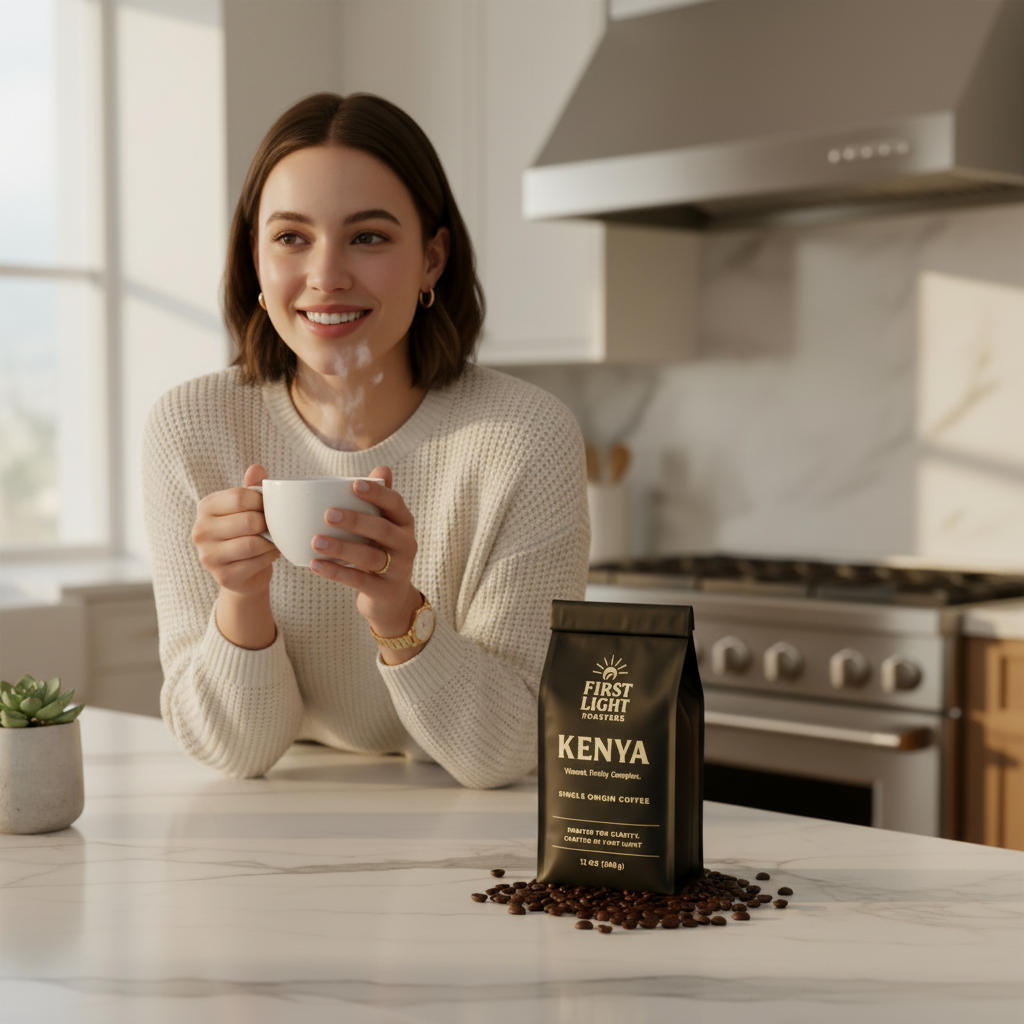
Don't settle for a mediocre morning. Elevate your coffee ritual with the vibrant, wine-like notes of our hand-selected Kenyan AA. Roasted in small batches with intention and delivered fresh to your door.

Leave a comment
This site is protected by hCaptcha and the hCaptcha Privacy Policy and Terms of Service apply.