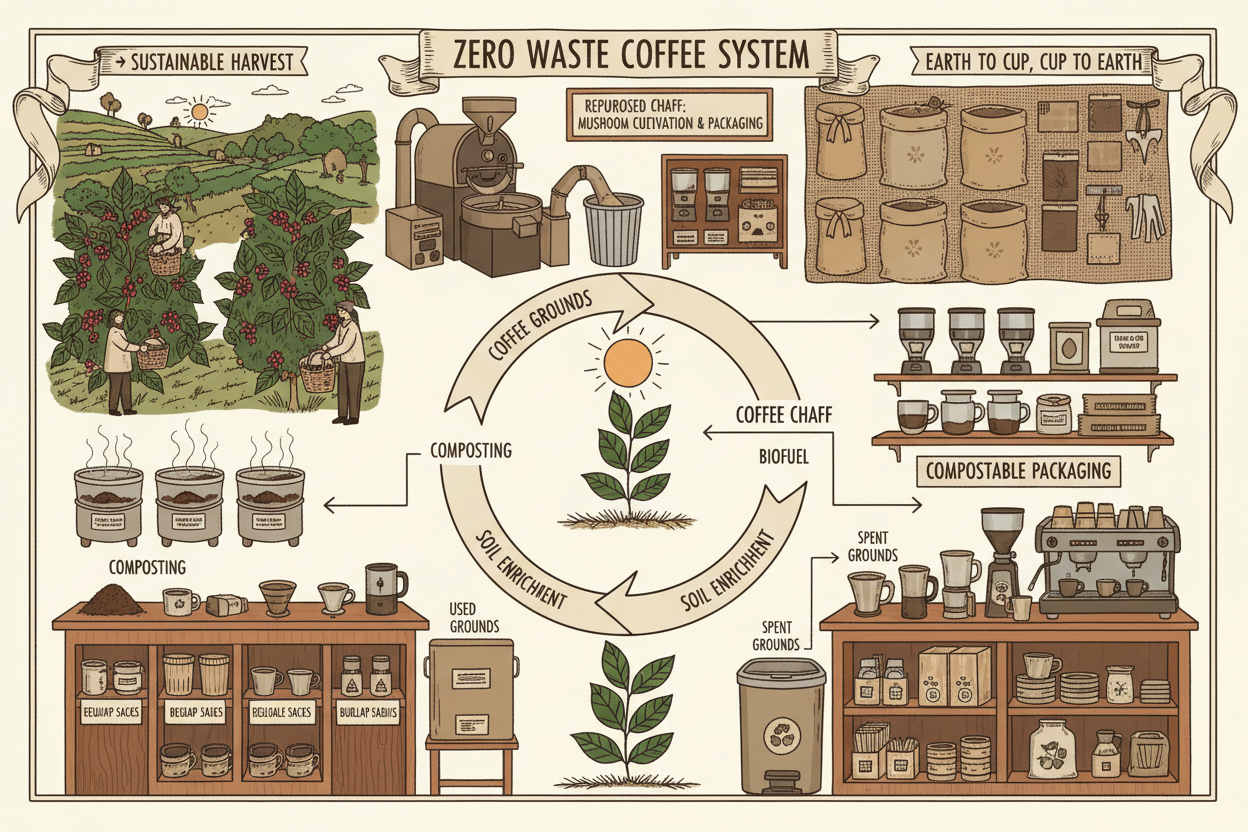
Introduction: The Roastery as a Living System
In the specialty coffee world of 2026, the pursuit of clarity is no longer confined to the flavor profile of the bean. It has expanded to encompass the entire metabolic footprint of the production facility. We have moved past the era of "offsetting" carbon and into the era of circular engineering: where every byproduct of the roasting process is captured, recycled, or upcycled into the production chain. At First Light Roasters, our motto: "Roasted for Clarity. Crafted at First Light": serves as the primary blueprint for our zero-waste infrastructure.
A traditional 20th-century roastery was a linear, entropic system: energy in, coffee out, and massive amounts of heat, water, and biomass waste discarded into the atmosphere and local landfills. In 2026, we view the roastery as a biological metabolism. To honor the volcanic integrity of the Rift Valley, we must ensure that our processing is as restorative as the regenerative forestry of our partner farms. This guide explores the engineering of the modern metabolic roastery and why circular design is the final frontier of specialty excellence.
I. Thermodynamic Recycling: The Physics of Closed-Loop Heat Exchange
The most significant waste product in any roastery is not physical: it is thermal energy. Traditional drum roasters vent up to 70% of their generated heat directly into the environment through exhaust stacks. In 2026, we treat every joule of heat as a precious commodity managed through **Recuperative Thermal Engineering**.
1.1 Recuperative vs. Regenerative Burner Systems
Modern electric and hydrogen roasters utilize dual-stage heat exchangers. The hot exhaust air from the roasting chamber, which can reach $250^\circ\text{C}$ ($482^\circ\text{F}$), is passed through a ceramic honeycomb matrix. This matrix captures the thermal energy before the air is filtered and vented. This stored energy is then used to pre-heat the intake air for the next batch. The efficiency of this system is modeled by the equation for heat exchanger effectiveness ($\epsilon$):
$$\epsilon = \frac{Q_{actual}}{Q_{max}} = \frac{C_h(T_{h,in} - T_{h,out})}{C_{min}(T_{h,in} - T_{c,in})}$$
By optimizing this effectiveness, we reduce the total electrical load of our roastery by over 45%. This ensures that the technical precision we demand is powered by the same energy used in the previous hour's production.
1.2 Managing the Roast Curve via Thermal Stability
This isn't just about sustainability: it's about flavor definition. By utilizing recycled heat, we stabilize the intake air temperature, reducing the "environmental noise" that causes fluctuations in the roast curve. This ensures that the delicate organic acids of a Kenyan AA lot are developed with absolute consistency, batch after batch, regardless of the seasonal weather outside our facility. We are no longer roasting at the mercy of the atmosphere; we are roasting in a controlled metabolic loop.
II. Chaff-to-Energy: The Molecular Upcycling of Biomass
Chaff: the papery silverskin that detaches from the bean during roasting: has historically been the primary waste burden of the industry. In 2026, chaff is recognized as a high-density biomass fuel with significant caloric value.
2.1 Bio-Pelletization and High-Heat Gasification
At First Light, we utilize an on-site pellet press that compresses raw chaff, which is light and prone to spontaneous combustion, into high-density, high-BTU fuel pellets. These pellets are then fed into a small-scale gasifier. Through the process of **Pyrolysis**, the pellets are heated in a low-oxygen environment to produce "Syngas". This gas provides supplemental heat for our facility or energy for our laboratory equipment, further decoupling our pursuit of clarity from the fossil fuel grid.
2.2 Biochar: Closing the Mineral Cycle
The byproduct of our gasification process is **Biochar**: a stable, carbon-rich form of charcoal. Biochar is a miracle amendment for the productivity of garden systems. We ship this biochar back to our partner producers in the Rift Valley, where it is added to their compost. This completes a million-year mineral cycle: the Potassium and Magnesium pulled from the volcanic soil by the tree are captured in the chaff, converted into biochar, and returned to the same earth to feed the next generation of heirloom plants.
III. Hydro-Circularity: The Zero-Liquid Discharge (ZLD) Lab
As we established in the Home Barista's Lab, water is the primary solvent of specialty coffee. In a professional 2026 roastery, water is used for cooling (quenching), equipment sanitation, and sensory analysis.
3.1 Atmospheric Water Generation and Recapture
Our facility operates on a Zero-Liquid Discharge (ZLD) protocol. Water used in the "quenching" phase: where a fine mist is used to rapidly stop the roasting process: is captured through specialized drain and condensation systems. This wastewater is passed through an intensive filtration stack including:
- Activated Carbon: To remove organic particulates and odors.
- Reverse Osmosis: To strip the water of all dissolved solids.
- UV Sterilization: To ensure the biological purity of the recirculated stream.
3.2 Condensate Harvesting for Sensory Standards
We harvest the condensate from our high-efficiency climate control systems, which maintain the volatility stability of our green coffee warehouse. This distilled water is then remineralized with specific concentrations of Magnesium to create the "Standard Solvent" needed for our professional cupping protocols. Not a single liter of water is wasted in our pursuit of a clean natural profile.
IV. Packaging 2.0: The End of the Laminate Era
The most visible waste in the coffee industry has always been the non-recyclable bag. In 2026, the traditional multi-layer laminate (a composite of plastic and aluminum) is officially obsolete.
24.1 High-Barrier Mono-Materials
At First Light, we utilize 100% recyclable mono-material Polyethylene (PE) bags. Through advanced polymer engineering, these bags provide the same oxygen ($O_2$) and moisture ($H_2O$) transmission rates as traditional foils without the ecological cost. This ensures the volatile aroma compounds are preserved while maintaining a clean, circular waste stream for our customers.
24.2 Industrial Compostability and Cellulose Engineering
For our limited-edition "Rift Valley Reserve" lots, we utilize bags made from certified industrial-compostable cellulose and starch-based resins. These bags are designed to break down into nutrient-rich organic matter within 90 days in a commercial facility, returning the packaging itself to the carbon cycle. This level of packaging innovation is the final step in our zero-waste commitment.
V. The Logistics of Clarity: Electric Fleets and IoT Totes
The metabolic roastery extends its circular reach into the delivery chain. In 2026, we have eliminated the "corrugated waste" (cardboard boxes) for our local wholesale partners.
5.1 Reusable IoT Totes
We ship our beans in RFID-tracked, reusable silicone-lined totes. These totes are sanitized and returned to the roastery after every delivery, eliminating thousands of pounds of cardboard and tape waste annually. This system also allows us to track the **Internal Humidity and Temperature History** of the beans via IoT sensors, ensuring that the aromatic volatiles remain stable until they reach the grinder.
5.2 Solar-Powered Last-Mile Electrification
Our delivery fleet is 100% electric, charged by the massive solar array on the roof of our metabolic facility. This ensures that the Sommelier's experience is not tainted by the carbon footprint of the journey. At First Light, we don't just talk about sustainability; we engineer it into the pavement.
Conclusion: The Ethics of Efficiency
The engineering of a zero-waste roastery is not just a moral choice: it is a technical necessity for the future of specialty coffee. In 2026, a wasteful roastery is an inefficient roastery. By capturing every joule of energy, every liter of water, and every gram of biomass, we are able to reinvest more value into the people and the land of the Great Rift Valley.
At First Light Roasters, we believe that clarity is a holistic concept. It starts with the minerals in the soil, continues through the technical precision of the roast, and ends with the responsible management of our footprint. This is exceptional specialty coffee, crafted at first light, for a refined and full-bodied experience consistently delivered on a global scale. Join us in the circular pursuit of clarity.
Breathe in the Pursuit of Clarity
Support a roastery that gives back more than it takes. Shop our Sustainable 2026 Collection
FAQ: Understanding Zero-Waste Roasting Engineering
Is zero-waste coffee more expensive to the consumer?
While the initial infrastructure for a metabolic roastery is an investment, the long-term operational efficiency: such as a 45% reduction in energy costs and the elimination of single-use packaging: helps us stabilize prices in the volatile 2026 market. Efficiency actually protects the consumer from price spikes.
What exactly is "chaff" and why is it useful?
Chaff is the dried silverskin (parchment) that detaches from the coffee bean during the roasting process. In 2026, we view it as a biomass resource rather than trash. It can be pelletized for fuel or gasified to produce heat and biochar.
Can coffee bags really be recycled?
Traditionally, no, because of the metal/plastic mix. But in 2026, mono-material PE bags are the industry standard for 100% recyclability. Check for the "Level 4 PE" recycling symbol to ensure your bag enters the circular stream.
How does a roastery recycle heat?
Modern roasters use recuperative heat exchangers. These systems capture the thermal energy from hot exhaust and transfer it to the cold incoming air, significantly reducing the energy required to reach roasting temperatures.
What is Biochar and how does it help the farm?
Biochar is a carbon-rich charcoal produced from roasting byproducts. When returned to the farm, it improves soil structure, increases nutrient retention, and sequesters carbon for hundreds of years, supporting the regenerative forestry of the Rift Valley.
What is Zero-Liquid Discharge (ZLD)?
ZLD is a circular water system where all wastewater from the facility is purified and recycled back into the system. This ensures that no liquid waste is discharged into the local ecosystem.
Does zero-waste roasting change the taste of the coffee?
Yes, for the better. By using "clean" heat sources like electricity and instantly removing chaff through high-velocity air, zero-waste systems produce a cup with higher clarity and fewer "smoky" or "papery" off-flavors common in old drum roasters.
Why is 2026 the year of "Metabolic Roasting"?
Climate change and the global shift toward circular economies have made the old, linear model of roasting economically and ecologically unviable. In 2026, transparency and circularity are the primary indicators of a brand's quality and longevity.