

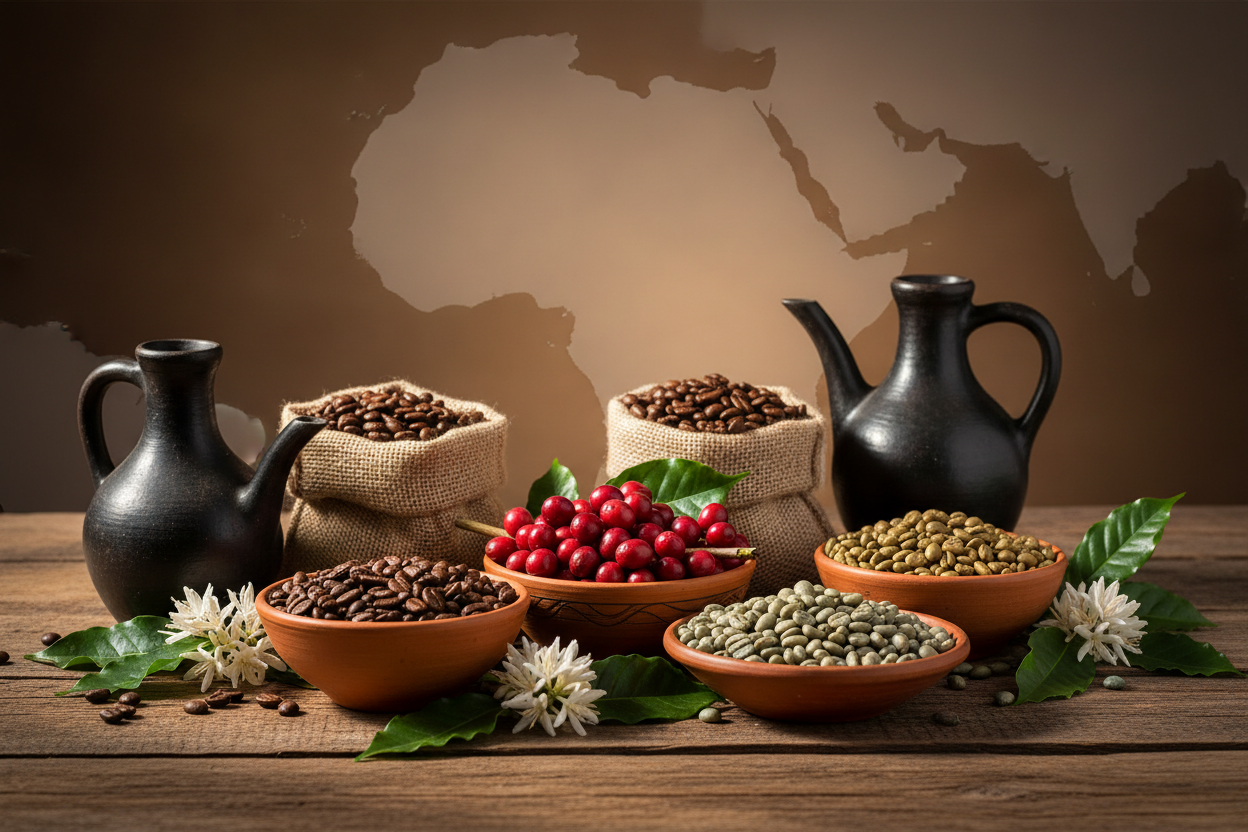
A Guide to East African Coffee Types
Introduction: The Cradle of the Bean
In the global specialty market of 2026, one region stands above all others for its ability to produce high-definition, vibrant, and transparent flavor: East Africa. At First Light Roasters, our motto: "Roasted for Clarity. Crafted at First Light": is a tribute to these diverse origins. While the geology of the Rift Valley provides the mineral foundation, the different micro-climates and traditions across East Africa create a stunning spectrum of taste.
Whether you are a newcomer to specialty coffee or a seasoned prosumer, understanding the "personality" of each East African country is essential. In this guide, we break down the primary coffee-producing nations of the region, their signature flavor profiles, and why they are the mandatory first step in your education of the bean. This is your map to the most exciting coffees on earth.
I. Ethiopia: The Genetic Ancestry
Ethiopia is the birthplace of Arabica coffee. Unlike other countries where coffee was introduced as a commercial crop, coffee grows wild in the forests here. This provides a level of natural complexity that is impossible to replicate elsewhere.
1.1 Yirgacheffe and Sidamo: The Floral High Notes
If you enjoy coffee that smells like a garden, you are looking for Yirgacheffe. These coffees are famous for their **Jasmine** and **Bergamot** (Earl Grey tea) notes. They are typically light-bodied and incredibly elegant. In 2026, we prize the "Washed" Ethiopian lots for their tea-like transparency, which allows the delicate floral chemistry to shine.
1.2 Guji and Harrar: The Fruit Bombs
Regions like Guji and Harrar are known for their "Natural" (dry) processing. These beans are dried inside the fruit, which imparts intense flavors of **Blueberry**, **Strawberry**, and **Stone Fruit**. A Clean Natural from First Light offers a "Jammy" sweetness that feels like a bold red wine.
II. Kenya: The "Sparkling" Powerhouse
Kenyan coffee is often described as the "Champagne" of the coffee world. It is bold, intense, and possesses an acidity that "sparkles" on the tongue.
2.1 The Signature Savory-Sweet Balance
What makes Kenyan AA and AB lots unique is their combination of **Blackcurrant** sweetness and a savory, tomato-like complexity. This is due to the high phosphoric acid content in the volcanic soil. Kenyan coffee doesn't just sit on the palate; it vibrates.
2.2 The Technical Prowess of the Nyeri and Kirinyaga Regions
The central highlands of Kenya are home to the most sophisticated washing stations (factories) in the world. The "Kenya-Washed" method involves long fermentation times and double-washing, which creates the absolute clarity that is the hallmark of the Nairobi Standard.
III. Rwanda: The "Land of a Thousand Hills"
Rwanda has made one of the most incredible recoveries in agricultural history. Today, it produces some of the cleanest and most balanced coffees in East Africa.
3.1 Silky Body and Red Fruit
Rwandan coffees (particularly from the Lake Kivu region) are known for their **Silky Mouthfeel** and notes of **Red Apple**, **Plum**, and **Cane Sugar**. They are less "aggressive" than Kenyan coffees, making them an excellent daily drinker for those who value refined sweetness over intense acidity.
3.2 The Bourbon Heritage
Almost all Rwandan coffee is of the **Bourbon** varietal. This specific genetic strain is prized for its high sugar content. When we roast Rwandan beans, we focus on developing these caramels to create a "Full-Bodied" experience that remains transparent and clear.
IV. Burundi: The Wild Cousin
Neighboring Rwanda, Burundi shares many of the same high-altitude growing conditions but often produces a "wilder" and more unpredictable cup.
4.1 Complex Spice and Honey
Burundian coffees often feature a unique **Spicy Undertone** (think cinnamon or clove) paired with a deep **Wild Honey** sweetness. They are incredibly complex and tend to change flavor dramatically as the cup cools, which is a favorite characteristic of the barista sommelier.
4.2 High-Altitude Resilience
Like Kenya, Burundi coffee is grown at very high altitudes (often above 1,800 meters), resulting in dense, hard beans that can withstand our technical light-roasting process without losing their character.
V. Why Choose East Africa?
In 2026, choosing East African coffee is a statement of intent. It means you are choosing **Quality over Convenience**.
- Aromatic Intensity: No other region can match the perfume-like scent of a fresh-ground Ethiopian heirloom.
- Cognitive Performance: As we explored in the Entrepreneur's Foundation, the clean, "jitter-free" energy of East African roasts is ideal for deep work.
- Traceability: Thanks to the blockchain reforms of 2026, you can often trace your East African bag back to the exact hill (colline) or washing station where it was grown.
Conclusion: Start Your Journey Today
The world of East African coffee is vast and rewarding. From the floral elegance of Ethiopia to the bold energy of Kenya and the silky sweetness of Rwanda, there is an origin for every palate. By focusing on these types, you are building the foundation for a lifetime of the pursuit of clarity.
At First Light Roasters, we are proud to offer a curated selection of these East African masterpieces. This is exceptional specialty coffee, crafted at first light, for a refined and full-bodied experience consistently delivered on a global scale. Pick a country. Brew a cup. See the clarity.
Begin the Pursuit of Clarity
Explore the different types of East African coffee through our seasonal tasting flights. Shop the Collection
FAQ: East African Coffee Basics
Which East African coffee is the least acidic?
If you are sensitive to acidity, we recommend starting with **Rwandan** or **Burundian** coffees. They tend to have a silkier, more balanced profile with notes of chocolate and stone fruit, compared to the "sparkling" acidity of Kenya.
What is an "Heirloom" variety?
"Heirloom" is a term used primarily for Ethiopian coffee to describe thousands of wild or semi-wild varieties that have grown naturally in the region for centuries. This genetic diversity is what gives Ethiopian coffee its unique floral and complex flavor.
Why does Kenyan coffee taste like blackcurrant?
The signature blackcurrant note is a result of the specific **SL28** and **SL34** varietals combined with the phosphorus-rich volcanic soil of the Kenyan highlands. It is one of the most recognizable "flavor markers" in the specialty world.
What is the difference between "Washed" and "Natural" coffee?
"Washed" coffee has the fruit removed before drying, resulting in a cleaner, more "transparent" cup that highlights acidity. "Natural" coffee is dried inside the fruit, resulting in a heavier body and intense "berry" flavors.
Is East African coffee more expensive?
Generally, yes. Because it is grown at high altitudes and requires meticulous hand-picking and processing, East African coffee commands a premium in the 2026 specialty market. However, as we noted in the Economics of Taste, it remains the world's most undervalued luxury asset.
How should I brew these coffees?
To experience the full clarity of East Africa, we recommend a **Pour-Over** (like a V60 or Chemex). This method uses a paper filter to remove oils and fines, allowing the delicate floral and fruit notes to shine.
Why is 2026 a great time to try these coffees?
New autonomous logistics and blockchain systems mean that East African coffee is reaching the US and Europe faster and fresher than ever before, preserving those delicate "high-note" aromatics.
What does "90 plus" mean?
A "90 plus" coffee is an elite lot that has scored 90 points or higher on the 100-point specialty scale. East Africa produces more 90-plus point coffees than any other region.
Does East African coffee have more caffeine?
No, caffeine levels are generally determined by the Arabica species. However, because the flavor is so "clean," many users report feeling a more focused and less "jittery" energy compared to lower-quality commodity blends.
What is the "Nairobi Standard"?
The Nairobi Standard is the world's most rigorous auction and grading system, which ensures that only the most uniform and high-quality beans are exported from Kenya.


Leave a comment
This site is protected by hCaptcha and the hCaptcha Privacy Policy and Terms of Service apply.