

Kenya AA vs. AB vs. PB: What Coffee Grades Actually Mean
If you have spent any time browsing specialty coffee offerings, you have seen the letters AA, AB, and PB attached to Kenyan coffee. They appear on bags, on roaster websites, in wholesale catalogs, and in the tasting notes of barista competitions. Most people assume they indicate quality levels — that AA is best, AB is second, and PB is something else entirely. The reality is both simpler and more interesting than that, and understanding it will change how you shop for and appreciate Kenyan coffee.
Grading in Kenya is a precise, official system administered by the government's coffee directorate. It is based primarily on bean size, with secondary evaluation for defects and moisture content. It is not, strictly speaking, a quality ranking in the cup-score sense of that term — though there are genuine relationships between grade and cup quality that make the system worth understanding in depth.
The important thing to know upfront is this: Kenyan coffee of all three major grades can be extraordinary. The grade tells you what size bean you are working with and gives you some structural information about how it will behave in the roaster. The cup quality — the brightness, the fruit, the body, the clarity — is determined by growing region, variety, processing, and roaster skill, none of which the grade directly encodes.
The Screen Size System Explained
Coffee grading in Kenya uses a system of mesh screens — essentially sieves with holes of precisely calibrated diameters measured in fractions of an inch or in millimeters. Harvested, processed, and dried coffee beans (now called green beans) are passed through these screens in sequence from largest to smallest. The screen through which a bean does not pass — meaning the smallest screen that retains it — determines its grade.
AA is the largest commercially traded grade: beans retained on a screen with 7.2mm holes, or what the industry calls an 18-mesh screen. AB is a combined grade that covers beans retained on the 6.8mm or 6.4mm screens (17 and 16 mesh respectively) — the A and B designations were originally separate grades but are now sold together in the vast majority of commercial transactions. C grade covers smaller beans below 15 mesh, and T and TT grades cover the tiniest fragments and broken pieces sorted out during the grading process.
Peaberry, designated PB, is different in kind rather than just size. It is a natural botanical anomaly that occurs when a coffee cherry develops only one seed instead of the usual two. Normally, two seeds develop facing each other inside the cherry, which creates the flat side on the interior of a standard coffee bean. When only one seed develops, it grows round rather than flat-sided — the "pea" in peaberry refers to its rounded shape. Peaberries typically constitute 5 to 10 percent of any given harvest and are sorted separately by hand or with specialized equipment. They command their own pricing tier because many roasters and drinkers believe the unique shape creates a distinctly different roast behavior and flavor profile.
Does Size Actually Predict Cup Quality?
This is where it gets genuinely interesting, because the relationship between grade and cup quality is real but not simple, and the nuances matter for anyone making informed buying decisions.
Larger beans do have structural advantages in the roaster: more uniform heat penetration due to greater mass-to-surface-area ratio, lower likelihood of scorching or tipping, and generally more developed internal cell structure. These characteristics tend to produce more even roasts and more consistent cups, particularly when a roaster is working with high volumes and cannot individually profile every batch.
However, cup quality in Kenya is more strongly predicted by growing region, processing method, and coffee variety than by screen size alone. A meticulously processed AB from Nyeri grown at 1,900 meters from SL28 trees will frequently outscore a poorly processed AA from a less ideal growing environment in a lower-altitude region. The grade is a proxy for certain physical properties, not a guarantee of cup quality — and the specialty coffee industry has understood this for decades. Many of the highest-scoring Kenyan lots in competitive cupping sessions have been AB or PB, not AA.
What the AA designation reliably indicates is: large, fully formed beans with more predictable roasting behavior. For roasters running consistent volumes and seeking batch-to-batch repeatability, this consistency has genuine operational value. For specialty roasters like First Light who are cupping every lot individually and adjusting profiles accordingly, the grade is one useful data point among many — not the primary decision criterion.
The Case for Peaberry: Different, Not Inferior
Peaberry coffee has a devoted following in the specialty world, and the enthusiasm is grounded in real observations about cup character rather than mere novelty.
The round shape of the peaberry means it rolls differently in the roasting drum — more uniformly in some roasters' experience, because it doesn't lie flat against other beans the way a flat-sided bean does. Whether this mechanical difference creates a meaningfully different cup is a genuine debate in roasting circles, but what is not debatable is that peaberry lots from Kenya tend to taste different from AA or AB lots harvested from the same crop and processed at the same washing station.
The flavor profile of Kenyan PB tends toward slightly higher perceived sweetness and more concentrated, intense fruit, often with a lighter body than AA. This is partly explained by the biology: since only one seed developed inside the cherry, it had exclusive access to all the sugars, acids, and nutrients that two seeds would otherwise have shared. More resources concentrated in a single seed plausibly results in more concentrated flavor development.
Whether peaberry is "better" than AA is entirely a matter of preference and brewing application. For filter coffee where brightness and fruit intensity are the priority, PB can be extraordinary. For espresso where body is important, AA's fuller structure may be preferable. The intelligent approach is not to rank them against each other but to understand them as genuinely different expressions of the same origin — and to try both.
How First Light Uses the Grading System
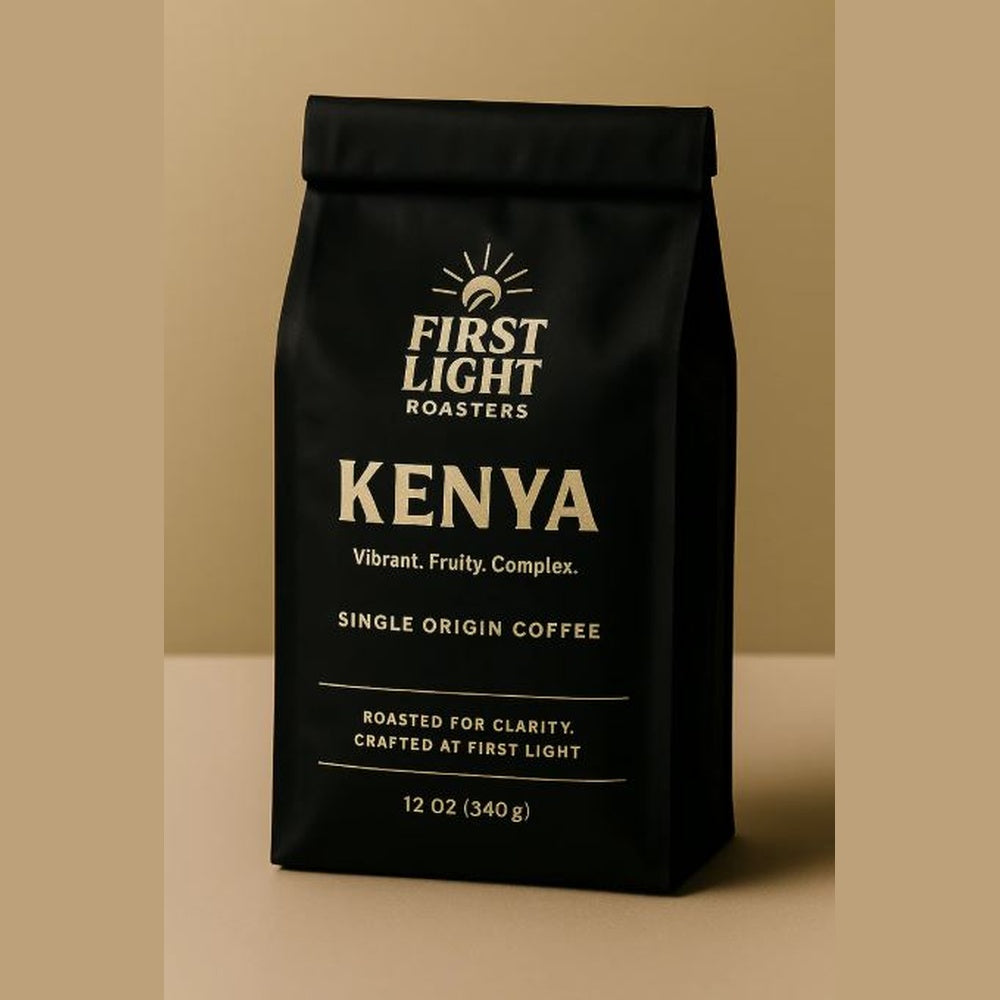
At First Light, we purchase AA grade as our primary Kenya offering because the size consistency gives us predictable roasting behavior and reliable batch-to-batch results. The larger beans provide a slightly longer, more controllable development window, and the physical uniformity means fewer variables to manage during the roast. When you buy a bag of our Kenya AA and then buy another bag three months later, the roast profile that produced both bags was substantially identical — and that consistency is only possible when the green coffee is also consistent.
We cup AB and PB lots from our supply partners as they become available throughout the season. When the cup quality justifies it — and it frequently does — we bring them in as limited or seasonal offerings. We have cupped AB lots that outscored our standard AA offering from the same washing station in the same season, driven by specific microlot processing variations. We have had PB lots with such intense blackcurrant concentration that they merited feature placement despite their smaller physical size.
Our buying philosophy is straightforward: grade tells us what to expect structurally; cupping tells us what we actually have. We never purchase on grade alone, and we never dismiss a lot because it isn't AA. Every purchasing decision at First Light begins with the cup, and the cup is the final judge of whether a green lot earns a place in our lineup.
What to Look For When You Buy Kenyan Coffee
When shopping for Kenyan coffee — from First Light or anyone else — here is a practical framework for using the grading information available on the bag and in the product description.
AA means large beans with predictable roasting behavior, likely sourced from the main growing regions and typically roasted with a medium-light profile to preserve acidity. This is the safe choice for first-time Kenya buyers, and it is excellent. AB means slightly smaller beans that are still capable of exceptional cup quality when sourced well; it is often available at a slight price discount that can make high-quality Kenyan coffee more accessible. PB means round peaberry beans with a distinct, concentrated flavor profile worth exploring once you know what standard Kenyan washed coffee tastes like and want to compare.
Beyond grade, the information that actually predicts cup quality is: a named washing station or cooperative (not just "Kenya"), a stated growing region (Nyeri, Kirinyaga, Murang'a), a roast date within the past six to eight weeks, and some clear indication that the roaster has cupped and approved the specific lot rather than simply purchasing it by grade from a broker. The best Kenyan coffees in the world are the ones where someone at every point in the supply chain — at origin, during green buying, and at the roastery — cared enough about cup quality to do the work. The grade just describes the physical specs. The rest of the story is told by the people who handled it with care.
Kenya AA, AB, and PB each have a legitimate and worthwhile role in the specialty coffee world. Understanding what the grades actually describe and what they genuinely don't — makes you a more informed buyer and a more appreciative drinker. At First Light, we are always happy to talk through the difference over a cup.



Leave a comment
This site is protected by hCaptcha and the hCaptcha Privacy Policy and Terms of Service apply.