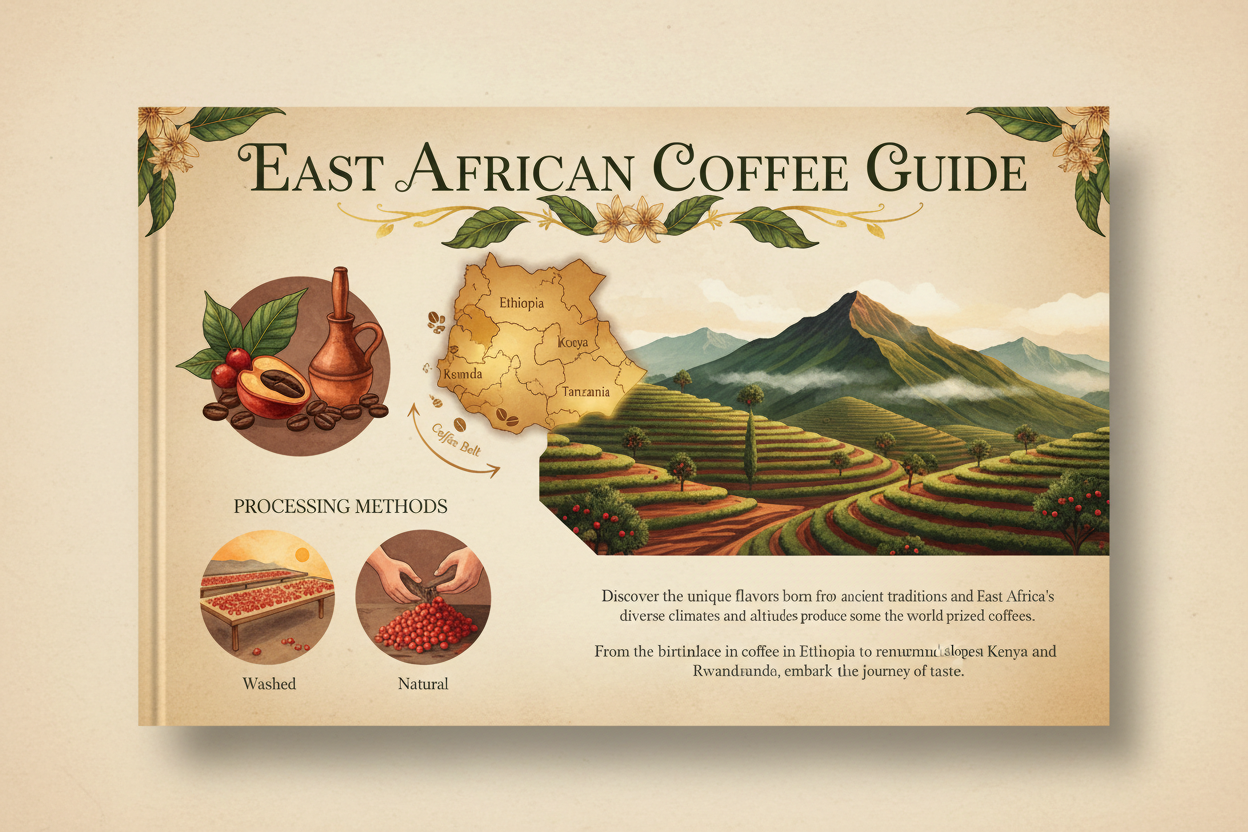
The Master Guide to East African Coffee
Introduction: The Pursuit of Coffee Mastery in 2026
Specialty coffee in 2026 is no longer a simple commodity: it is a technical discipline, a geological study, and a cultural movement. As the global climate shifts and consumer demands for transparency reach an all-time high, understanding the "why" behind your cup is as important as the flavor itself. At First Light Roasters, our mission is captured in our motto: "Roasted for Clarity. Crafted at First Light."
East Africa, specifically the Great Rift Valley, represents the absolute peak of coffee evolution. This Master Index is your gateway to our eight-part technical series, designed to establish a new standard for coffee education. We invite you to explore the intersections of volcanic geology, molecular chemistry, and regenerative ethics that define our collection. This is exceptional specialty coffee, crafted for a refined and full-bodied experience consistently delivered on a global scale.
Experience the Peak of Clarity
Explore our curated selection of East African lots, each chosen for its technical excellence. View our single-origin offerings
Pillar I: The Geological Foundation
Every great cup begins with the earth. The Great Rift Valley is a massive geological scar that provides the mineral-rich Andosol soils necessary for high-density coffee production. In our first pillar, The Rift Valley Manifesto, we explore the tectonic forces of the Somali-Nubian divergence and how the Pleistocene-era volcanic ash blanketed the region in ignimbrites.
Understanding the cation exchange capacity (CEC) of these soils explains why East African beans are packed with vital trace elements like Potassium and Magnesium. These minerals are the precursors to the sparkling phosphoric acidity and deep body that define our technical roasting standard.
Pillar II: The Molecular Science of Roasting
How do you roast a bean that is physically denser than almost any other in the world? The answer lies in thermodynamics and heat application. In Roasted for Clarity: Decoding the Science of Brightness, we take a deep dive into the Maillard reaction and the evolution of organic acids.
We reveal why a "High Energy Charge" is essential for penetrating the core of a Strictly Hard Bean (SHB) and how managing the Rate of Rise (RoR) prevents the "baked" flavors that destroy origin clarity. Learn how we balance Citric and Malic acids while preserving the delicate volatile compounds that read as floral perfume in your cup.
Pillar III: The Genetic Birthplace
Ethiopia is the soul of the coffee world, home to an estimated 6,000 to 15,000 distinct landrace varieties. In Ethiopia: The Genetic Birthplace of Arabica Coffee, we decode the "Heirloom" label and explore the four distinct production systems: Forest, Semi-Forest, Garden, and Plantation.
This pillar also provides an essential deep dive into the historic 2025/2026 harvest, which saw record production of 11.6 million bags alongside historic pricing volatility. Discover why the shift toward home-processed naturals is creating a new market of micro-lots for the modern connoisseur.
Pillar IV: Technical Powerhouse Grading
If Ethiopia is the birthplace, Kenya is the technical laboratory. In The Kenya Coffee Grading System: Understanding AA, AB, and PB Lots, we decode the screen-size methodology used by the Nairobi Coffee Exchange.
We examine the biological mutation of the Peaberry and the royalty of SL-28 and SL-34 varietals. Most importantly, we explain the scientific "Double Wash" process: a 72-hour labor of love that ensures the pristine clarity found in our premium Kenyan offerings.
Pillar V: The Evolution of Natural Processing
In 2026, the oldest tradition in coffee has become its new frontier. The Art of the Natural Process explores why "Clean Naturals" are dominating the specialty market. We look at the science of sugar translocation and osmotic pressure: how the fruit sugars move from the mucilage into the seed to create explosive berry notes.
This pillar also addresses the sustainability shift: as water scarcity impacts the Rift Valley, natural processing offers a water-free, regenerative alternative that preserves local ecosystems.
Taste the Future of Flavor
From sun-dried Guji to double-washed Nyeri, explore the Rift Valley's best. View our single-origin offerings
Pillar VI: Emerging Frontiers and Climate Resilience
The coffee map is being redrawn. In The New Frontiers: Emerging Coffee Regions of 2026, we analyze the upslope migration of plantations and the rise of climate-resilient F1 hybrids like Starmaya and Centroamericano.
We explore why origins like Nepal and Papua New Guinea are becoming essential for supply chain stability and how AI-driven crop monitoring is helping smallholders survive a +2°C world.
Pillar VII: The Modern Tasting Ritual
In 2026, the barista has evolved into a sommelier. The Barista as Sommelier is a technical guide to sensory analysis, retronasal olfaction, and the physics of the "slurp".
Learn about "functional wellness stacking" and why Gen Z is driving a trend toward "Swangy" and "Swavory" flavor profiles. This pillar transforms your daily morning habit into a sophisticated wellness ritual rooted in chemical complexity.
Pillar VIII: Transparency and Evidence-Based Ethics
Our final pillar, Transparency as Trust, establishes the ethical framework for the modern coffee industry. We move past vague sustainability claims and into the era of blockchain-verified traceability and regenerative agriculture.
Understand the "Coffee Scorecard" and why paying a living income to farmers is the only way to secure the future of the world's most precious specialty beans.
Conclusion: The Global Standard for First Light
The East African coffee mastery series is more than just a collection of blogs: it is a technical manifesto for the next decade of specialty coffee. By connecting geology to the cup and chemistry to the community, we ensure that every sip tells a story of millions of years of evolution and centuries of craftsmanship.
At First Light Roasters, we are committed to this pursuit of clarity. We invite you to re-read these pillars, explore our current arrivals, and join us in celebrating the undeniable superiority of the Rift Valley. This is exceptional specialty coffee, crafted at first light, consistently delivered on a global scale. Experience the clarity.
Ready to start your journey?
Roasted for clarity, delivered fresh to your door. View our single-origin offerings
FAQ: Mastering the Rift Valley Collection
What is the most important factor in coffee clarity?
Clarity is achieved through the synergy of volcanic soil minerals (Pillar I), technical roasting precision (Pillar II), and rigorous processing (Pillar IV).
Why is East African coffee considered the best in the world?
The region possesses the unique combination of the Earth's most ancient coffee genetics (Pillar III), the world's most mineral-rich volcanic soil (Pillar I), and the most technically advanced grading and processing systems (Pillar IV).
Is all Ethiopian coffee heirloom?
Most high-end Ethiopian coffee is mixed heirloom landraces, but there are also specific high-performing JARC varieties developed for disease resistance and technical excellence (Pillar III).
What is the difference between AA and PB grades?
AA refers to the largest bean screen size (17/18), while PB (Peaberry) is a biological mutation where a single round bean grows in the cherry instead of two. Both are prized for flavor intensity (Pillar IV).
How is climate change affecting coffee in 2026?
Climate volatility is forcing coffee to move to higher altitudes and driving the adoption of heat-resilient F1 hybrids and precision AI-driven farming (Pillar VI).
What does "Evidence-Based Ethics" mean?
It refers to the use of blockchain and digital ledger technology to provide verified proof of social impact, living wages, and regenerative soil health (Pillar VIII).
How should I taste coffee to notice these differences?
Use the sommelier approach: evaluate dry aroma (volatile compounds), slurping for retronasal delivery, and noticing how the clarity shifts as the temperature drops (Pillar VII).
Is natural process coffee sustainable?
Yes: modern "Clean Naturals" are water-free and energy-efficient, making them a critical sustainable tool for regions facing erratic rainfall (Pillar V).
What is the "Clarity" roast level?
At First Light, we typically roast to an Agtron 95-85 range (Light to Light-Medium). This maximizes origin top-notes and avoids masking the bean's soul with roast bitterness (Pillar II).
Where can I find these coffees?
Our seasonal Rift Valley collection is available through our direct trade partnerships. View the latest arrivals here: View our single-origin offerings

Leave a comment
This site is protected by hCaptcha and the hCaptcha Privacy Policy and Terms of Service apply.