Specialty coffee culture has a complicated relationship with blends. The rise of single-origin coffee over the past two decades has been driven by a legitimate and important idea: that specific coffees from specific places have specific flavors worth celebrating, and that blending them together erases that specificity in the name of a more generic outcome. This critique has real merit. A poorly designed blend can make excellent component coffees taste ordinary. It can hide defects behind other flavors. It can be, in the uncharitable framing, the coffee equivalent of a house salad — present but unmemorable.
But this critique has also, in the hands of the more dogmatic single-origin advocates, been taken too far. It treats all blending as a compromise, when in fact a well-designed blend can achieve things no single origin can accomplish alone. Blending, done right, is not the absence of craft — it is a different kind of craft, applied to a different kind of goal.
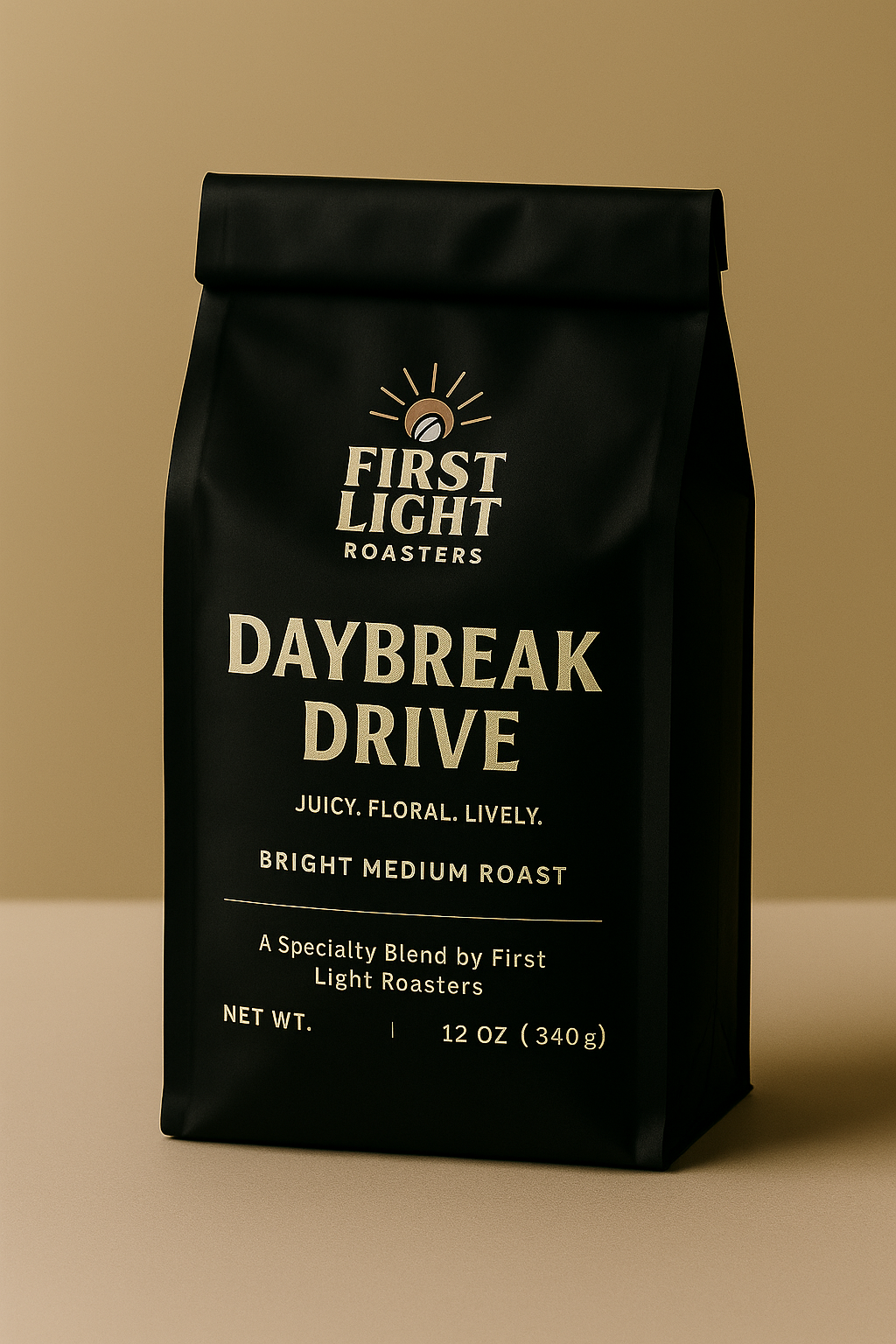
We built Daybreak Drive because we recognized that not everyone wants to think about their morning coffee. Some people do — some people want to know the county, the washing station, the variety, the development time ratio. We make coffee for those people too, and we celebrate their engagement. But some people want to wake up, make a great cup, and get on with their day. Daybreak Drive is for the second person. And making something for them with the same standards we apply to everything else we roast was a challenge worth taking seriously.
The Brief: What Daybreak Drive Had to Be
Every blend development process begins with a brief — a description of what the final product must achieve. The brief for Daybreak Drive was both simple and demanding: create a blend that delivers consistently excellent flavor without requiring any particular engagement from the drinker; that works well in multiple brewing methods without significant parameter adjustment; that tastes the same in March as it does in September; and that delivers an experience that makes someone want to buy another bag before the first one is gone.
The "tastes the same every month" requirement was the most technically demanding part of the brief. Single-origin coffees change seasonally — different harvests, different lots, sometimes different washing stations. This seasonal variation is a feature for engaged drinkers; it is a liability for a blend that promises consistency as its primary value. Building a consistent blend requires a component strategy that can be adjusted as individual origins fluctuate without changing the overall cup profile.
The "works well in multiple brewing methods" requirement influenced our decisions about roast level and component balance. A blend designed for espresso may be too heavy for filter brewing; a blend designed for delicate pour-over may taste thin through a drip machine. Daybreak Drive had to function well enough through standard automatic drip, satisfying enough as a French press, and interesting enough as a pour-over that any of the three would produce a cup worth drinking. This cross-method functionality required a specific balance of body, acidity, and sweetness that would not excel in any single method but would succeed in all of them.
The Components and Why We Chose Them
Daybreak Drive is built on three component coffees that cover distinct flavor dimensions. While we do not publish the specific origin percentages — both for sourcing flexibility reasons and because the component balance shifts slightly season to season — we can describe what each component contributes and why it earns its place.
The structural core of the blend is a washed Central American coffee — currently our Honduran single-origin partner lot, though the specific sourcing has flexibility built in for seasonal consistency management. This component contributes the medium body, clean sweetness, and structural balance that gives the blend its approachable, reliable character. It is the foundation: not exciting on its own in this context, but essential for the consistency the blend requires.
The brightness layer comes from a small percentage of our Kenya AA. This is the component that lifts the blend above "good and reliable" into "actually interesting" territory — providing just enough acidity and fruit character to prevent the cup from reading as flat or one-dimensional. The Kenya percentage is calibrated to be perceptible as a brightness note in the finish, not as the dominant character of the cup. Daybreak Drive should not taste like diluted Kenya AA; it should taste like a well-balanced blend that has an interesting finish.
The depth layer comes from a small addition of a natural-process coffee — typically Ethiopian natural or Brazilian natural depending on the season — that contributes sweetness, body, and the subtle dried-fruit depth that prevents the blend from tasting sharp or thin. Natural-process coffees bring a fullness to blends that washed coffees cannot achieve on their own, and even a small percentage of natural-process coffee changes the mouthfeel of a blend measurably.
The Roasting Challenge: One Profile, Two Goals
Blends present a specific roasting challenge that single-origin coffees do not: the components may have different density, moisture content, and optimal development windows. A Honduran washed coffee and a Kenyan washed coffee do not behave identically in the drum, even if they arrive at the same screen size. Blending green coffee before roasting means one profile must serve all components simultaneously — which requires compromise.
For Daybreak Drive, we resolved this tension by blending pre-roast and developing a profile that targets the optimal development point for the structural core (the Central American component) while accepting slightly less precision for the minority components. The Kenya percentage is small enough that its different roasting behavior is manageable within the range of a single profile calibrated for the Honduras core. The natural-process component's different density is accounted for by the profile's drying phase management.
The result is a blend roasted to what we would call a true medium — not our Kenya AA's medium-light, and not a dark roast, but a genuine middle point where brown sugar sweetness, caramelization-derived depth, and preserved brightness from the Kenya component all land in balance. Agtron approximately 55 to 58 on the whole bean surface. The beans emerge a consistent, attractive medium brown without surface oil — a color that signals to an informed buyer that care has been taken.
Post-roast batch calibration for Daybreak Drive is more demanding than for our single-origin coffees, because the blend's consistency requirement means that variation is harder to hide. Every production batch is cupped against the archived reference before release. Deviations that would be acceptable in a seasonal single origin — slightly more brightness in a new Kenyan lot, slightly less body in a Honduran season — must be caught and adjusted for in a blend whose entire value proposition is consistency.
Why Consistency Was the Hardest Part to Achieve
The most difficult part of building a consistent year-round blend is not the initial development — it is the ongoing management through seasons, harvest cycles, and supply chain fluctuations. Green coffee is an agricultural product, and no two seasons produce identical results. Managing blend consistency across seasons requires active monitoring of each component's cup character, proactive adjustment of blend ratios as components shift, and a sourcing strategy that maintains reserve stock of key components to bridge supply gaps between harvests.
We maintain a rolling inventory of each Daybreak Drive component with enough volume to cover at least one to two months of projected production. When a new lot arrives for any component, it is cupped against the previous lot before being incorporated into production batches. If the new lot shows meaningful variation from the previous one, we adjust the blend ratio for that component to compensate — slightly more Honduras if the new lot is fuller-bodied, slightly less Kenya if the new lot's acidity has shifted brighter than the previous.
This active management means that the blend formulation on paper is not a fixed document. It is a flexible framework that describes a flavor target and the general approach for achieving it, with specific component percentages adjusted quarterly or as needed based on current supply characteristics. The customer experience — the cup that you brew and drink — should be consistent even as the underlying formulation adapts to maintain that consistency. This is a different kind of quality assurance than single-origin roasting, and it requires a different kind of attention.
Who Daybreak Drive Is For
Daybreak Drive is for anyone who wants their morning coffee to be reliably, unfussily excellent. It is for the household where one person is a coffee enthusiast and the others just want a good cup. It is for the office coffee program that wants to serve something better than commodity coffee without requiring staff to adjust parameters for different origins. It is for the home brewer who wants to engage less and enjoy more.
It is also for First Light customers who want a second coffee in their rotation — something to reach for on mornings when they do not have the bandwidth to engage with the specificity of the Kenya AA, but who still want the quality standard that First Light represents.
We make no apology for building a coffee around consistency and accessibility. These are legitimate values, and delivering on them with the same craft and rigor that we bring to our most demanding single-origin offerings is, in our view, equally worthwhile. Daybreak Drive may be our most approachable coffee. It is not our least considered one.
Daybreak Drive exists because consistency and craft are not opposites. It exists because some mornings, you just need a great cup and we wanted to build one you could rely on completely. That is the story behind the blend.