First Light Roasters built its identity on Kenya. The volcanic slopes above Nyeri, the SL28 and SL34 varieties, the double-wash processing, the bright complexity of a well-roasted AA — these are the pillars of what we do and the standards against which we evaluate everything else. Kenya set our quality benchmark. Kenya defined what we mean by "single origin" — not just a country name on a bag but a specific place, a specific process, a specific flavor story.
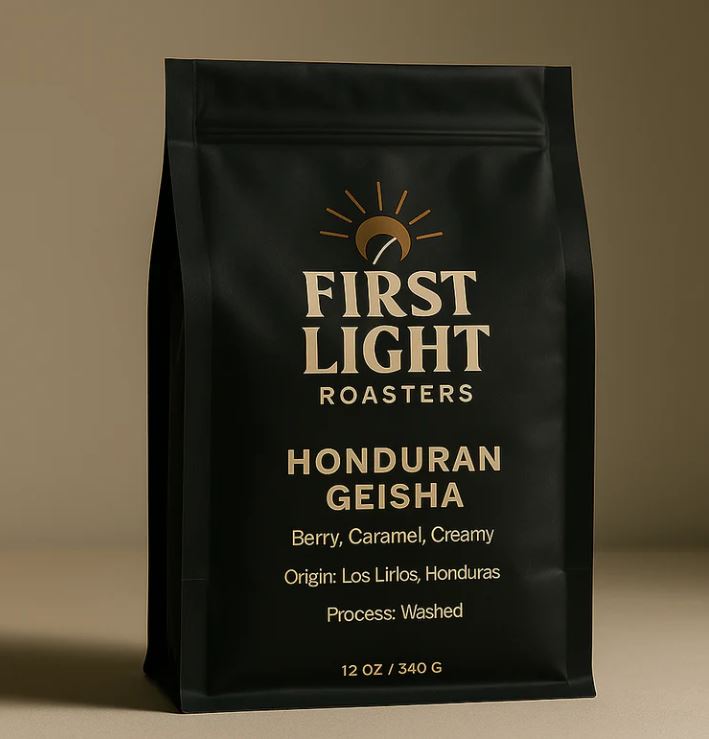
But Kenya is one country in a world of extraordinary coffee origins, and our curiosity about what other places can offer did not stop at the Kenyan border. Over the years of building our lineup, we found two origins that meet our exacting standards from different directions: Honduras, which delivers extraordinary sweetness and structural balance at a price point that makes specialty coffee accessible; and Ethiopia, where coffee was born and where flavor complexity reaches heights that even Kenya, for all its brilliance, does not always match.
This post is about why we chose these two specific origins to complete our single-origin range, how we source them, and what each brings to the First Light lineup that Kenya alone cannot provide. If you have only ever tried our Kenya AA, this is your invitation to explore what we have built around it.
Why Honduras?
Honduras is not a country that most specialty coffee drinkers think of first. Colombia, Ethiopia, Kenya, Guatemala — these are the names that dominate specialty coffee conversations. Honduras arrives as a surprise, which is partly the point.
Honduras has undergone a dramatic quality transformation over the past two decades. Historically associated with undifferentiated commodity production, Honduran coffee has been reimagined by a generation of smallholder farmers and cooperatives that have invested in altitude planting, varietal selection, and processing precision. The country's western highlands — particularly the departments of Copán, Santa Bárbara, and Ocotepeque — produce coffees at elevations of 1,200 to 1,800 meters that compete seriously with more established Central American origins.
What Honduras offers that Kenya does not is structural sweetness. While Kenya is about brightness and fruit intensity, well-grown Honduran coffee is about balance: brown sugar and toffee sweetness, medium body with genuine depth, mild and clean acidity that supports rather than dominates the cup. It is the coffee equivalent of a perfectly ripe peach — not about sharp edges but about full, round, satisfying flavor from entry to finish.
Honduras also offers extraordinary value for cup quality. At the specialty tier, Honduran coffee achieves 86 to 90 point cup scores at significantly lower green prices than comparable-quality Kenyan or Ethiopian coffee. This allows us to offer a single-origin coffee of genuine specialty quality at a price point that is more accessible than our Kenya AA, broadening the First Light experience to customers who want quality without the premium.
How We Source Our Honduras
Our Honduras sourcing is organized around the Copán department in the western highlands, where an established network of smallholder cooperatives processes washed coffee from farms at 1,400 to 1,700 meters. We work with a specific cooperative whose members have committed to cherry quality selection and consistent processing standards as conditions of the premium pricing arrangements we maintain.
Every Honduras lot we purchase begins as a sample shipment cupped at the roastery against our quality standard. We look for: clean, defect-free processing (no fermentation off-notes, no earthy or musty characters from problematic drying); cup scores at or above 86 SCA points; the specific flavor profile we associate with high-quality Honduran washed coffee (caramel, brown sugar, soft fruit, clean finish); and consistency from bag to bag within the seasonal lot.
We do not purchase Honduran coffee off-the-shelf from a broker. Every lot is evaluated, and we return to established supply partners when they consistently deliver the quality we need, rather than chasing the lowest available price each season. This consistency matters not just for quality but for the supply chain relationship: cooperatives that can count on reliable buyers are better positioned to invest in the farm and processing improvements that sustain and improve quality over time.
Our Honduras is roasted to a medium profile — slightly more developed than our Kenya AA — because the lower inherent acidity and fuller body of the origin respond better to slightly more Maillard browning. This brings the caramel and brown sugar sweetness fully forward without flattening the flavor structure. The result is a cup that is approachable for a wide range of drinkers while remaining genuinely interesting for those who pay attention.
Why Ethiopia?
Ethiopia is where coffee came from. The Coffea arabica species evolved in the forests of the Ethiopian highlands, and wild coffee trees still grow in the Kaffa and Bale regions where Arabica's story began. No other origin has Ethiopia's claim to the crop, and no other origin produces cups with Ethiopia's range of complexity at the top end of the quality spectrum.
We chose to include an Ethiopian single origin in the First Light lineup for a specific reason: Ethiopia delivers floral, tea-like, and stone fruit complexity that Kenya, for all its brightness and fruit intensity, doesn't consistently produce. The best washed Yirgacheffes and Gedeo lots show jasmine, bergamot, rose, and peach in a combination that is uniquely and unmistakably Ethiopian — the most aromatic, most complex, most delicate expression of what Coffea arabica is capable of producing.
For drinkers who come to First Light through our Kenya AA, Ethiopia represents a completely different dimension of single-origin coffee quality. Where Kenya is vivid and assertive — the cup that announces itself immediately — a washed Ethiopian at its best is subtle and layered, revealing more with each sip, asking you to slow down and pay attention. They are complementary opposites: the brightness of Kenya versus the delicacy of Ethiopia.
We also source natural-process Ethiopian lots seasonally when the cup quality warrants it. Natural Ethiopia is a different experience again: heavy, sweet, intensely fruited, with blueberry and strawberry jam notes that read almost like dessert coffee. It divides opinion — some drinkers love the fermented sweetness intensity; others find it overwhelming — but at its best it is undeniably extraordinary.
How We Source and Roast Our Ethiopia
Ethiopian sourcing is more complex than Kenyan sourcing from a traceability standpoint. The Ethiopian coffee supply chain historically lacked Kenya's auction infrastructure, and while the Ethiopian Commodity Exchange (ECX) has improved documentation over the past decade, lot-level traceability in Ethiopia requires more active effort than in Kenya.
We focus our Ethiopian sourcing on specific cooperatives in the Yirgacheffe and Gedeo zones — the two most consistently high-scoring subregions within southern Ethiopia's Sidama zone — that have established direct relationships with specialty importers who can provide full documentation from cooperative to ship. We cup multiple Ethiopian samples each season and select the lots that show the specific floral, stone fruit, and bergamot complexity we associate with the best Yirgacheffe and Gedeo profile.
For washed Ethiopian, we roast to a light-medium profile — slightly lighter than our Kenya AA, because Ethiopian washed coffee is even more acid-sensitive and loses its delicate floral notes quickly under heat. The roast development targets the emergence of sweetness through Maillard browning while stopping well short of the point where caramelization begins to compete with the floral aromatics.
Natural Ethiopian is roasted to a specific profile calibrated for that processing method: slightly more development than the washed to integrate the heavy fermentation-derived fruit character into a sweeter, more balanced expression. The natural process amplifies sugar-derived compounds that require more heat to fully develop, and the roast profile reflects this.
How the Three Origins Work Together
Kenya, Honduras, and Ethiopia form a deliberate three-part single-origin portfolio at First Light. Each occupies a distinct flavor space that the others cannot fill.
Kenya is brightness and intensity — the coffee that shows you what high acidity and complex organic chemistry taste like when everything is done right. It is demanding, distinctive, and rewards the brewer who engages carefully.
Honduras is accessibility and sweetness — the coffee that converts skeptics and satisfies regulars, delivering genuine specialty quality in a round, balanced, friendly package. It is the gateway single origin, approachable for someone new to specialty coffee while genuinely interesting to experienced drinkers.
Ethiopia is complexity and delicacy — the coffee that asks you to pay attention, that reveals more with each successive cup, that shows the full aromatic range of the Coffea arabica species at its evolutionary origin. It is the origin that most clearly demonstrates why variety and terroir are not marketing language but measurable reality.
Together, these three origins let First Light customers experience the breadth of what specialty single-origin coffee can be — without each origin needing to be everything. Kenya does not need to be delicate; that's Ethiopia's role. Ethiopia does not need to be sweet and round; that's Honduras's role. And Honduras does not need to be vivid and assertive; that's Kenya's role. The portfolio is additive and complementary, and we are proud of every origin in it.
→ Explore All Our Single Origins →
Kenya is where First Light began. Honduras and Ethiopia are where we grew. Together, these three origins represent our commitment to a complete, honest, and genuinely excellent single-origin coffee program. We invite you to explore all three.